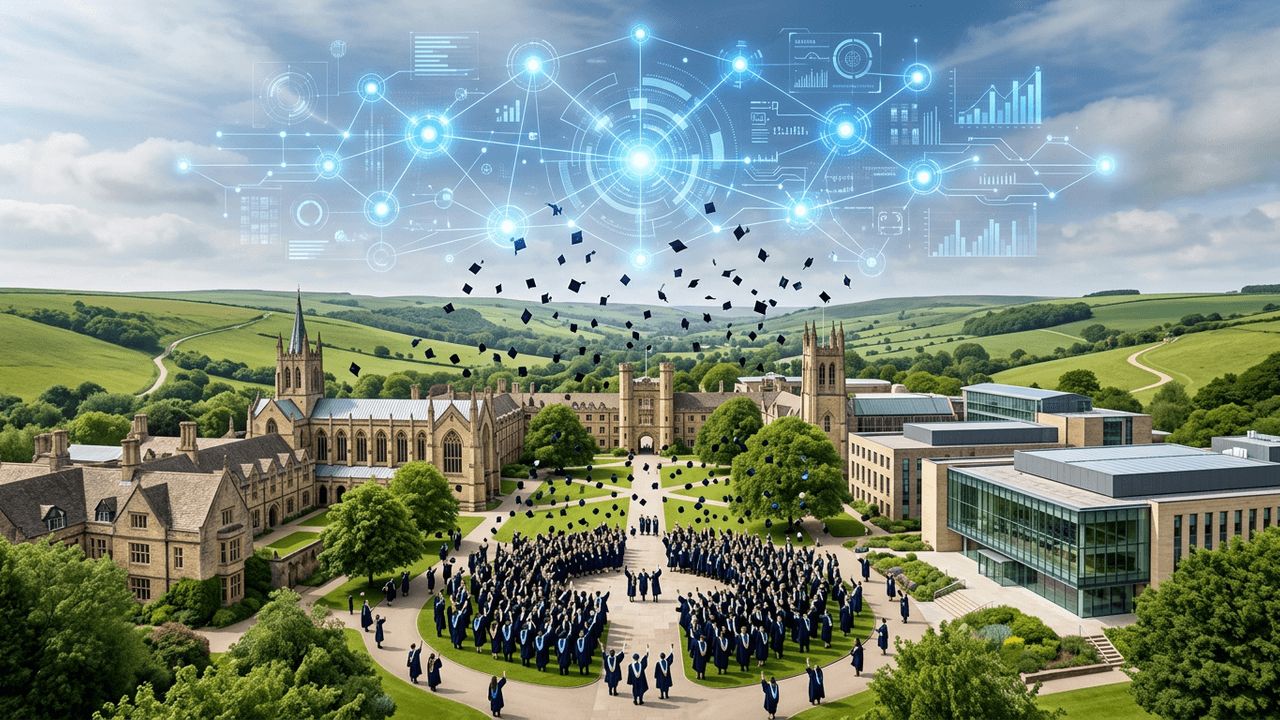
Higher Education in the North West
The story of higher education in Derry City and Strabane is one of steady, hard-won expansion. For much of the twentieth century, students from the North West who wanted a degree had to leave, travelling to Belfast, Dublin or across the water. That pattern has changed substantially. The district now hosts a significant university campus, a growing range of degree-level provision delivered locally, and a policy consensus that expanding higher education capacity in the North West is essential to the region's economic future.
This matters more here than in many places. Retaining talented graduates is one of the district's persistent challenges, and higher education is the mechanism most likely to solve it. Students who study locally are far more likely to build careers locally, and university research activity creates the kind of knowledge-intensive employment that a regional economy needs to move beyond low-wage sectors.
Understanding the Higher Education Landscape
Higher education in the district operates through several channels. There is direct university provision on campus. There is degree-level study delivered in further education colleges under franchise or validation arrangements with universities. There is distance and blended learning from institutions based elsewhere. And there is cross-border access, since students in the district can readily study in Donegal and elsewhere in the Republic of Ireland.
Understanding these routes matters because they carry different fee structures, different entry requirements and different student experiences. A foundation degree delivered locally in a college setting can be a far better fit for some students than relocating for a traditional campus degree, and it can articulate into the final year of an honours programme afterwards.
The Leading Universities and Higher Education Providers
1. Ulster University, Magee Campus
Ulster University's Magee campus is the anchor institution for higher education in the district and by a considerable margin the most significant. Occupying a historic site that has grown steadily, it delivers degrees across a wide spread of disciplines including computing, business, law, nursing and health sciences, psychology, social work, cinematic arts, drama and Irish language and literature.
The campus has particular research strength in areas relevant to the region: stratified medicine, personalised healthcare, cognitive analytics and intelligent systems. Its School of Computing and Intelligent Systems has been influential in supplying graduates to the district's growing technology sector, and the medical school development has been a long-standing regional priority. Students consistently praise the campus for its scale, which is large enough to offer breadth but small enough to feel personal, and for its riverside setting.
2. Ulster University Graduate and Professional Programmes
Beyond undergraduate study, the postgraduate provision available at Magee serves a distinct population: professionals upskilling mid-career, graduates specialising further, and international students. Masters programmes in areas such as computing, business management, social work, cognitive behavioural therapy and creative technologies are delivered with substantial part-time and flexible options. For working professionals in the district, the ability to pursue a masters without relocating is a significant benefit.
3. North West Regional College Higher Education Provision
North West Regional College delivers a substantial volume of higher education, including higher national certificates, higher national diplomas and foundation degrees validated by university partners. Subjects span engineering, computing, business, construction, creative media, health and social care and hospitality management. The appeal is a smaller-scale, more supported learning environment with strong vocational focus and clear routes into the final year of a related honours degree. Fees are typically lower than full university rates, and many students study part-time while working.
4. The Open University in Ireland
Distance learning has a long and important history in the district, and the Open University serves a large cohort of local students. Its flexible, modular structure allows people to study around employment, caring responsibilities and irregular schedules, with no formal entry requirements for most undergraduate programmes. Subjects range across arts, sciences, business, computing, health and education. For adults in the district who cannot attend a campus, this remains the single most accessible route to a degree.
5. Atlantic Technological University, Donegal
Cross-border study is a genuine option for students in the district, and the Donegal campuses of Atlantic Technological University are within commuting distance for many. Provision includes engineering, computing, business, nursing, creative arts and hospitality, delivered within the Irish higher education system. For students in Strabane and the western parts of the district, this can be geographically closer than institutions in Northern Ireland, and the different fee and grant arrangements sometimes work in students' favour.
6. Queen's University Belfast Regional and Online Provision
While its campus is in Belfast, Queen's University Belfast is a major destination for high-achieving students from the district and delivers some professional and online programmes accessible to those remaining locally. Its strengths in medicine, dentistry, pharmacy, law and engineering draw students from across the North West, and its research reputation is a significant national asset. Postgraduate online provision in areas such as education and public health serves professionals who need Queen's credentials without relocation.
7. Ulster University Nursing and Allied Health Provision
Health workforce education deserves separate mention because of its scale and local impact. Nursing, midwifery and allied health programmes delivered at Magee combine academic study with extensive clinical placement in local hospitals and community settings. These programmes are a direct pipeline into the health service in the North West, and their expansion has been central to addressing regional workforce shortages. Students value the placement quality and the near-certainty of employment on qualification.
8. Higher-Level Apprenticeship Degree Partnerships
Higher-level apprenticeships combining employment with degree-level study have become a serious alternative to conventional university entry. Delivered through partnerships between colleges, universities and employers, these programmes let students earn while studying towards foundation degrees and honours degrees in engineering, computing, accountancy, business and increasingly health-related fields. Graduates emerge with a degree, several years of relevant work experience and no tuition debt, which is a compelling proposition.
9. Professional Body and Institute Provision
Chartered professional bodies deliver degree-equivalent and postgraduate-level qualifications that are studied widely in the district, particularly in accountancy, human resources, marketing, construction management and engineering. These qualifications are often more directly valued by employers in their sectors than a general degree, and they are typically pursued part-time alongside employment. Local training providers support delivery and examination preparation.
10. Emerging Medical and Health Sciences Provision
The development of graduate-entry medical education in the district represents the most significant recent expansion of higher education in the North West. Designed to train doctors with a strong grounding in general practice and community medicine, this provision addresses acute regional workforce needs while raising the district's research and teaching profile. Its establishment has been a long campaign, and its growth is expected to catalyse further health sciences investment locally.
Trends in Regional Higher Education
The push to expand student numbers in the North West has been the defining policy theme, driven by arguments about regional balance, economic development and access. Growth in student places brings knock-on effects: demand for purpose-built student accommodation, expansion of campus facilities, and a livelier city-centre economy during term time.
Industry partnership has intensified. Universities increasingly co-design curricula with employers, embed placements and live projects, and collaborate on applied research. In the district this is most visible in computing and health, where graduate supply directly shapes local employers' growth plans.
Flexible and modular study is expanding. Micro-credentials, stackable modules and part-time pathways allow learners to accumulate qualifications over time rather than committing to three or four continuous years. This suits mid-career professionals and improves access for those with financial or family constraints.
Research commercialisation is another growth area. Spin-out companies, technology transfer and innovation centres linked to university research create high-value jobs and are an increasingly important part of how universities justify public investment.
Choosing Where and What to Study
Begin with the subject rather than the institution. Course content varies substantially between universities under identical titles, so read module lists carefully and identify which programme actually covers the areas that interest you. Check the balance of assessment, the amount of practical or placement work, and whether professional accreditation is included where relevant.
Consider graduate outcomes for the specific course, not the whole institution. Employment rates, typical destinations and further study progression vary widely between departments within the same university. Ask admissions staff directly for course-level data.
Weigh the financial picture honestly. Fee levels, maintenance support, the cost of living at home versus relocating, and the earning potential of apprenticeship routes all affect the real return on your investment. Studying locally while living at home can transform the affordability of a degree.
Finally, visit. Open days reveal things prospectuses cannot: the atmosphere of a department, the accessibility of staff, the quality of facilities and whether you can picture yourself there. Higher education in Derry City and Strabane has expanded meaningfully, and for a growing number of students the best option is now on their doorstep rather than several hours away.
Want your brand featured in front of decision-makers? Publish a guest post or get a link insertion in our guides through AAMAX's guest post and link insertion service.
Helpful Links
 SponsoredAAMAX — Full-Service Digital Agency
Write for Us
Share your expertise with our readers. We welcome guest contributions from industry specialists.
Pitch your idea