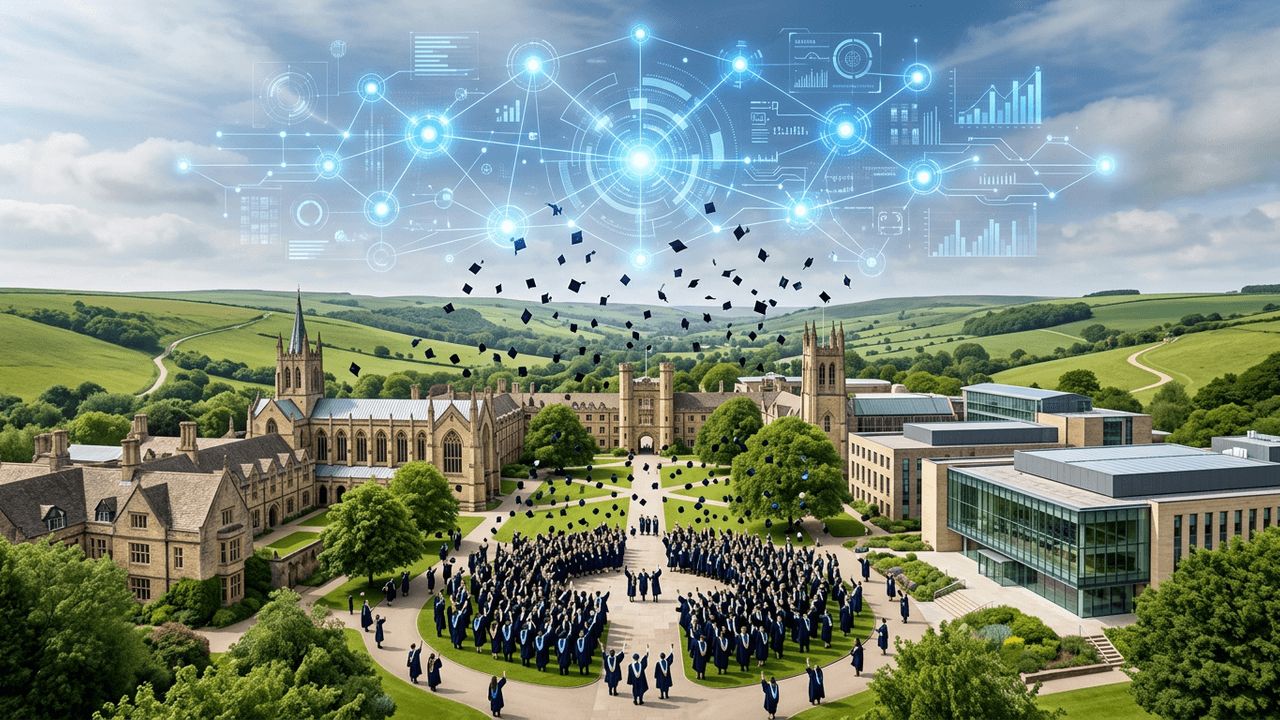
The City That Redefined Higher Education
Cambridge is one of a handful of cities globally where higher education is not simply present but foundational. Its institutions shape the local economy, the built environment and the international reputation of the region. Around them has grown a cluster of research institutes, teaching hospitals, business schools and specialist providers that collectively give students an extraordinary range of university-level options.
For applicants, that abundance requires clarity. A world-leading research university and a modern applied university serve different ambitions equally well. The following overview covers the most significant university-level institutions and providers associated with Cambridge, along with the qualities that distinguish each.
Ten Leading University-Level Institutions in Cambridge
1. University of Cambridge
The University of Cambridge needs little introduction. Its collegiate structure, supervision system and research output place it permanently among the strongest universities in the world. Teaching is delivered through a combination of faculty lectures and small-group supervisions, an approach that produces exceptional analytical depth. Strengths span mathematics, physics, engineering, medicine, law, classics and economics, and its research income supports laboratories of global significance.
2. Anglia Ruskin University
Anglia Ruskin is Cambridge's modern applied university and a genuine powerhouse in professional education. Nursing, allied health, optometry, education, law, business and creative industries are its core strengths, and its teaching emphasises employability, placements and simulation-based learning. Its medical school and health faculties are closely connected to regional NHS provision, making it central to workforce development across the East of England.
3. Cambridge Judge Business School
As the management school of the University of Cambridge, Judge delivers MBA, executive MBA, master's and executive education programmes with a distinctive emphasis on entrepreneurship and innovation. Its position inside one of Europe's most active technology clusters gives students unusual access to founders, investors and corporate partners, and its accelerator programmes have supported a long list of research-driven start-ups.
4. Cambridge Institute of Continuing Education
Based at Madingley Hall, the Institute of Continuing Education specialises in part-time undergraduate and postgraduate study for adult learners. Programmes cover archaeology, creative writing, history, philosophy, psychology and applied sciences, delivered in formats designed around professional commitments. For career changers and lifelong learners, it is one of the most respected providers in the country.
5. Cambridge Faculty of Education
The Faculty of Education is a leading centre for teacher training and educational research, delivering postgraduate teaching qualifications alongside master's and doctoral research in pedagogy, policy and child development. Its influence on curriculum thinking and assessment practice extends well beyond the region.
6. Cambridge Theological Federation
The Federation brings together several colleges and institutes offering degrees in theology, ministry and religious studies, validated at university level. It is notable for ecumenical breadth, rigorous scholarship and a strong tradition of research in biblical studies, ethics and interfaith dialogue.
7. Hughes Hall
Hughes Hall is a constituent college of the University of Cambridge focused on mature and postgraduate students. Its research centres in areas such as sport and exercise science, climate engagement and criminal justice give it a distinctly applied character, and its community is notably international and professionally experienced.
8. Wolfson College
Another Cambridge college dedicated to mature and graduate students, Wolfson is recognised for its egalitarian ethos and interdisciplinary research culture. It hosts numerous research groups and public lecture series, and its accommodation and family-friendly facilities make it a practical choice for postgraduate researchers.
9. Cambridge Muslim College
Cambridge Muslim College delivers degree-level and diploma programmes in Islamic studies, theology and leadership, combining classical scholarship with contemporary social research. It has become an important centre for academic engagement between Islamic intellectual traditions and modern British society.
10. Cambridge University Health Partners Institutions
The teaching and research bodies clustered around Addenbrooke's and the wider biomedical campus function as university-level training environments for clinicians and biomedical scientists. Postgraduate researchers work alongside hospital consultants and industry scientists, creating a translational research environment that few locations can match.
Research, Innovation and the Cambridge Advantage
What genuinely differentiates studying in Cambridge is proximity to research application. The city's science and business parks host pharmaceutical, semiconductor, artificial intelligence and clean technology firms that recruit directly from local institutions and often collaborate on funded projects. Students frequently encounter industry supervisors, guest lecturers and internship opportunities as a routine part of their degree.
This ecosystem has also driven a marked increase in interdisciplinary programmes. Degrees blending computer science with biology, engineering with sustainability, and business with data analytics reflect employer demand for graduates who can operate across boundaries. Expect that trend to intensify as artificial intelligence reshapes professional practice.
How to Choose Between Cambridge Institutions
Begin with the type of learning that suits you. Research-intensive universities reward independent reading, abstraction and self-direction. Applied universities reward practical competence, placement performance and professional accreditation. Both routes lead to excellent careers, but the daily experience differs considerably.
Then assess accreditation and progression. Health, education, law and engineering programmes should carry recognition from the relevant professional body. For postgraduate study, examine supervisor expertise and research group activity rather than institutional reputation alone. Finally, consider practicalities: accommodation costs in Cambridge are high, so investigate college housing, bursaries and part-time work opportunities early.
Final Thoughts
Cambridge offers a rare combination of academic tradition, applied professional training and dense industrial innovation within a compact and walkable city. Whether your ambition is doctoral research, a professional qualification, an MBA or a part-time degree completed alongside work, there is an institution here designed for it. Choose based on teaching style, professional recognition and research alignment, and the wider Cambridge environment will amplify whatever you set out to achieve.
Want your brand featured in front of decision-makers? Publish a guest post or get a link insertion in our guides through AAMAX's guest post and link insertion service.
Helpful Links
 SponsoredAAMAX — Full-Service Digital Agency
Write for Us
Share your expertise with our readers. We welcome guest contributions from industry specialists.
Pitch your idea