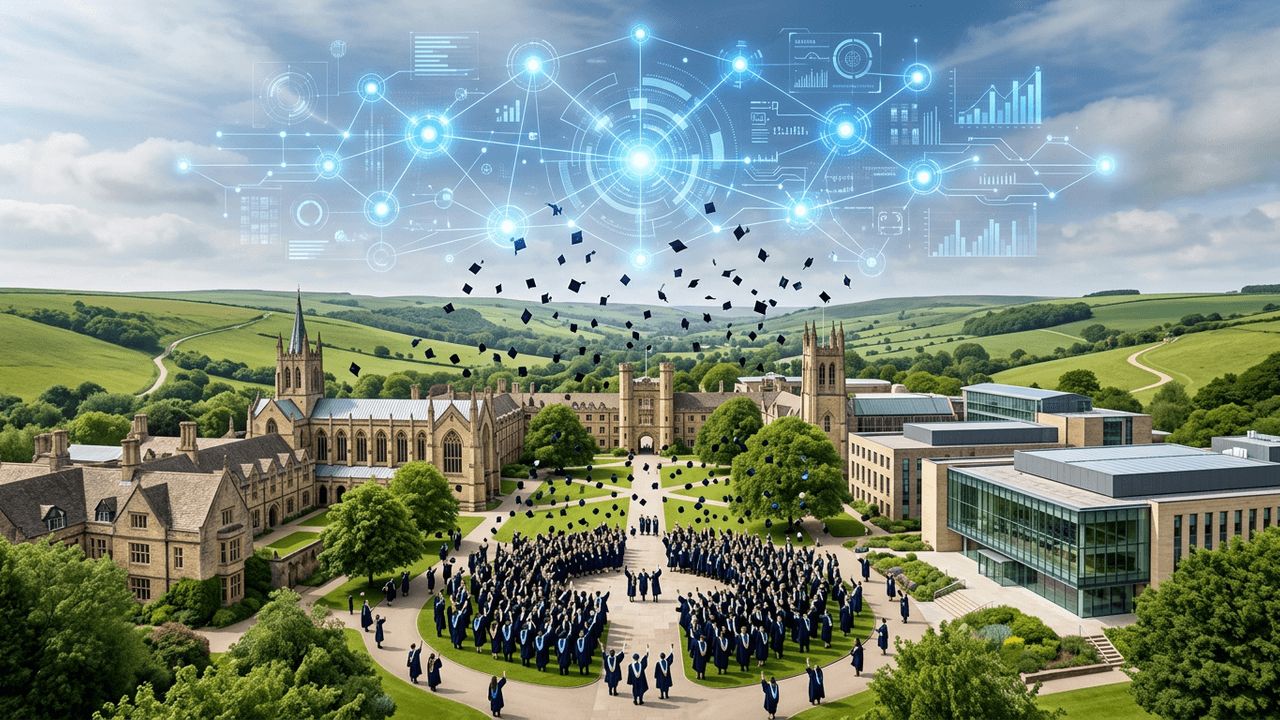
Higher Education From a Bury Base
Bury does not host a large standalone university campus, and that fact is often misread as a limitation. In reality, the borough enjoys one of the more favourable higher education positions in the country. Greater Manchester contains multiple major universities, several of them internationally ranked, and Bury's tram and rail links place them within a manageable daily commute. At the same time, local degree-level provision delivered in the town itself has expanded, offering genuine higher education without relocation costs.
That combination creates real strategic choice. A student can live at home, study a validated degree locally and keep costs low. Another can commute daily into Manchester and access research-intensive facilities. A third can move into halls for the full residential experience while remaining close to family. Each path has merit depending on finances, subject and temperament.
The Top 10 University Options for Bury Students
1. The University of Manchester — The region's flagship research-intensive institution and a member of the Russell Group. Its breadth is exceptional, spanning medicine, engineering, physical sciences, humanities, business and social sciences, supported by major research infrastructure, extensive libraries and a global academic reputation. For Bury students targeting competitive professional degrees, this is the natural first consideration, and the commute is entirely feasible by rail or tram.
2. Manchester Metropolitan University — A large modern university with particular strength in applied and professional disciplines: architecture, digital media, sport, education, nursing, business and law. Its emphasis on employability, industry placements and practical assessment appeals to students who want a clear line between study and career. Facilities have been substantially rebuilt over the past decade and are among the best in the sector.
3. University of Bolton — Notably accessible from western Bury, this university has built its identity around small teaching groups, strong tutor contact and specialist provision in areas such as medical engineering, dental technology, special effects, games design and motorsport engineering. Students who worry about being lost in a very large institution often find the scale here reassuring.
4. University of Salford — With a campus close to the media and technology cluster at MediaCity, Salford is strongly positioned in journalism, broadcast production, film, robotics, built environment and health professions. Industry proximity translates into live projects, guest practitioners and placement opportunities that are difficult to manufacture elsewhere.
5. Bury College Higher Education Provision — Degree-level and higher technical study delivered within Bury itself, typically validated by partner universities. Courses span business, computing, health and social care, education and creative subjects. The advantages are considerable: no relocation, low travel cost, small cohorts and teaching staff who know students individually. For mature learners balancing work and family, this local option is frequently the most realistic route into higher education.
6. Edge Hill University — A short journey west, this institution has an especially strong reputation in teacher education, nursing, midwifery, paramedic science and sport. Its campus environment is green, self-contained and well resourced, making it popular with students who want a traditional campus feel rather than a city-dispersed one.
7. University of Central Lancashire — Accessible via the M66 and rail links north, this university offers unusually broad provision including dentistry, pharmacy, forensic science, fire engineering, policing and journalism. Its professional accreditation across health and applied science subjects is extensive, and living costs in the area compare favourably with Manchester.
8. Royal Northern College of Music — For Bury's musicians, this conservatoire represents the specialist route. Training is intensive and performance-centred, with one-to-one tuition, ensemble work and public concert programmes. Entry is by audition and standards are high, but the borough's strong school music tradition means local students do progress here.
9. The Open University — Distance learning remains the most flexible higher education route available, and it is heavily used across Bury by working adults, parents and career changers. Study is modular and part-time by default, materials are excellent, and tutor support is structured. Degrees are respected by employers, and the ability to study around shift work makes it uniquely accessible.
10. Degree Apprenticeship Routes with Regional Employers — Increasingly attractive and often overlooked, degree apprenticeships combine full employment with university study funded by the employer. Manufacturing, engineering, accountancy, digital, healthcare and public sector organisations across Greater Manchester recruit at this level. Graduates finish with a full honours degree, several years of experience and no tuition debt, though competition is intense and the workload demanding.
Weighing Cost Against Experience
Living at home while studying in Manchester can reduce total costs by a very substantial margin across a three-year degree, with the main expense being an annual travel pass. The trade-off is a reduced social immersion, since much of university friendship formation happens in shared accommodation and late-evening campus life. Students choosing the commute should compensate deliberately by joining societies, taking on course representative roles or working on campus.
Conversely, moving into halls buys independence and community but adds rent, bills and food costs. Many Bury students split the difference, commuting in first year to save money and moving into a shared house in second year once friendship groups are established.
Choosing a Course, Not Just an Institution
Reputation operates at subject level more than institutional level. A modern university may outperform a highly ranked one in a specific discipline because of staff expertise, facilities or industry links. Examine module content in detail, check contact hours, look at assessment balance between examination and coursework, and investigate placement provision. Professional accreditation is critical in fields such as engineering, psychology, architecture, nursing and law, so confirm it explicitly rather than assuming.
Graduate outcome data for the specific course is more useful than overall figures. Ask what proportion progressed into professional employment or further study, and in what roles. Where possible, speak to current students at open days about teaching quality, feedback turnaround and support responsiveness.
Trends in Higher Education
Several shifts are worth noting. Blended delivery has become permanent, with recorded lectures and digital resources supplementing in-person seminars, which particularly benefits commuting students. Higher technical qualifications and two-year accelerated degrees are expanding, offering faster and cheaper routes to graduate-level skills. Employers increasingly value demonstrable capability, portfolios and placement experience alongside classification, meaning what students do during a degree matters as much as where they do it.
Conclusion
Bury students are unusually well served in higher education, provided they think in terms of the wider region rather than the town boundary. Local provision offers affordability and support; Manchester and its neighbours offer scale, research and specialism. The right choice balances subject fit, financial reality and the kind of environment in which you will genuinely thrive across three or more demanding years. Research thoroughly, visit in person and make the decision on evidence rather than reputation alone.
Want your brand featured in front of decision-makers? Publish a guest post or get a link insertion in our guides through AAMAX's guest post and link insertion service.
Helpful Links
 SponsoredAAMAX — Full-Service Digital Agency
Write for Us
Share your expertise with our readers. We welcome guest contributions from industry specialists.
Pitch your idea