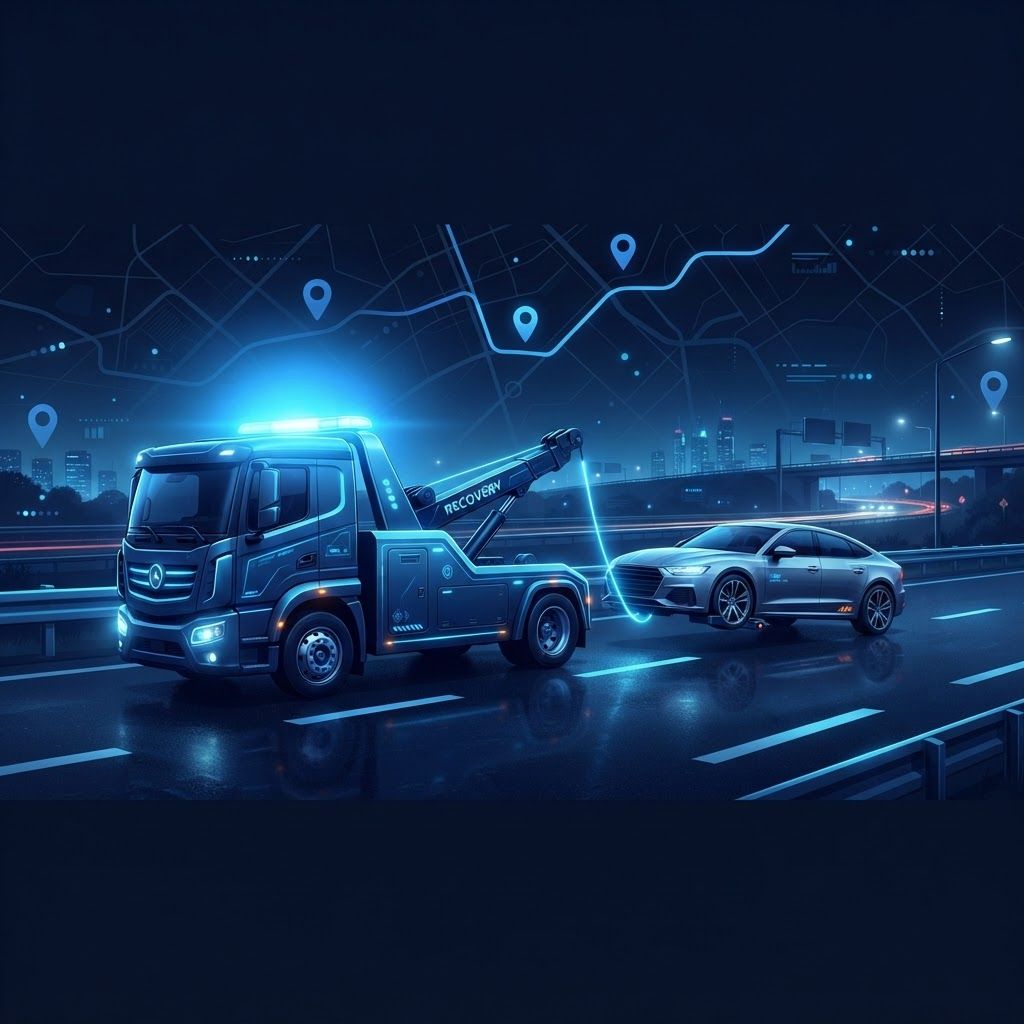
Recovery Demand in West Lothian
West Lothian carries some of Scotland's busiest road traffic. The M8 and M9 run through the area, joined by the A89, A801, A71 and A803, funnelling commuter and freight movements between Edinburgh, Glasgow, Falkirk and Stirling. High traffic volumes on fast roads mean breakdowns and collisions are frequent, and hard shoulder incidents require rapid, professional response for safety reasons as much as convenience. Meanwhile, rural roads around Linlithgow, Torphichen and the Bathgate Hills present narrow access, farm gateways and ditches that demand skilled winching rather than simple towing.
Winter compounds this. Ice, snow and standing water cause loss of control, flat batteries and vehicles stranded on inclines. Understanding the recovery options available in advance, and storing a reliable contact, turns a stressful roadside situation into a manageable one.
1. 24/7 Emergency Roadside Recovery
Round-the-clock recovery operators form the core of the sector. The best local providers maintain multiple vehicles across the area so they can reach an incident on the M8 or in a residential Livingston street within a reasonable window at any hour. They handle jump starts, tyre changes, fuel delivery, lock-outs and full recovery to a home or garage. Response time, clear pricing quoted before dispatch, and appropriate insurance and licensing are the markers that distinguish a professional operator from an opportunistic one.
2. Motorway Recovery Specialists
Motorway work is a distinct discipline. Operators must manage live-lane risk, comply with Police Scotland and traffic officer instructions, use compliant amber beacons and high-visibility markings, and remove vehicles quickly to reduce congestion and secondary collision risk. Specialist motorway recovery firms train crews specifically for this environment and often hold arrangements with traffic authorities. If you break down on the M8 or M9, the priority is to exit the vehicle to a safe place behind the barrier where possible and call for help immediately rather than attempting repairs.
3. Flatbed and Tilt-Tray Transport
Flatbed recovery lifts the entire vehicle clear of the road, which is essential for all-wheel-drive vehicles, low-slung performance cars, electric vehicles, automatics with non-neutral-safe transmissions and vehicles with seized wheels or damaged suspension. Towing such vehicles on their own wheels risks serious drivetrain damage. Flatbeds are also the correct option for accident-damaged cars where alignment is compromised. Any competent operator should ask what vehicle you have before deciding equipment, and a firm that offers only conventional towing for an EV should be questioned.
4. Accident and Collision Recovery
Collision recovery involves more than moving a vehicle. Operators must make the scene safe, contain spilled fluids, sweep debris, coordinate with emergency services and transport the vehicle to a storage compound or approved repairer. Established firms hold secure storage facilities and manage the insurance interface, providing documentation for claims. Given ADAS sensors and hybrid high-voltage systems in modern cars, crews also need awareness of safe handling procedures around damaged battery packs and undeployed airbag systems.
5. Heavy and Commercial Vehicle Recovery
West Lothian's distribution and logistics activity means HGV and coach recovery is a genuine local requirement. This work needs heavy rotator units, underlifts, air-brake knowledge and load-transfer capability, since a stranded articulated trailer often cannot be moved until its load is redistributed or transferred. Heavy recovery operators also handle plant machinery, agricultural vehicles and bus recovery. Because motorway HGV incidents cause severe congestion, response speed and coordination with traffic authorities are critical.
6. Motorcycle Recovery Services
Motorcycles require dedicated handling. Correct recovery uses purpose-built trailers or flatbeds with wheel chocks and soft straps at proper anchor points to avoid damaging forks, fairings, exhausts and brake lines. Generic recovery operators without motorcycle experience frequently cause cosmetic or mechanical damage. Given the active riding community using West Lothian's rural roads, a specialist motorcycle recovery contact is worth having stored for any regular rider.
7. Vehicle Transport and Logistics Providers
Not all towing is emergency work. Transport providers move vehicles between dealerships, auctions, storage and private buyers, deliver classic and high-value cars in enclosed transporters, and handle multi-car movements for fleets and traders. For a classic or show vehicle, enclosed transport protects against stone chips, weather and road film during transit. These operators typically offer scheduled booking and goods-in-transit insurance, which matters when transporting a valuable vehicle.
8. EV and Hybrid Recovery Specialists
Electric vehicles have specific recovery requirements. Most cannot be towed with driven wheels on the ground because regenerative motors can be damaged, and battery packs demand careful handling after impact or immersion. Specialist EV recovery uses flatbeds, understands high-voltage isolation procedures, and can advise on quarantine periods for damaged battery packs due to thermal runaway risk. As electric vehicle numbers rise across Livingston and the wider region, this capability is becoming a baseline expectation rather than a specialism.
9. Off-Road and Winching Recovery
Rural West Lothian generates recovery jobs that ordinary tow trucks cannot handle — vehicles in ditches, stuck on soft farm ground, bogged in forestry tracks or slid off icy minor roads. Off-road recovery specialists use heavy winches, snatch blocks, recovery boards and 4x4 units to extract vehicles without causing further damage to the vehicle or the surrounding land. Correct technique here prevents bent subframes, torn bumpers and damaged sills, all common results of improvised recovery attempts.
10. Roadside Assistance Memberships
National breakdown organisations and insurer-provided assistance packages offer pre-paid recovery, often including home start, roadside repair and onward travel. They typically subcontract to local operators, so the actual crew attending may well be a West Lothian firm. Membership makes financial sense for high-mileage drivers and offers predictable costs, but coverage limits vary — some policies exclude recovery beyond a set radius, exclude certain vehicle types or restrict the number of annual call-outs. Reading the terms before you need them avoids disappointment.
What to Do When You Break Down
On a motorway, move to the hard shoulder or an emergency refuge area, switch on hazard lights, exit through the passenger side if it is safe, and wait behind the barrier away from traffic. Do not attempt repairs on a live carriageway. On smaller roads, get the vehicle as far off the carriageway as possible and use a warning triangle at a safe distance where conditions allow.
When calling for recovery, give your precise location using motorway marker posts, junction numbers or a location-sharing app, describe your vehicle type including whether it is electric or all-wheel drive, and explain the fault. Confirm the price and expected arrival time before agreeing. Keep your registration, insurance details and any breakdown membership number accessible.
Choosing a Reliable Operator
Verify that the operator carries appropriate public liability and goods-in-transit insurance, that their vehicles are properly plated and licensed, and that staff can demonstrate relevant recovery training. Established firms provide written invoices, transparent hourly or fixed pricing, and clear storage terms. Be cautious of unsolicited recovery offers at accident scenes, where inflated storage fees and release charges have historically caused problems for drivers.
Final Thoughts
Recovery is a service you hope never to need but cannot afford to get wrong. West Lothian's mix of motorway, urban and rural roads means the right operator depends on where and what has failed — motorway specialists for trunk roads, flatbeds for EVs and low cars, heavy units for commercials, and winching specialists for rural incidents. Save a trusted local number now, understand what your breakdown cover actually includes, and keep basic safety equipment in the vehicle through winter.
Want your brand featured in front of decision-makers? Publish a guest post or get a link insertion in our guides through AAMAX's guest post and link insertion service.
Helpful Links
 SponsoredAAMAX — Full-Service Digital Agency
Write for Us
Share your expertise with our readers. We welcome guest contributions from industry specialists.
Pitch your idea