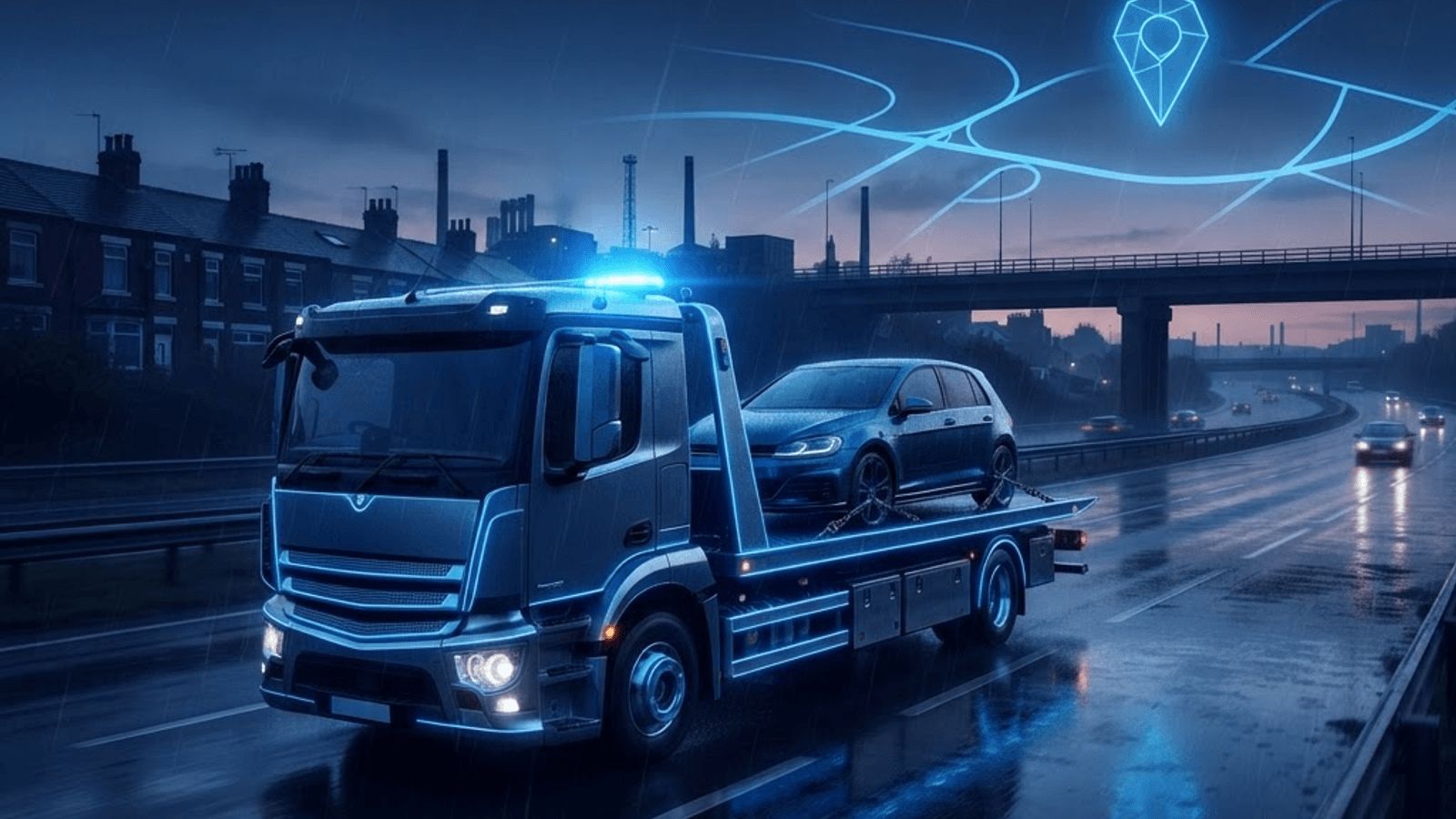
Vehicle Recovery in the Tameside Area
Tameside sits at a busy junction of the Greater Manchester road network. The M60 and M67 pass through or alongside the borough, while the A57, A627, A635 and A6017 carry heavy daily traffic between Ashton-under-Lyne, Denton, Hyde, Droylsden and Stalybridge. Add the steep, exposed Pennine routes climbing toward Mossley and Saddleworth, and the demands placed on local recovery operators are genuinely varied.
That variety shapes the sector. A recovery operator working in Tameside needs the equipment to lift a low-slung sports car from a multi-storey car park, extract a van from a muddy construction site and clear a motorway lane safely under police direction. The best local providers have invested in fleets capable of handling all of it.
1. Flatbed and Tilt-Tray Recovery Operators
Flatbed recovery is the gold standard for most modern vehicles. The entire vehicle is winched onto a hydraulic tilting bed, keeping all four wheels off the road. This eliminates any risk of transmission damage, which matters enormously for four-wheel-drive vehicles, automatics and electric cars where towing with driven wheels on the ground can cause serious harm.
Tameside flatbed operators handle accident recovery, non-runners, seized engines and prestige vehicles where absolute care is essential. Low-approach-angle beds and specialist strapping protect lowered suspension and alloy wheels during loading.
2. 24-Hour Emergency Breakdown Recovery
Round-the-clock operators are the ones you call at three in the morning on a wet night. These businesses maintain crews on rotation and vehicles ready to deploy, with response times across Tameside typically measured in tens of minutes rather than hours.
Beyond simple transport, many carry equipment for roadside resolution, including jump packs, fuel cans, tyre inflation kits and basic diagnostic tools. A significant proportion of callouts are resolved at the roadside, which is faster and cheaper than a full recovery.
3. Motorway and Trunk Road Specialists
Recovery on the M60 and M67 is a specialised discipline. Operators must work under traffic management protocols, coordinate with police and highway authorities, deploy appropriate warning lighting and clear the carriageway with minimal disruption.
These providers carry high-visibility equipment, impact protection vehicles where required and crews trained in live-lane safety. Response speed on motorways is critical, since a stationary vehicle on a hard shoulder or in a live lane represents a serious hazard.
4. Accident and Incident Recovery Services
Following a collision, recovery involves more than moving a vehicle. Operators clear debris, contain fluid spills, secure the scene and document vehicle condition for insurance purposes. Many maintain secure compounds where damaged vehicles are stored pending assessment.
Established Tameside accident recovery businesses work directly with insurers and accident management companies, streamlining the claims process. They will also often arrange onward transport to a nominated repair centre.
5. Motorcycle Recovery Specialists
Motorcycles require entirely different handling from cars. Specialist operators use dedicated wheel chocks, soft straps and ramps designed to secure a bike upright without loading the suspension or damaging fairings.
Given how popular Pennine riding is among Tameside motorcyclists, dedicated bike recovery covering the moorland routes above Mossley and toward the Woodhead Pass is genuinely valuable. Riders consistently report that generalist recovery firms lack the correct equipment.
6. Heavy and Commercial Vehicle Recovery
Tameside's industrial estates and logistics operations generate demand for heavy recovery. These operators run substantial rotator and underlift vehicles capable of recovering rigid trucks, articulated units, buses and plant machinery.
Heavy recovery frequently involves complex lifting, load transfer and stabilisation, requiring qualified operators and detailed planning. Providers also handle overturned vehicle righting and load recovery, work that demands both specialist gear and considerable experience.
7. Roadside Assistance and Mobile Mechanics
Mobile mechanics occupy a useful middle ground between roadside assistance and full recovery. Equipped with diagnostic tools, common consumables and portable equipment, they resolve a meaningful share of breakdowns without any towing at all.
Typical roadside fixes include battery replacement, alternator belt repair, fuel pump relay faults, misfuelling drainage and puncture repair. When the fault proves terminal, they arrange recovery, so the customer makes one call rather than two.
8. Vehicle Transport and Trade Delivery Services
Not all towing is emergency work. Vehicle transport operators move cars between dealerships, auctions, storage facilities and private buyers throughout the region. Enclosed transporters protect classic, prestige and newly restored vehicles from road grime and stone chips.
Tameside's position near major motorway routes makes it a practical base for these services, and many operators run multi-car transporters for cost-effective trade movements across the North West and nationally.
9. Off-Road and Specialist Extraction
Vehicles become stuck in situations conventional recovery cannot reach: waterlogged fields near the Tame valley, unsurfaced Pennine tracks, construction sites and soft verges. Specialist extraction operators use four-wheel-drive recovery vehicles, extended winch capacity, ground anchors and traction matting.
This category also covers underground car park recovery, where restricted height and tight turning circles rule out standard flatbeds, requiring compact recovery units and skate systems instead.
10. Scrap and End-of-Life Vehicle Collection
When a vehicle reaches the end of its life, authorised operators collect it free of charge or with payment for scrap value, issuing the certificate of destruction required for deregistration. These businesses operate as authorised treatment facilities, ensuring fluids and components are handled to environmental standards.
Serviceable parts are typically recovered for resale, feeding the local used parts supply chain, while remaining materials are recycled. Collection is usually available within a day or two across the borough.
What to Do When You Break Down
Prioritise safety before anything else. Move the vehicle off the carriageway where possible, switch on hazard lights, and on motorways exit from the passenger side and stand behind the barrier rather than remaining in the vehicle. Carry a reflective jacket and a torch as standard.
When calling for recovery, provide your exact location using motorway marker posts, junction numbers or a mapping application, along with your vehicle make, model, transmission type and the nature of the fault. Automatic and electric vehicles must be specified, since they require flatbed transport.
Choosing a Reliable Recovery Provider
Confirm the operator holds appropriate goods-in-transit and public liability insurance, and ask whether their equipment suits your specific vehicle. A reputable provider quotes clearly upfront, including any out-of-hours premium, mileage charge and storage fees.
Check whether your motor insurance, vehicle warranty, bank account package or breakdown membership already includes recovery cover, as many drivers pay separately for a service they already hold. Saving the number of a trusted local Tameside operator in your phone before you need it remains the single most useful preparation you can make.
Want your brand featured in front of decision-makers? Publish a guest post or get a link insertion in our guides through AAMAX's guest post and link insertion service.
Helpful Links
 SponsoredAAMAX — Full-Service Digital Agency
Write for Us
Share your expertise with our readers. We welcome guest contributions from industry specialists.
Pitch your idea