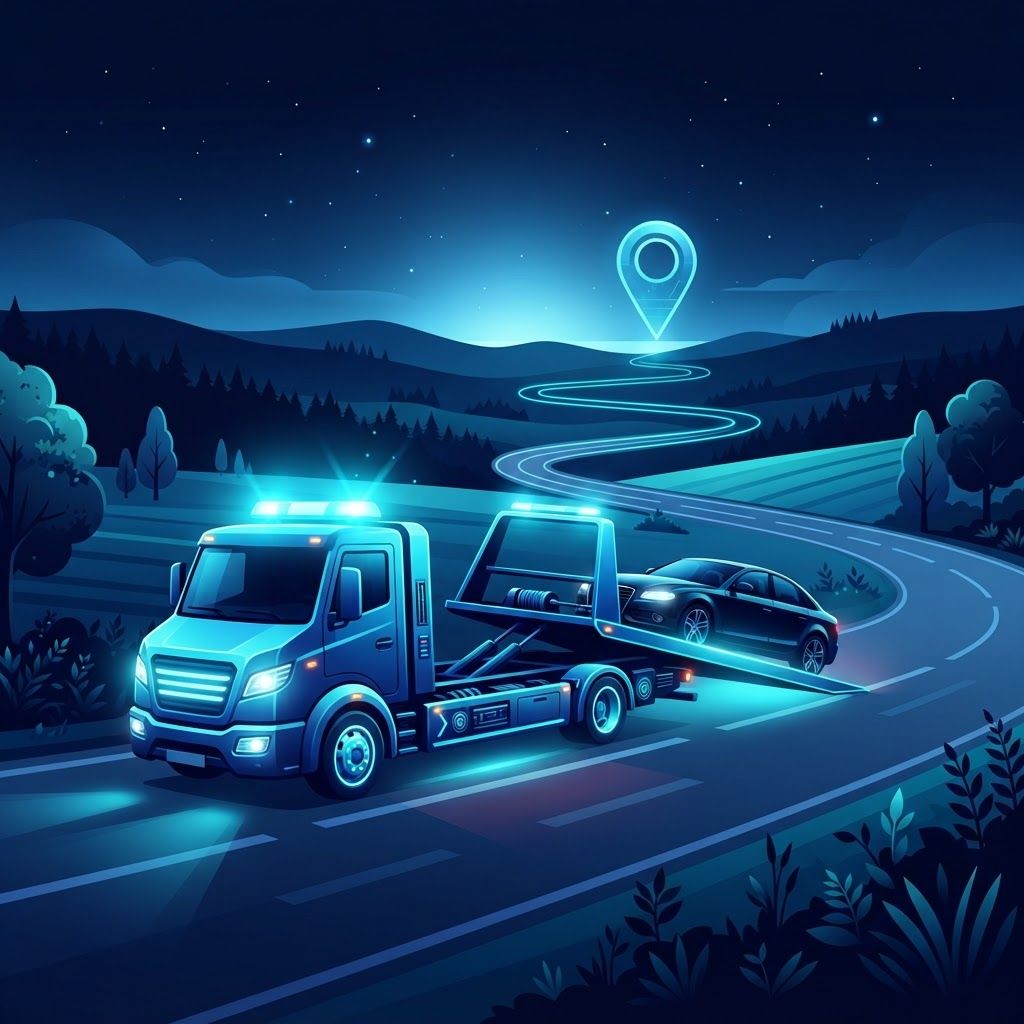
Vehicle Recovery in Challenging Terrain
Few counties test a recovery operator like Powys. Breakdowns occur on mountain passes, single-track lanes with no passing places, farm tracks, forestry roads and long stretches of A-road where the nearest garage may be thirty miles away. Mobile signal is unreliable across much of the Cambrian Mountains and the Beacons, and winter weather can close routes entirely.
These conditions demand more from recovery services than an urban environment does. Operators need vehicles capable of accessing difficult locations, winching equipment, knowledge of local geography that satellite navigation cannot supply, and the judgement to work safely on roads without lighting or hard shoulders.
Ten Towing and Recovery Options
1. National breakdown organisations such as the major motoring associations provide the most widely used cover. Their strength is nationwide network coordination and roadside repair capability, with a high proportion of breakdowns fixed on the spot rather than requiring a tow. In remote Powys locations they subcontract to local operators, which is how the system achieves rural coverage.
2. Independent local recovery operators based in Newtown, Welshpool, Brecon and Llandrindod Wells are the practical backbone of the service. These businesses hold local authority and police contracts, respond quickly because they are genuinely nearby, and know which lanes their vehicles can physically reach.
3. Twenty-four hour emergency recovery specialists operate through the night and at weekends. Breakdowns do not respect office hours, and operators maintaining genuine round-the-clock crews are invaluable when a family is stranded on an unlit mountain road at midnight.
4. Flatbed and tilt-tray recovery services transport vehicles without wheels turning, which is essential for four-wheel drives, automatics, low-clearance cars and electric vehicles where towing with wheels on the ground can cause serious damage.
5. Heavy recovery operators handle lorries, buses, agricultural machinery and plant. Powys sees regular incidents involving articulated vehicles struggling on narrow lanes or gradients, and specialist heavy units with substantial winching capacity are needed to resolve them.
6. Off-road and agricultural recovery specialists extract vehicles from fields, forestry tracks, ditches and boggy ground. Using tractors, winches and off-road capable recovery vehicles, they handle situations that conventional recovery trucks cannot approach.
7. Accident recovery and insurance-approved operators work directly with insurers, handling collision-damaged vehicles, securing scenes, clearing debris and transporting vehicles to approved repair centres with the documentation insurers require.
8. Vehicle transport and multi-car movement services support dealerships, auctions and private buyers moving vehicles across the country. Non-emergency transport on covered or open transporters is a substantial part of the sector.
9. Motorcycle recovery specialists use equipment designed to secure bikes without damage, including wheel chocks and soft straps. Given the volume of motorcycle tourism on Powys roads, this is a busier service than the county's population alone would suggest.
10. Electric vehicle recovery services represent the newest category. Electric vehicles require flatbed transport and technicians aware of high-voltage safety procedures, and operators have invested in training and equipment as adoption grows.
What to Look for in a Recovery Provider
Response time in your area is the critical measure. National averages mean little if the nearest contracted operator to your home is an hour away. Ask breakdown providers directly about coverage in rural mid Wales before buying a policy.
Check what the cover includes. Roadside assistance, local recovery, national recovery, home start and onward travel are separate elements, and a policy without national recovery may only take you to the nearest garage, which could be closed.
Confirm vehicle suitability. Some policies exclude vehicles over a certain age, weight or length, and caravans, trailers and horseboxes often require specific cover.
Verify insurance and licensing for independent operators, along with membership of recognised recovery industry bodies, which indicates adherence to safety and operational standards.
Trends in the Recovery Sector
Electric vehicle adoption is changing equipment requirements substantially. Flatbeds are replacing traditional suspended tows, and operators increasingly carry mobile charging units capable of providing enough range to reach a charge point, which addresses one of the more common call-outs.
Technology has improved dispatch. GPS location sharing, automated job allocation and real-time arrival estimates have reduced uncertainty, though these depend on mobile coverage that remains patchy in Powys valleys.
Roadside repair capability continues to improve, with technicians carrying diagnostic equipment able to resolve electronic faults that once required recovery to a workshop. This reduces both cost and disruption.
Driver shortages affect the recovery sector as they do haulage, and rural operators in particular face challenges recruiting technicians willing to work night shifts across large geographic areas.
Staying Prepared on Powys Roads
Carry a charged phone and a power bank, and note that emergency calls can sometimes connect via another network where your own has no signal. Keep warm clothing, a torch, water and a high-visibility vest in the vehicle, particularly in winter.
Know your location. Identifying a breakdown position on an unnamed mountain road is difficult, and using a location-sharing app or noting the nearest junction, bridge or farm name speeds response considerably.
If you break down on a narrow lane, move as far left as safely possible and consider that agricultural vehicles may need to pass. On faster roads, exit the vehicle on the safe side and wait well away from the carriageway behind a barrier where one exists.
Save a local recovery number in your phone as well as your breakdown provider's. In severe weather or during exceptionally busy periods, a direct arrangement with a nearby operator is sometimes the quickest route to getting home.
Recovery services in Powys combine national network reach with genuinely local expertise, and choosing cover that reflects rural realities is one of the more sensible precautions any driver in the county can take.
Want your brand featured in front of decision-makers? Publish a guest post or get a link insertion in our guides through AAMAX's guest post and link insertion service.
Helpful Links
 SponsoredAAMAX — Full-Service Digital Agency
Write for Us
Share your expertise with our readers. We welcome guest contributions from industry specialists.
Pitch your idea