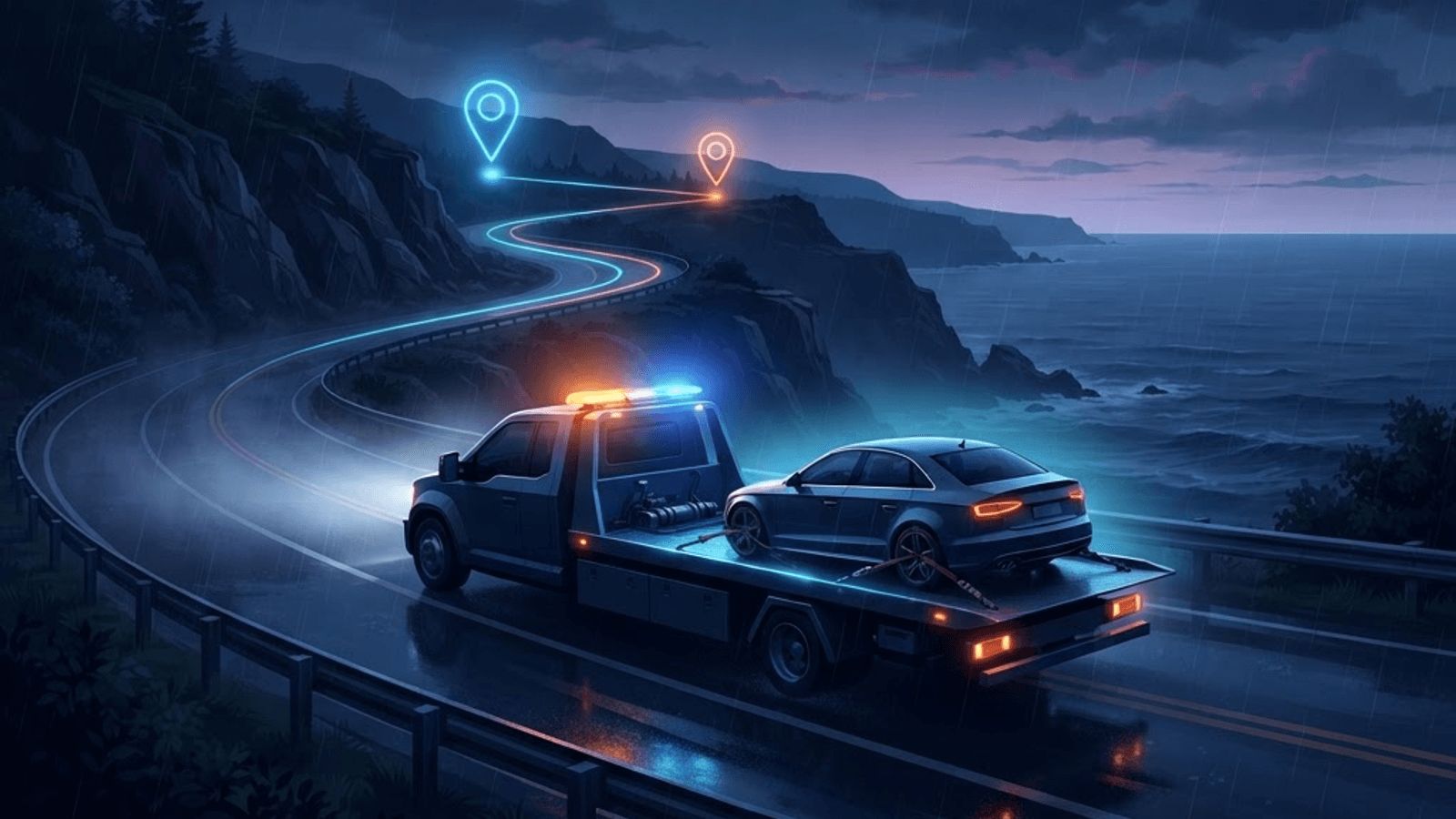
Vehicle Recovery in a Rural Coastal County
Breaking down in Pembrokeshire presents challenges that urban drivers rarely face. Mobile signal is patchy across large parts of the county, particularly in the Preseli Hills, along sections of the coast path road network, and in wooded valleys. Many roads are single track with passing places, which complicates the arrival and manoeuvring of a recovery vehicle. Distances between towns mean response times are inherently longer than in cities.
Seasonal factors compound this. Summer brings a substantial influx of visitors towing caravans and driving unfamiliar roads, increasing both incident volume and the proportion of recoveries involving larger vehicles. Winter brings weather-related incidents on exposed coastal routes. A recovery operator serving Pembrokeshire needs local route knowledge, appropriate equipment for narrow lanes, and realistic coverage across a wide area.
Understanding Recovery Service Types
Recovery falls into several distinct categories. Roadside assistance attempts repair at the scene, resolving a significant proportion of breakdowns without towing at all — flat batteries, wheel changes, fuel issues and minor electrical faults. Local recovery transports a vehicle to a nearby garage or home address. National recovery transports to any UK destination, which matters for visitors whose vehicle fails while on holiday in the county.
Specialist recovery covers accident scenes, vehicles off-road or in ditches, motorcycles requiring specific equipment, and heavy commercial vehicles needing substantially greater lifting capacity. Not every operator handles every category, which is worth confirming before you need the service.
The Top 10 Recovery Providers Serving Pembrokeshire
1. The AA — The largest roadside assistance organisation in the UK, with patrol coverage extending across Pembrokeshire. Its principal advantage is the proportion of breakdowns fixed at the roadside, avoiding the need for recovery entirely. Membership tiers cover roadside, home start, local recovery and national relay, and the mobile application provides location-based reporting which is genuinely useful when you cannot describe where you are on an unmarked rural lane.
2. RAC — Comparable in scale and coverage, the RAC operates patrols across West Wales with similar tiered membership. Its patrol vehicles carry diagnostic equipment and a range of commonly needed parts, and it has invested in electric vehicle support including mobile charging capability, which is increasingly relevant as EV ownership grows in the county.
3. Green Flag — Operating through a network of approved local recovery operators rather than an employed patrol fleet, Green Flag frequently dispatches Pembrokeshire-based contractors who know the roads intimately. Pricing is often more competitive than the larger organisations, and the local knowledge advantage in a county like this should not be underestimated.
4. Independent Pembrokeshire Recovery Operators — The county supports a number of independent recovery businesses, many family run, operating flatbed and spec-lift vehicles. Their core advantage is proximity and flexibility. They can reach remote locations more quickly than a nationally dispatched service, understand which lanes their equipment can physically access, and often have direct relationships with local garages. Most operate on a pay-per-call basis without membership.
5. Manufacturer Breakdown Cover — New vehicles typically include manufacturer-branded assistance for the warranty period, delivered through partnership with a major provider. The benefit is that recovery defaults to a franchised dealer with brand-specific diagnostic capability, which matters for complex electronic faults that a general garage may struggle to resolve.
6. Insurance-Linked Recovery Cover — Many comprehensive motor policies include breakdown assistance as an add-on. Policyholders frequently have this cover without realising it, and checking existing insurance documents before purchasing separate membership is worth doing. Coverage levels vary considerably, so read what is actually included regarding home start and national recovery.
7. Heavy Vehicle and Commercial Recovery Specialists — Serving the haulage, port and construction activity around Milford Haven and Pembroke Dock, these operators maintain heavy recovery equipment capable of lifting HGVs, plant machinery and agricultural vehicles. This requires substantially different equipment and training from car recovery, and only a limited number of operators in the region are properly equipped.
8. Motorcycle Recovery Specialists — Motorcycles require specific handling to avoid damage, including appropriate straps, wheel chocks and loading ramps. Given Pembrokeshire's popularity with touring riders, operators offering dedicated motorcycle recovery serve a real need, particularly during the summer riding season.
9. Accident Recovery and Police-Contracted Operators — Following a collision, recovery is often arranged through police-approved contractors who attend scenes, make vehicles safe, clear debris and remove damaged vehicles to secure storage. These operators work to specific protocols and hold the necessary authorisations for roadside incident management.
10. Caravan, Motorhome and Trailer Recovery Services — Pembrokeshire's tourism economy generates significant demand for recovery of caravans and motorhomes, which require operators with appropriate towing capacity and experience. Specialist clubs and providers offer cover tailored to leisure vehicles, including recovery of both the towing vehicle and the caravan together, which standard car policies frequently exclude.
What to Do When You Break Down
On a Pembrokeshire road, prioritise safety before anything else. Move the vehicle as far left as possible, switch on hazard lights, and on rural lanes be aware that visibility around bends is often extremely limited. Exit via the passenger side where possible and wait behind a barrier or hedge rather than in the vehicle if you are in a hazardous position.
Locating yourself accurately is the biggest practical challenge here. Note the last village passed, any road number, distinctive landmarks, or use a location-sharing application. Many rural lanes have no signage for miles, and an inaccurate location is the most common cause of extended waiting times. If mobile signal is absent, walking a short distance to higher ground frequently restores it.
Choosing Cover Before You Need It
Assess your actual risk profile. High-mileage rural drivers benefit from comprehensive cover including national recovery. Those driving mainly locally in a newer vehicle may find basic roadside assistance sufficient. Check whether cover follows the vehicle or the person, which matters for households with multiple cars or drivers.
Home start is particularly valuable in Pembrokeshire, since a substantial proportion of breakdowns occur on the driveway rather than the road, typically battery-related. Finally, keep both a membership number and a local independent operator's details accessible offline in the vehicle, because the moment you need them is precisely when your phone may have no signal to look anything up.
Want your brand featured in front of decision-makers? Publish a guest post or get a link insertion in our guides through AAMAX's guest post and link insertion service.
Helpful Links
 SponsoredAAMAX — Full-Service Digital Agency
Write for Us
Share your expertise with our readers. We welcome guest contributions from industry specialists.
Pitch your idea