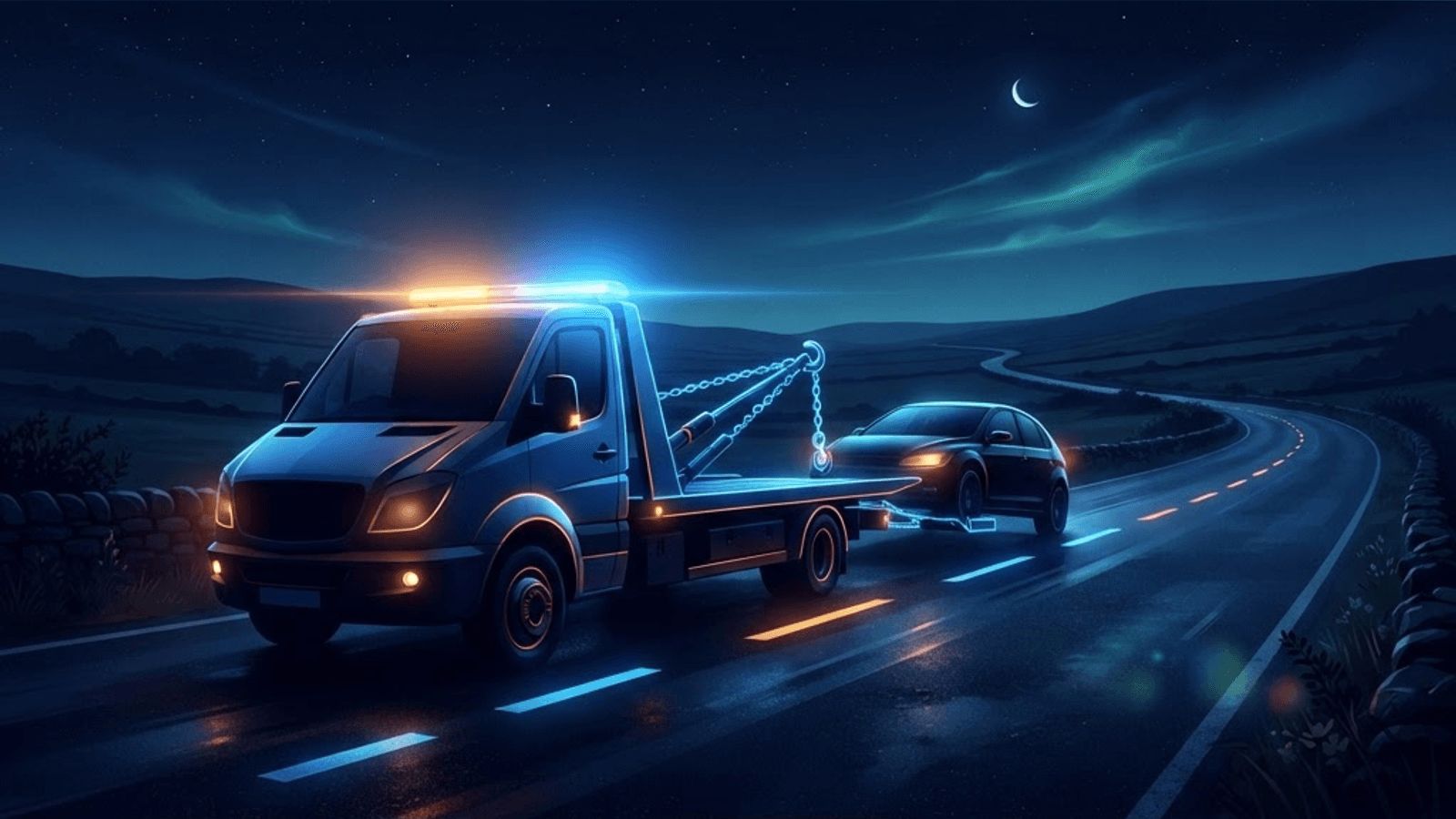
Why Recovery Provision Matters in This District
Few districts present a more varied recovery challenge than Newry, Mourne and Down. The main arterial route through Newry carries heavy cross-border traffic including significant commercial volume, where a breakdown creates immediate congestion and safety risk. Beyond that, the district contains steep and narrow upland roads through the Mournes, coastal routes exposed to weather, and a dense network of rural lanes in Lecale and around Rathfriland where a stranded vehicle may be a considerable distance from the nearest garage.
Seasonal factors intensify demand. Summer brings substantial tourist traffic to Newcastle, Rostrevor and the Mourne coastal road, often in unfamiliar vehicles on unfamiliar roads. Winter brings ice on upland routes and flooding on low-lying rural roads. Agricultural activity adds another dimension, with tractors, trailers and farm vehicles requiring specialist recovery equipment that standard tow trucks cannot provide.
Understanding Recovery Equipment and Capability
Recovery is not a single service, and matching equipment to circumstance matters. Flatbed or tilt-and-slide transporters carry the vehicle entirely, which is essential for four-wheel drive vehicles, automatic transmissions, electric vehicles and any severely damaged vehicle. Wheel-lift units are faster and more manoeuvrable, suitable for shorter moves of conventional vehicles in confined urban settings.
Heavy recovery vehicles with substantial winching capacity handle commercial trucks, buses and vehicles that have left the road, which is a genuine requirement on the district's upland and rural routes. Underlift and rotator equipment allows recovery from ditches and embankments without further damage. Specialist agricultural recovery requires low loaders with appropriate ramp angles and load capacity.
Electric vehicles deserve particular mention. They must generally be transported on a flatbed rather than towed, and operators need training in high-voltage isolation and awareness of thermal risk following collision damage. Any modern recovery operator serving the district should be equipped and trained for this.
Leading Towing and Recovery Services Locally
AA breakdown and recovery provides nationwide coverage with an extensive contractor network across the district. Its strength lies in membership-based response, comprehensive cover options including onward travel, and integration with roadside repair so that many faults are resolved without recovery at all.
RAC roadside assistance operates similarly, with patrol coverage and local contractor arrangements throughout Newry, Mourne and Down. It is well regarded for diagnostic capability at the roadside and for handling recovery to a chosen destination rather than only the nearest garage.
Green Flag recovery services deliver a contractor-network model that performs strongly in rural areas, valued for straightforward cover terms and for recovery to a preferred destination, which matters when the nearest garage is not the customer's usual workshop.
Established independent recovery operators in Newry handle a large share of local incidents, particularly on the main cross-border route. Their advantage is genuine local response speed, familiarity with the road network, and equipment ranging from light wheel-lift units to heavier winching capability.
Downpatrick and Lecale area recovery specialists serve mid-Down and the coastal Lecale roads, with strong local knowledge of narrow rural lanes and access constraints that would defeat operators unfamiliar with the area.
Mourne area recovery services based around Kilkeel, Annalong and Newcastle provide the specialist capability required for steep gradients, narrow coastal roads and off-road extraction from forest tracks and upland routes popular with visitors.
Heavy commercial vehicle recovery contractors operating from the Newry industrial corridor recover trucks, trailers and buses, with the substantial winching, lifting and load transfer equipment required. Their role is critical to keeping the border freight route open following incidents.
Agricultural and plant recovery operators serving the farming and construction communities transport tractors, harvesters, excavators and heavy plant on low loaders, requiring specialist securing knowledge and appropriate movement authorisation for oversize loads.
Accident recovery and insurance-approved operators across the district manage post-collision recovery, secure storage and onward transport to approved repair centres, coordinating with insurers and police recovery schemes. Their documentation standards and secure compounds are central to insurance claims.
Vehicle transport and enclosed transporter services complete the picture, moving classic, prestige, non-runner and newly purchased vehicles across Ireland and Great Britain. Enclosed transport in particular is used by local collectors and dealers protecting high-value vehicles from road contamination.
Trends in Vehicle Recovery
The most significant development is electric vehicle recovery capability. As electric adoption grows across the district, operators have invested in flatbed capacity, high-voltage safety training and specialist equipment for handling damaged battery vehicles safely. This has become a genuine differentiator.
Technology has also improved response coordination, with precise location sharing, live status updates and digital job management substantially reducing the uncertainty of waiting on a rural roadside. Roadside repair capability has increased too, with many operators now able to resolve battery, fuel, tyre and lockout situations on site rather than recovering the vehicle at all.
Safety standards have risen throughout the sector, with greater emphasis on scene protection, high-visibility equipment, traffic management awareness and operator qualification, reflecting the genuine danger of working at the roadside on fast rural roads.
Practical Advice When You Need Recovery
Move to a place of safety before anything else, exit away from traffic where possible, and use hazard lights and a warning triangle if it is safe to place one. Provide a precise location using a mapping application or nearby landmarks, since rural addresses are often ambiguous. State the vehicle type and drivetrain clearly, particularly if it is four-wheel drive, automatic or electric, because that determines the equipment required. Confirm cost and destination before work begins if you are not using a membership service, and photograph the vehicle before loading for your own records.
Final Thoughts
Towing and recovery across Newry, Mourne and Down is a capable, well-equipped sector, combining national providers such as the AA, RAC and Green Flag with skilled independent operators who know the district's upland, coastal and rural roads intimately. Whether the requirement is a straightforward urban recovery in Newry, an extraction from a Mourne forest track or heavy commercial recovery on the border route, appropriate equipment and expertise are available locally.
Want your brand featured in front of decision-makers? Publish a guest post or get a link insertion in our guides through AAMAX's guest post and link insertion service.
Helpful Links
 SponsoredAAMAX — Full-Service Digital Agency
Write for Us
Share your expertise with our readers. We welcome guest contributions from industry specialists.
Pitch your idea