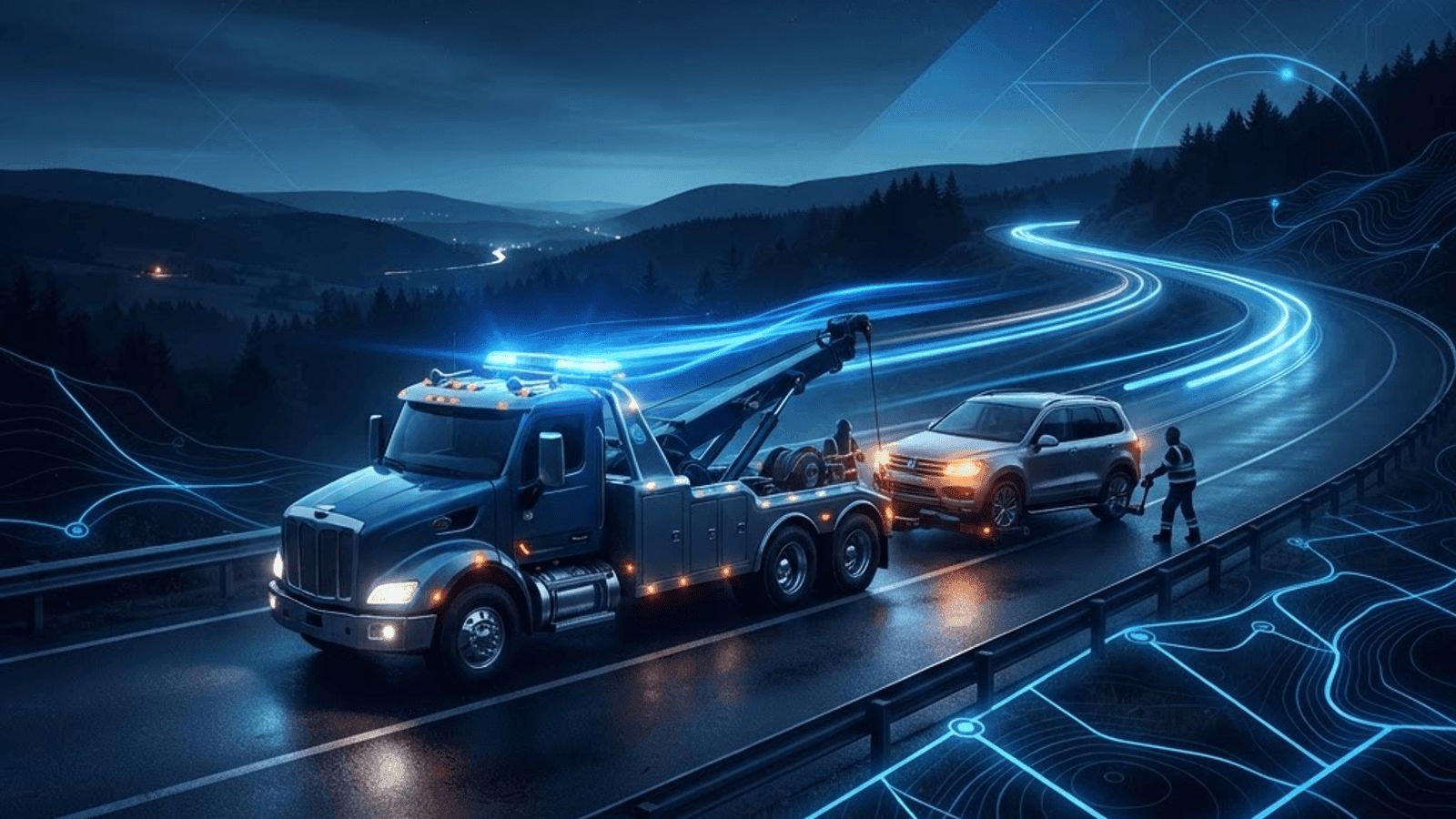
Vehicle Recovery in Havant: Local Context
Havant's road network makes recovery services particularly important. The A27 and A3(M) carry heavy commuter and freight traffic, and incidents on these routes require rapid, competent clearance. The Hayling Island bridge creates a single point of access for thousands of residents, meaning a stranded vehicle there causes disproportionate disruption. Add Portsmouth's ferry port traffic, narrow historic streets in Emsworth and Langstone, and multi-storey parking in the town centre, and the result is a recovery sector that needs to handle an unusually wide range of scenarios.
Local operators have adapted accordingly, running mixed fleets of flatbed transporters, spec-lift wreckers, low-clearance equipment and heavy recovery units. Understanding the categories helps you request the right service when something goes wrong.
1. National Roadside Assistance Providers
The major motoring organisations maintain patrol coverage across Hampshire, supported by contracted local agents. Their principal advantage is the roadside fix; a substantial majority of callouts are resolved without recovery through jump starts, tyre changes, fuel delivery, key and lockout assistance and minor mechanical intervention. When recovery is needed, membership tiers determine whether you are taken to a nearby garage or to any destination in the UK. Response times in the Havant area are generally competitive given the density of patrol coverage.
2. Independent 24-Hour Local Recovery Operators
Independent recovery firms based in and around Havant and Waterlooville provide round-the-clock service without membership requirements. They are often quicker to reach local incidents than a national provider routing from further afield, and they tend to be more flexible about destination. For motorists without breakdown cover, or for situations that membership excludes such as recovering a non-running project vehicle, independents are the practical choice. Pricing is usually a callout charge plus mileage.
3. Flatbed and Tilt-Tray Transport
Flatbed transporters carry the entire vehicle on a hydraulically tilting bed, eliminating any wheel contact with the road. This is essential for all-wheel-drive vehicles, automatic transmissions, electric vehicles with fixed-drive motors, lowered or modified cars and anything with accident damage affecting steering or suspension. Any towing service handling modern or valuable vehicles should offer flatbed capability, and it is worth specifying when you make the call.
4. Accident Recovery and Incident Management
Accident recovery is a distinct discipline. Operators work alongside police and emergency services, managing scene safety, clearing debris, containing fluid spills and extracting damaged vehicles without causing further harm. Companies approved to work on the strategic road network must meet specific equipment and training standards. They typically provide secure storage, liaise with insurers and coordinate onward movement to an approved bodyshop, which significantly reduces the administrative burden on the vehicle owner.
5. Heavy and Commercial Vehicle Recovery
Recovering HGVs, buses, coaches and plant requires purpose-built equipment: heavy underlift wreckers, rotator cranes, air cushion systems and load transfer capability. Given the freight volumes moving through Portsmouth port and along the A27, heavy recovery capability is essential to the region. These operators also handle load shift, jack-knifed articulated vehicles and off-road extraction, work that demands extensive training and rigorous risk assessment.
6. Motorcycle Recovery Specialists
Motorcycles need specific handling. Correct recovery uses a dedicated bike trailer or a flatbed with a front wheel chock and soft straps secured to appropriate frame points, with the suspension partially compressed to prevent movement. Operators experienced with motorcycles avoid strapping to handlebars or fairings, which causes damage. Given Havant's active motorcycling community and the popularity of South Downs routes, several local firms have invested in proper motorcycle recovery equipment.
7. Classic and Prestige Vehicle Transport
Enclosed transport protects classic, prestige and competition vehicles from weather, road debris and public view. Operators in this niche use low-angle loading ramps to avoid grounding, soft wheel straps rather than chassis hooks, and carry appropriate goods-in-transit insurance reflecting high vehicle values. Services extend beyond breakdowns to include show transport, auction delivery and moving non-running restoration projects.
8. Electric and Hybrid Vehicle Recovery
Electric vehicle adoption has grown steadily across Hampshire, and EVs require specific recovery procedures. Most cannot be towed with driven wheels on the road, making flatbed transport mandatory. Operators need training in high-voltage isolation, awareness of battery thermal risk following collision or immersion, and knowledge of manufacturer-specific transport modes. Some now carry mobile charging units capable of delivering enough range to reach a charge point, a service that is becoming increasingly valuable.
9. Vehicle Jump Start, Lockout and Fuel Services
Many callouts do not require towing at all. Battery failure is the single most common cause, particularly after cold snaps and periods of short-journey driving. Misfuelling is another frequent issue, and specialists can drain and flush a fuel system at the roadside, avoiding catastrophic engine or injection system damage. Lockout services use non-destructive entry techniques. These rapid-response services usually resolve the problem in under an hour at a fraction of recovery cost.
10. Off-Road, Water and Specialist Extraction
Havant's coastal geography creates unusual situations: vehicles caught by tides on Hayling Island foreshores, bogged down on soft ground, stuck in ditches on rural lanes, or trapped in flooded underpasses after heavy rain. Specialist extraction uses winching equipment, ground anchors, recovery mats and, where necessary, crane lift. Operators with this capability carry appropriate rigging and understand the load calculations involved in safe winch recovery.
What to Check Before You Need a Recovery Service
Verify what your existing cover actually includes. Many policies cover roadside assistance but not home-start, or exclude recovery to a destination of your choice. Check whether cover is attached to the vehicle or the driver, and whether passengers and pets are included. Confirm whether the provider handles your vehicle type, as some exclude modified vehicles, motorhomes and vehicles over certain weights. Save a local independent operator's details as a backup, since coverage gaps become apparent at the worst possible moment.
Staying Safe While You Wait
If you break down on a fast road, move as far left as possible, switch on hazard lights, and exit the vehicle via the passenger side where safe to do so. Wait behind a barrier rather than in the vehicle. Wear a high-visibility vest, keep one in the car, and do not attempt roadside repairs on a live carriageway. Provide the recovery operator with an accurate location using marker posts, junction numbers or a location-sharing app, as precise positioning meaningfully reduces response time.
Industry Developments
The sector is professionalising. Digital dispatch with live tracking now lets customers see their recovery vehicle approaching in real time, reducing anxiety during a stressful event. Telematics-triggered automatic breakdown alerts are increasingly built into new vehicles. And as electrification advances, recovery operators are investing in high-voltage training and specialist containment equipment, reshaping what a modern recovery fleet looks like.
Want your brand featured in front of decision-makers? Publish a guest post or get a link insertion in our guides through AAMAX's guest post and link insertion service.
Helpful Links
 SponsoredAAMAX — Full-Service Digital Agency
Write for Us
Share your expertise with our readers. We welcome guest contributions from industry specialists.
Pitch your idea