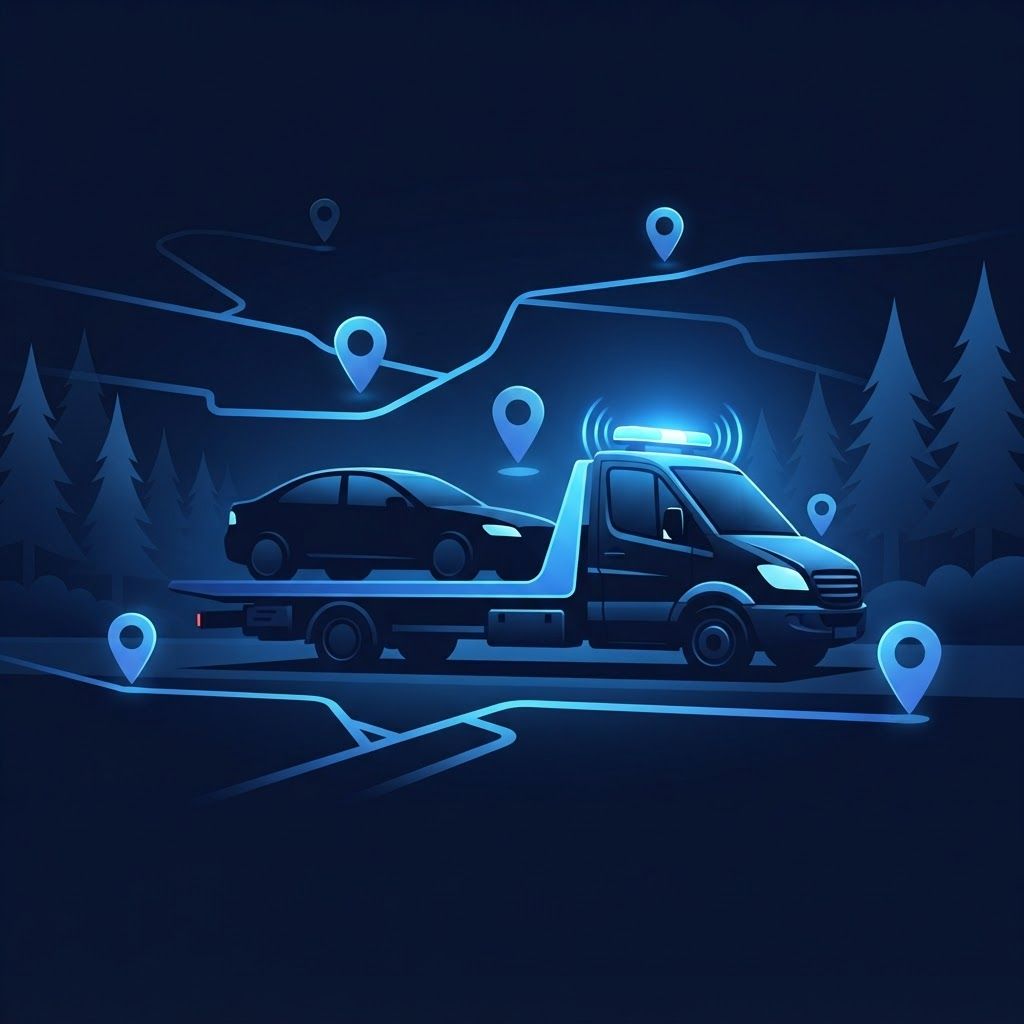
Recovery in a District of Contrasts
Epping Forest presents an unusual recovery environment. Within a few miles you move from the M11 and M25, where a stranded vehicle is a genuine safety emergency, to narrow single-track lanes around the Rodings where a recovery truck has limited room to manoeuvre, to dense forest roads with restricted access and overhanging branches, to busy urban streets in Loughton and Buckhurst Hill where parking and access are tight.
Operators working across this district need equipment and judgement suited to all of it. A flatbed that handles a motorway recovery efficiently may struggle on a narrow lane; a compact spec-lift unit that works in a town centre may be unsuitable for a heavy vehicle. The best local firms run mixed fleets for exactly this reason.
Types of Recovery Service
The sector covers several distinct services. Roadside assistance attempts to fix the vehicle where it stands, dealing with flat batteries, punctures, lost keys, misfuelling and minor electrical faults. A significant share of callouts are resolved this way, which is faster and cheaper than transport.
Vehicle recovery moves a non-driveable vehicle to a garage, home or storage facility. Flatbed or tilt-and-slide transport is the preferred method for most modern cars, particularly all-wheel-drive vehicles, automatics and electric cars, because towing on wheels can damage transmissions and drive motors. Spec-lift and wheel-lift towing remains useful in confined spaces.
Accident recovery involves collision scenes, requiring coordination with police and highways authorities, debris clearance, fluid containment and secure storage. Specialist recovery covers motorcycles, classic and low-clearance vehicles, plant machinery, horseboxes and light commercial vehicles.
What Makes an Excellent Operator
Response time is the headline metric, but it is only meaningful alongside accuracy. Good operators give a realistic estimated arrival and update the customer if it changes, rather than quoting an optimistic figure and going silent. Firms that provide live tracking or regular status updates dramatically reduce the stress of waiting at a roadside.
Equipment quality is the second differentiator. Modern flatbeds with low approach angles, winches, skates for immobile wheels, soft straps rather than chains and wheel-basket systems protect vehicles during loading. Damage during recovery is more common than most drivers realise, and it almost always traces back to inadequate equipment or rushed technique.
Driver competence is the third. Recovery operators handling a customer's vehicle need to understand how to release electronic parking brakes, put automatics into transport mode, disable air suspension, isolate high-voltage systems on electric vehicles and avoid low-slung bodywork. A crew that asks the right questions before loading is a crew that will not damage the car.
Electric Vehicle Recovery
Electric vehicle recovery has become a specialism in its own right. EVs must generally be transported on a flatbed with all four wheels off the ground, since towing with drive wheels turning can damage the motor and, in rare cases, generate current. Operators also need awareness of high-voltage isolation procedures and thermal risk following collision damage. Firms that have invested in EV-specific training and equipment are increasingly the only appropriate choice for electric vehicle owners in the district.
Motorway and Smart Motorway Work
The M11 and M25 sections serving Epping Forest include managed motorway arrangements where stopping places are limited and the hard shoulder may operate as a running lane. Recovery in these conditions is high-risk work requiring compliance with highways authority protocols, correct vehicle marking and lighting, and close coordination with control rooms. Operators approved for motorway work carry specific accreditation, and drivers should confirm this when a breakdown occurs on a fast road.
Insurance, Fleet and Trade Work
A large proportion of recovery volume comes from insurers, breakdown clubs, leasing companies, dealerships and fleets rather than direct public calls. Operators serving these clients need robust systems: digital job management, photographic condition reporting at collection and delivery, secure compound storage, and clear audit trails. Those same systems benefit private customers, because documented vehicle condition protects both parties if damage is disputed.
Secure storage is an important adjunct service. Firms with compound facilities can hold vehicles pending insurance decisions, garage capacity or owner instructions, and good operators are transparent about daily storage charges from the outset.
Pricing and Transparency
Recovery pricing typically reflects distance, vehicle type and weight, time of day, complexity of the extraction and whether the vehicle can be rolled. The clearest operators quote a callout figure plus a per-mile rate and explain any surcharges before dispatch. Drivers should be cautious of firms that refuse to give any indication of cost until the truck arrives, since the leverage at that point is entirely one-sided.
Membership breakdown cover from a motoring organisation remains the most cost-effective route for most drivers, but independent local operators often respond faster in rural parts of the district and are the primary option for non-member callouts, accident recovery and specialist vehicles.
What to Do When You Break Down
Safety comes first. On a motorway, exit the vehicle where possible and wait behind a barrier, not in the car. On rural lanes, position warning triangles at a safe distance and make the vehicle visible. Note the precise location using road markers or a location app, since accurate positioning is the single biggest factor in response speed across the district's rural areas. Have the registration, make, model, fuel type and a description of the fault ready, and state clearly whether the vehicle is automatic, all-wheel drive or electric.
Final Thoughts
The best towing and recovery services in Epping Forest combine fast, honest communication with the right equipment for a district that ranges from motorway to forest track. Choosing an operator with proper accreditation, modern flatbed capability, EV competence and transparent pricing turns a stressful breakdown into a manageable inconvenience.
Want your brand featured in front of decision-makers? Publish a guest post or get a link insertion in our guides through AAMAX's guest post and link insertion service.
Helpful Links
 SponsoredAAMAX — Full-Service Digital Agency
Write for Us
Share your expertise with our readers. We welcome guest contributions from industry specialists.
Pitch your idea