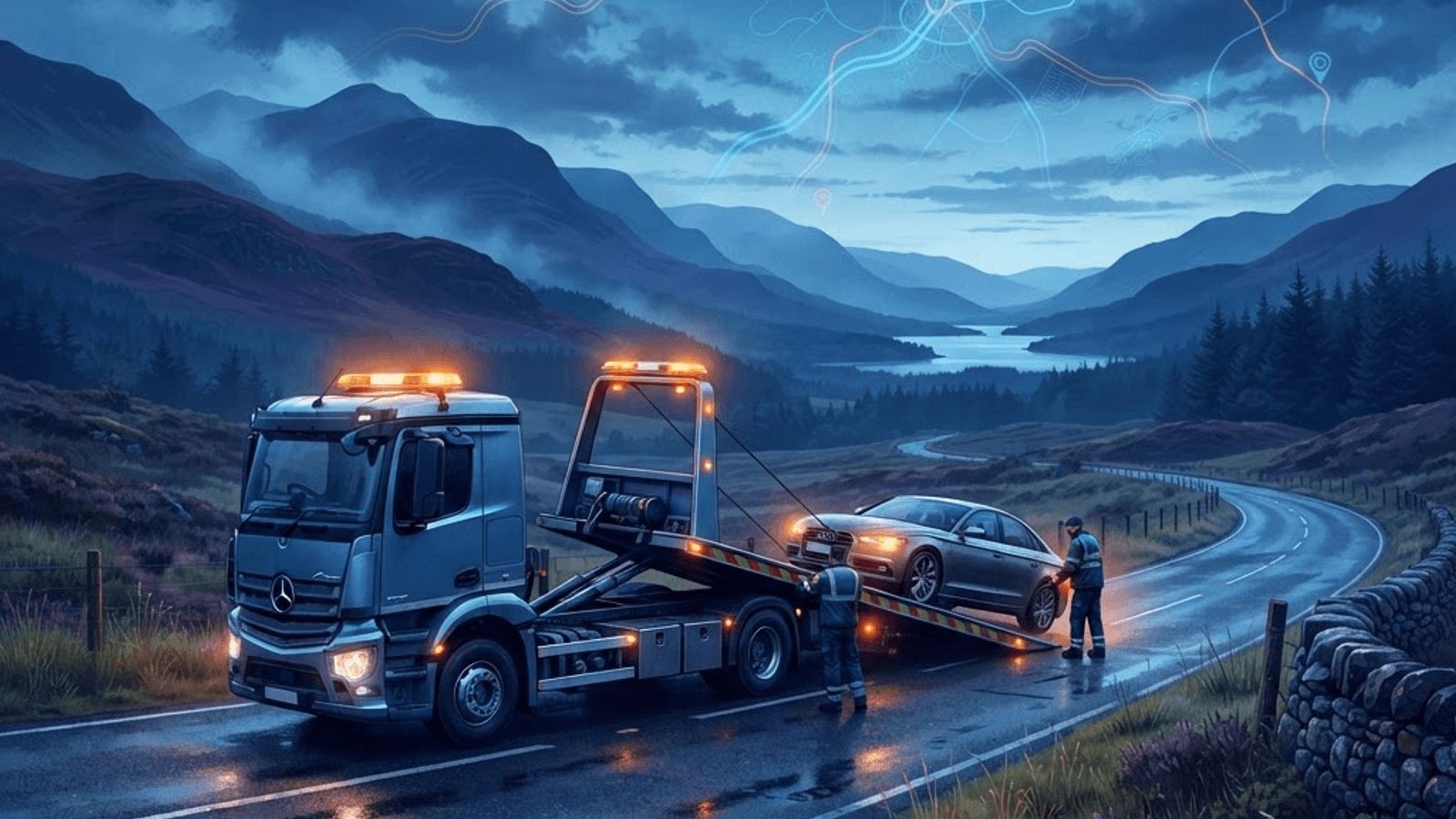
Why Recovery Matters in East Ayrshire
East Ayrshire's geography creates a particular set of breakdown challenges. The council area includes busy arterial routes such as the A77, A76 and A71, where a stranded vehicle is a genuine hazard, alongside long stretches of quiet rural road through the Doon Valley, around Muirkirk and across the moorland between Ayrshire and Lanarkshire where mobile signal can be patchy and traffic sparse.
Winter compounds this. Snow and ice on higher routes, early darkness, and the sheer distance from the nearest garage in some areas mean that a breakdown that would be a minor inconvenience in a city becomes a serious situation locally. Having a clear plan and a reliable recovery arrangement is therefore worth more here than in many parts of the country.
The Types of Recovery Provider
National roadside assistance organisations are the most familiar option. The AA, RAC and Green Flag operate nationwide patrol and contractor networks covering the whole of Ayrshire, with Start Rescue, Emergency Assist and Britannia Rescue offering comparable cover at varying price points. Their advantage is coverage and infrastructure: a single number, nationwide reach and the ability to recover you home from anywhere in the UK if you buy the appropriate tier.
Independent local recovery operators across Ayrshire work both directly for the public and as contractors to the national organisations. Many are family businesses running flatbed and spec-lift vehicles, with deep local knowledge of the road network, farm tracks and awkward access points. For incidents in remote parts of the region, a local operator who knows the ground often arrives faster than a distant contractor.
Garage-linked recovery is offered by numerous independent garages that operate their own recovery vehicle, collecting broken-down customer cars and returning them to the workshop. This joins recovery and repair into one conversation, which is convenient and usually cost-effective.
Manufacturer roadside assistance is included with most new vehicles for a defined period, and frequently extended when servicing is carried out within the franchised network. Owners often forget they have this cover and pay separately for something they already hold.
Specialist recovery covers heavier and more complex work: HGV and bus recovery for the region's haulage sector, agricultural and plant machinery recovery, motorcycle-specific transport, and low-loader movement of classic, modified and non-running vehicles.
Police-instructed and statutory recovery operates under contract to remove vehicles following collisions, obstructions or enforcement action. Release involves defined statutory fees and proof of ownership and insurance.
Understanding Levels of Cover
Roadside assistance policies vary enormously, and buyers frequently discover the gaps at the worst possible moment.
Roadside assistance is the base level, covering attendance and attempted repair at the scene, usually with a minimum distance from home before cover applies. Many policies exclude breakdowns at or near your own address entirely.
Home start removes that exclusion and covers breakdowns at home. Given how many failures are battery-related and occur on a cold morning on the driveway, this is often the most practically useful addition.
National recovery transports the vehicle, and usually its occupants, to any single destination in the UK when a roadside repair is not possible. Without this, you may be taken only to the nearest garage, which could be closed and far from home.
Onward travel provides a hire car, accommodation or public transport costs while the vehicle is repaired.
European cover extends protection abroad and is essential for anyone touring the continent.
Cover can be arranged as vehicle-based, which follows the car regardless of driver, or personal, which follows the individual into any vehicle they are driving or travelling in. Households with several cars and drivers should calculate carefully which structure is cheaper.
Choosing a Recovery Provider
Check response times honestly. Advertised averages reflect national performance, heavily weighted by urban areas. Ask specifically about rural Ayrshire coverage and how many patrols or contractors operate locally.
Confirm vehicle suitability. Low-slung, four-wheel-drive, automatic and electric vehicles frequently require flatbed transport rather than a conventional tow. Electric vehicles in particular must generally be moved on a flatbed to avoid drivetrain damage. Verify the provider has appropriate equipment.
Check limits. Many policies cap the number of callouts per year, exclude vehicles over a certain age, or exclude repeat callouts for the same unrepaired fault.
Verify insurance and licensing. Any operator carrying your vehicle should hold appropriate goods-in-transit and public liability insurance, and their vehicles should be correctly licensed and equipped with amber beacons.
What to Do When You Break Down
The first priority is always safety rather than the vehicle. If possible, move off the carriageway onto a verge or into a lay-by. Switch on hazard lights immediately. On a motorway or fast dual carriageway, occupants should normally leave the vehicle by the left-hand doors and move behind a barrier, away from traffic. On quiet rural roads, remaining in the vehicle with seatbelts fastened may be safer, particularly in poor weather or darkness.
Wear a high-visibility vest if you have one, and position a warning triangle well back where it is safe to do so, though not on a motorway. Note your location precisely using marker posts, road numbers, junction names or a smartphone location app, as this is the single biggest factor in how quickly help arrives in rural areas.
Preparing in Advance
A small amount of preparation prevents most serious difficulty. Keep a charged phone and a power bank in the car, along with a high-visibility vest, torch, warm layers, water and, in winter, a blanket and a shovel. Store your recovery provider's number offline rather than relying on an app that needs signal.
Test your battery before winter, since battery failure is the most common single cause of callouts. Check tyre condition and pressures monthly, and ensure you either have a serviceable spare and the tools to fit it, or understand how the tyre repair kit in your car works before you need it at the roadside.
Cost and Value
Paying for recovery at the point of need is considerably more expensive than holding a membership, particularly for long-distance transport. For drivers covering significant rural mileage across East Ayrshire, comprehensive cover including home start and national recovery is generally the sensible choice. Those with newer cars under manufacturer warranty should check what they already have before duplicating it, and households should compare the cost of individual policies against a single family or multi-car arrangement.
Want your brand featured in front of decision-makers? Publish a guest post or get a link insertion in our guides through AAMAX's guest post and link insertion service.
Helpful Links
 SponsoredAAMAX — Full-Service Digital Agency
Write for Us
Share your expertise with our readers. We welcome guest contributions from industry specialists.
Pitch your idea