

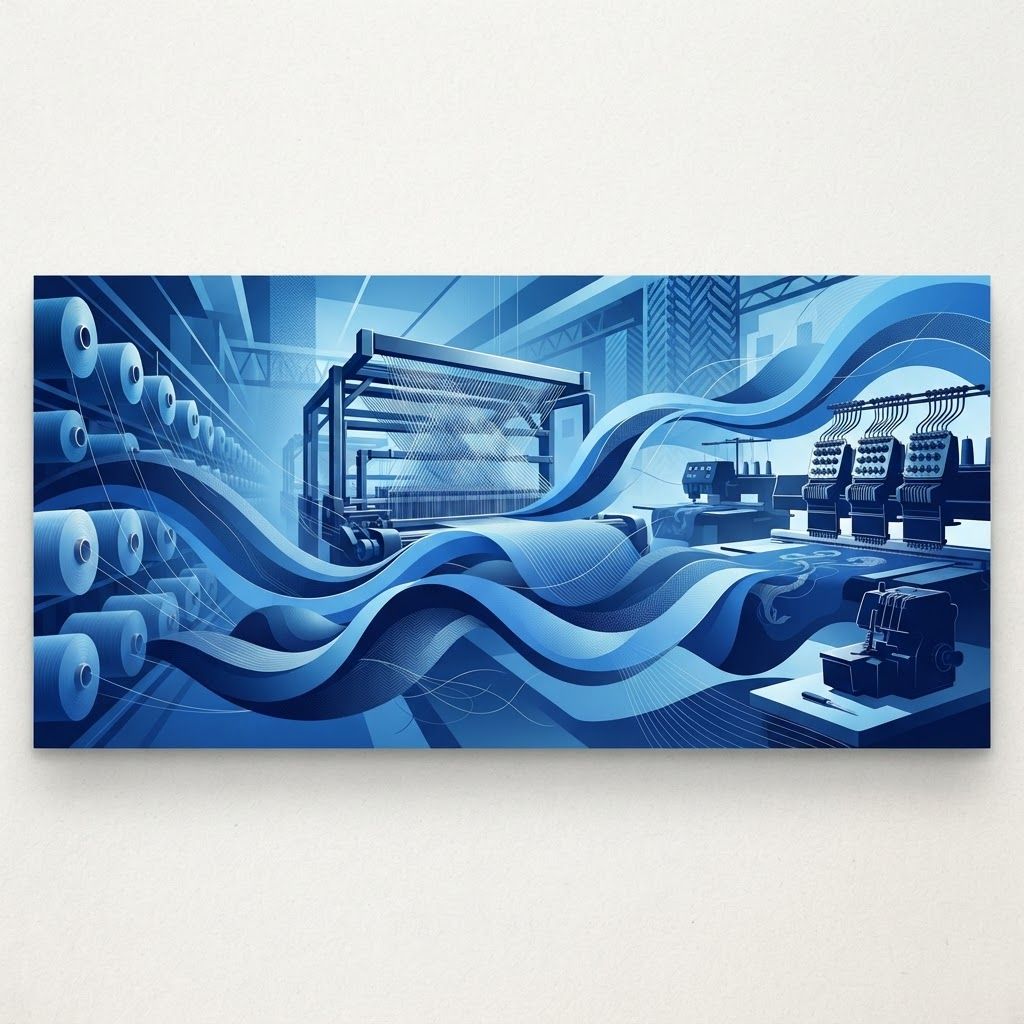
Textiles and Devon's Industrial Heritage
The South West once stood at the centre of England's woollen trade, and Devon's rivers powered fulling mills and weaving sheds for centuries. Teignbridge sits within that historical landscape, and although the industry contracted sharply during the twentieth century, textile manufacturing has not disappeared. Instead it has specialised. The surviving and newly established producers in the district tend to occupy defensible niches: technical and performance fabrics, marine and outdoor textiles, heritage weaving, interior furnishings, workwear and small-batch clothing production for brands that value traceability.
Several factors support this. The district has affordable industrial space at Heathfield and around Newton Abbot, proximity to a strong marine and outdoor products cluster across South Devon, good access to the M5 corridor for distribution, and a workforce with craft and engineering skills. There is also growing customer demand for locally made goods with transparent supply chains, which favours producers who can demonstrate exactly where and how a product was made.
Ten Textile Manufacturers Serving Teignbridge
Teign Valley Weaving Company produces woven wool and wool-blend cloth for interiors, throws, upholstery and apparel. It combines traditional loom work with modern finishing, supplying designers and heritage brands that require authentic construction and small minimum runs.
Estuary Marine Textiles manufactures covers, sail repairs, upholstery and protective fabrics for the boating sector along the Teign estuary and wider South Devon coast, using UV-stable and waterproof technical materials engineered for saltwater exposure.
Haldon Technical Fabrics focuses on performance and industrial textiles including coated fabrics, filtration media, geotextiles and engineered laminates supplied to manufacturers rather than consumers.
Newton Abbot Garment Works operates as a cut-and-sew production unit for clothing brands, offering pattern making, sampling, grading and small to medium production runs with full traceability for labels that market British manufacture.
Moorland Wool Processing works with fleece from Dartmoor and surrounding farms, handling scouring, carding, spinning and yarn production, and supplying knitters, weavers and craft producers with locally sourced natural fibre.
Riviera Interior Furnishings manufactures curtains, blinds, cushions and soft furnishings for hospitality and residential clients, with contract capability for hotels and holiday accommodation refurbishing in bulk.
Coastway Workwear Manufacturing produces durable workwear, high-visibility garments and uniform items for construction, agriculture, marine and service sector employers, including embroidery and heat-applied branding.
Chudleigh Knitwear Studio specialises in knitted garments and accessories using both hand-frame and computerised knitting, serving fashion labels and heritage brands with seamless and fully fashioned pieces.
Shaldon Print and Dye House provides digital fabric printing, screen printing and dyeing services, enabling designers to produce bespoke patterns and colourways in short runs without overseas minimums.
Dartmoor Sustainable Fibres develops and supplies fabrics from recycled, organic and low-impact fibres, working with brands that need documented environmental credentials for their supply chain.
Market Trends Reshaping Textile Production
Sustainability has moved from marketing claim to procurement requirement. Brands now ask suppliers for fibre provenance, water and energy data, chemical compliance documentation and end-of-life considerations. This favours smaller domestic manufacturers who can trace materials precisely and demonstrate short supply chains, which is a genuine competitive advantage for Teignbridge producers against high-volume overseas competition.
Reshoring is the second trend. Extended shipping times, freight cost volatility and quality control difficulties have persuaded some brands to move a portion of production back to the United Kingdom, particularly for premium lines, rapid replenishment and sampling. Domestic producers cannot compete on unit price for basic goods, but they win on speed, flexibility and reduced inventory risk.
Technical textiles represent the strongest growth area. Materials engineered for filtration, protection, medical use, construction and marine applications carry higher margins and depend on process expertise rather than labour cost, making them well suited to a high-wage economy.
Circularity is emerging more slowly but steadily, with repair services, take-back schemes, recycled fibre inputs and design for disassembly appearing in specifications, particularly for contract and workwear customers.
Challenges Facing Local Manufacturers
Skills are the most cited difficulty. Machinists, technicians and loom engineers are an ageing workforce, and formal training routes contracted along with the industry. Several producers now run internal apprenticeship arrangements because external provision is limited.
Energy cost is a serious pressure for wet processing, dyeing and finishing operations, which are inherently intensive. This has driven investment in heat recovery, efficient boilers and on-site renewable generation.
Access to finance for capital equipment is a further constraint, since modern knitting, weaving and printing machinery carries substantial cost and lenders have limited familiarity with the sector.
Working With a Textile Manufacturer
Prepare a clear technical specification. Fibre composition, weight, construction, finish, colour standards, shrinkage tolerance and testing requirements should all be defined before sampling, because ambiguity at this stage is the main cause of production disputes.
Understand minimums realistically. Small-batch producers offer flexibility but at higher unit cost, and dyeing in particular has practical minimum batch sizes that affect pricing.
Allow time for sampling and approval. A proper development cycle includes a first prototype, a corrected sample, a pre-production sample and bulk approval, and compressing it usually produces expensive mistakes.
Finally, visit. Textile quality is a tactile judgement, and the ability to walk a factory floor in Newton Abbot or the Teign valley, handle the cloth and speak to the people making it remains the strongest argument for manufacturing locally.
Want your brand featured in front of decision-makers? Publish a guest post or get a link insertion in our guides through AAMAX's guest post and link insertion service.
Helpful Links
 SponsoredAAMAX — Full-Service Digital Agency
Write for Us
Share your expertise with our readers. We welcome guest contributions from industry specialists.
Pitch your idea

