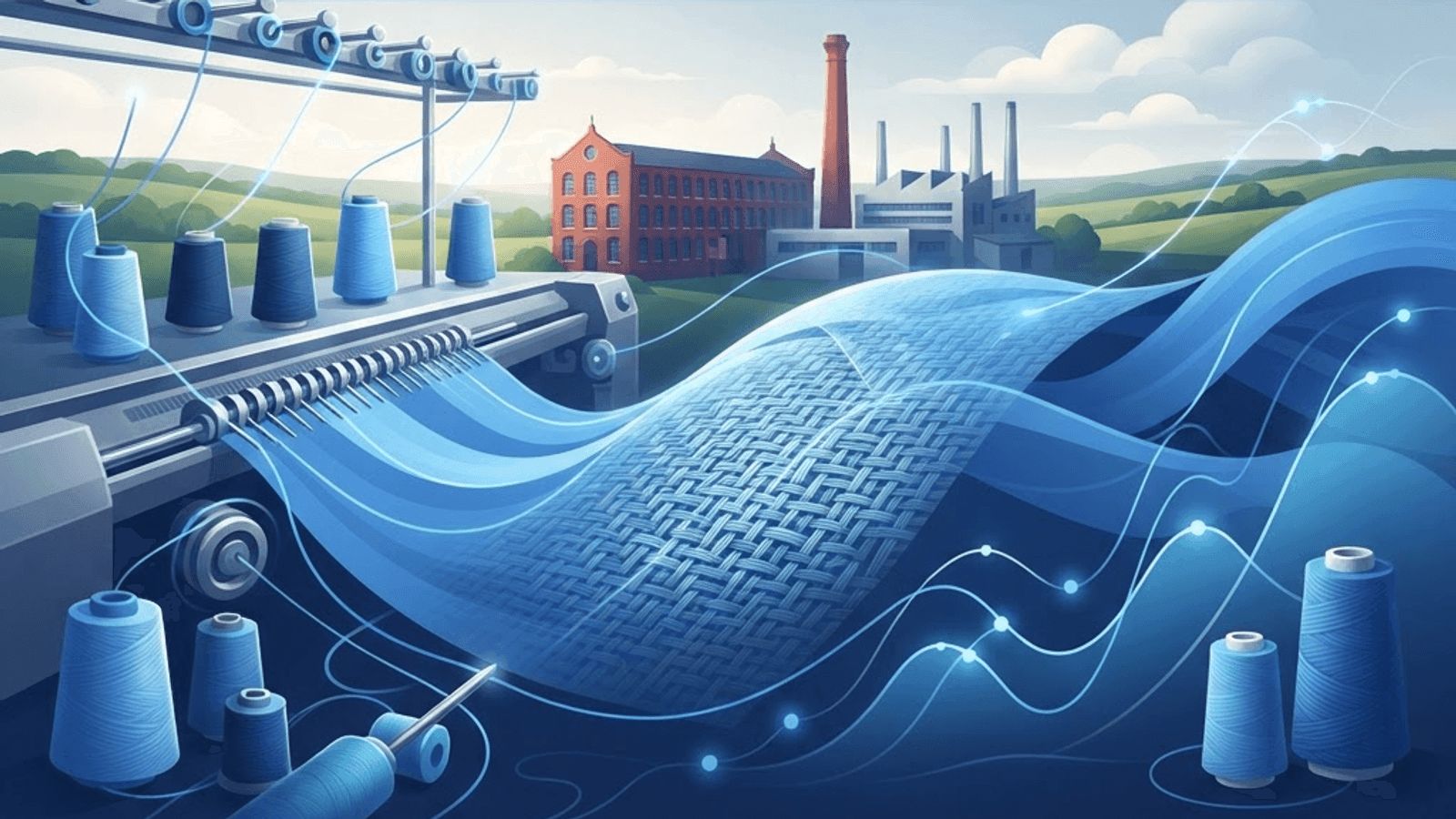
A Heritage Industry Finding a New Role
Leicestershire's association with textiles stretches back centuries. The county became a centre of hosiery and knitwear production during the industrial revolution, and framework knitting shaped the economy of towns and villages across the region long before the coal mines reached their peak. While the county's textile employment contracted sharply through the late twentieth century as production shifted overseas, it never disappeared entirely, and North West Leicestershire retains a working base of manufacturers operating in areas where proximity, speed and technical capability outweigh raw labour cost.
What survives is different from what existed before. The volume commodity garment production that once dominated has largely gone. In its place sit technical textiles for industrial applications, workwear and personal protective clothing, short-run and rapid-response fashion manufacturing, specialist knitwear, and contract production for brands that have deliberately reshored parts of their supply chain.
Why Local Manufacturing Is Returning
Several forces have improved the case for domestic textile production. Extended global supply chains proved fragile during recent disruptions, and brands discovered that long lead times and container-level minimum orders left them holding unsellable stock or missing demand entirely. Domestic production allows smaller, more frequent orders, faster replenishment of successful lines and dramatically reduced working capital tied up in inventory.
Sustainability reporting has reinforced the trend. Shorter supply chains produce lower transport emissions and, more importantly, allow genuine visibility of labour conditions and material provenance. Brands facing due diligence obligations find it substantially easier to audit a factory forty miles away than one on another continent.
The district's logistics advantages apply here too. A manufacturer in Coalville or Measham can reach distribution centres across the Midlands within an hour and most of the country within a working day.
The Top 10 Textile Manufacturers in North West Leicestershire
1. Forest Knitwear Group produces fine-gauge and chunky knitwear on computerised flat-bed machinery, serving fashion brands requiring short runs, rapid sampling and the ability to repeat successful styles within weeks rather than months.
2. Bardon Technical Textiles manufactures industrial fabrics for filtration, geotextile, acoustic and protective applications, supplying construction, quarrying and manufacturing customers with materials engineered to specified performance criteria.
3. Coalville Workwear Manufacturing specialises in durable workwear and high-visibility clothing, producing garments certified to relevant protective standards for construction, logistics and utilities employers.
4. Ashby Garment Studio operates as a full-package clothing manufacturer, handling pattern cutting, grading, sampling, production and finishing for emerging and established fashion labels.
5. Measham Dyeing and Finishing provides commission dyeing, printing, coating and finishing services to other manufacturers, with water treatment and chemical management systems designed around current environmental requirements.
6. National Forest Natural Fibres focuses on organic cotton, wool, linen and regenerated cellulosic fabrics, working with brands that require certified material provenance throughout the chain.
7. Ibstock Narrow Fabrics manufactures webbing, tapes, elastics and braided components for automotive, medical, safety harness and furniture applications, where dimensional consistency and breaking strain are critical.
8. Whitwick Home Textiles produces soft furnishings, curtains, cushions and contract textiles for hospitality and residential developers, including flame-retardant treatments required in commercial settings.
9. Kegworth Composite Fabrics supplies reinforcement fabrics and preforms for composite manufacturing, serving automotive, aerospace and sporting goods producers with glass, carbon and aramid materials.
10. Ivanhoe Textile Services offers testing, certification support, technical consultancy and production planning assistance to manufacturers and brands, bridging the gap between design intent and manufacturable specification.
Technology on the Factory Floor
Modern textile manufacturing bears little resemblance to its historical image. Computerised flat-bed knitting machines produce complete garment panels, and whole-garment technology can knit a finished item with minimal cutting and sewing, eliminating waste and labour. Digital textile printing allows short-run and personalised designs without screen preparation, transforming the economics of small batches. Automated cutting systems optimise fabric utilisation across markers, reducing material waste that historically ran into double-digit percentages.
Product lifecycle management and three-dimensional sampling software allow brands to review virtual samples before any physical production, compressing development timelines considerably and reducing the environmental cost of sampling.
Ethical and Environmental Compliance
The textile sector has faced justified scrutiny over labour practices, and Leicestershire specifically attracted attention during earlier investigations into garment manufacturing conditions. The industry's response in the region has included significantly increased auditing, greater buyer accountability and closer engagement with enforcement agencies on pay and working conditions.
Buyers sourcing locally should nonetheless conduct proper due diligence rather than assuming domestic production guarantees compliance. Verify payment of at least the national minimum wage through payroll evidence, confirm working time records, check subcontracting arrangements since unauthorised subcontracting is where most problems originate, and seek recognised third-party social audit certification. Environmental compliance around water discharge, chemical handling and waste is equally worth confirming, particularly with dyeing and finishing operations.
Working Effectively with a Manufacturer
Successful manufacturing relationships depend on specification quality. Provide complete technical packs including measurements, tolerances, construction details, trims, labelling and packing requirements. Agree quality standards and acceptable defect levels in writing before production. Understand minimum order quantities, which exist because machine setup costs must be amortised, and discuss whether fabric minimums or production minimums are the binding constraint.
Lead times should be discussed realistically, accounting for yarn or fabric procurement, which is frequently the longest element. Building buffer into launch dates avoids the air-freight costs and quality compromises that rushed production invites.
Final Thoughts
Textile manufacturing in North West Leicestershire has evolved from a volume industry into a capability-led one, competing on speed, technical performance, flexibility and transparency rather than price. For brands rethinking supply chain resilience, or for industrial buyers needing engineered fabrics, the district offers genuine capacity backed by generations of accumulated skill. Specify thoroughly, audit properly, and treat manufacturers as development partners rather than interchangeable vendors.
Want your brand featured in front of decision-makers? Publish a guest post or get a link insertion in our guides through AAMAX's guest post and link insertion service.
Helpful Links
 SponsoredAAMAX — Full-Service Digital Agency
Write for Us
Share your expertise with our readers. We welcome guest contributions from industry specialists.
Pitch your idea