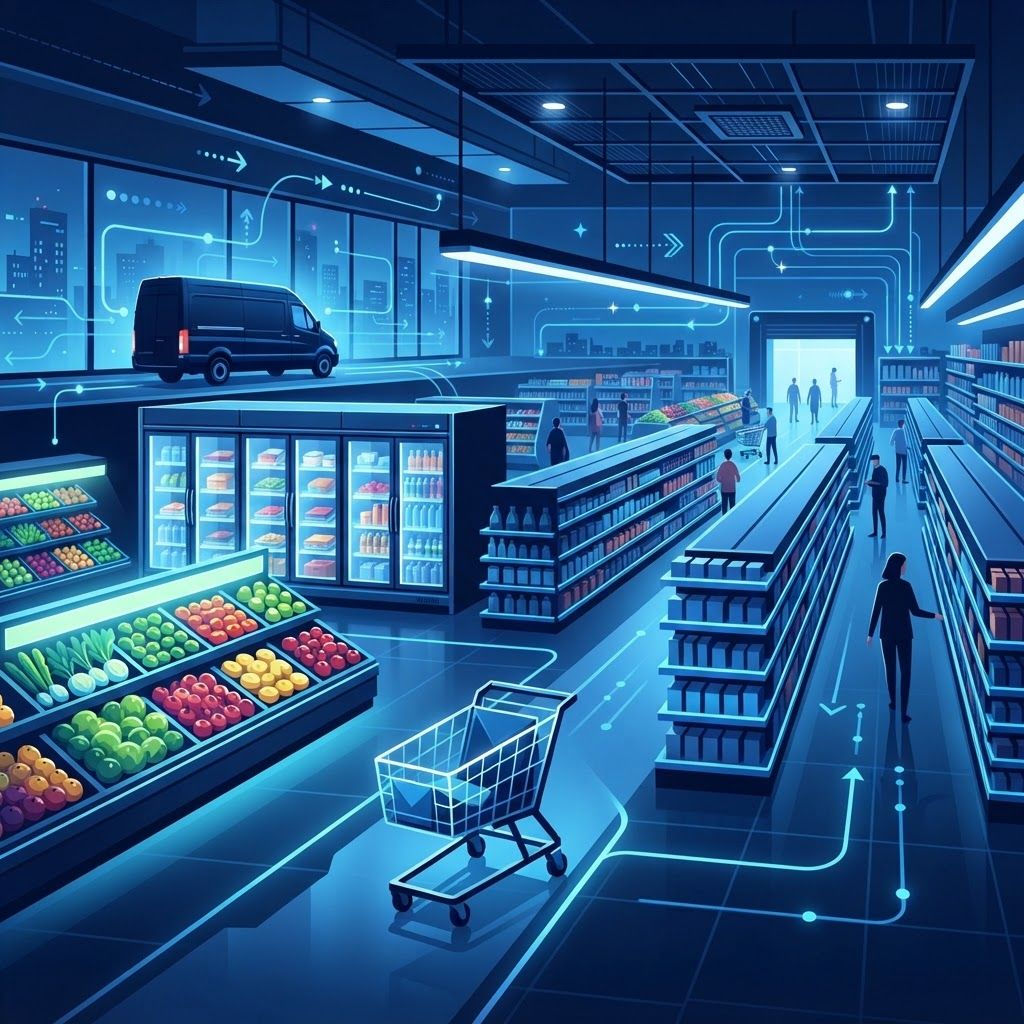
Grocery Shopping Across Huntingdonshire
Huntingdonshire's grocery provision is genuinely comprehensive for a largely rural district. Huntingdon and St Neots both support large superstores with extensive ranges and parking, while St Ives, Ramsey and Sawtry are served by mid-sized supermarkets and convenience formats. Village communities rely on smaller branches, local shops and increasingly on home delivery, which has expanded considerably across the district's postcodes.
Shopping behaviour has changed markedly in recent years. Household budget pressure has driven growth in discount retailers and own-label purchasing. Many households now split their shopping deliberately, using a discounter for staples, a superstore for branded items and specialist ranges, and convenience branches for top-up visits. Understanding where each chain genuinely excels makes that strategy considerably more effective.
Understanding Supermarket Formats
Superstores carry the widest ranges, including non-food, fresh counters, bakery, pharmacy and world food aisles. Discounters operate limited, carefully chosen ranges with high own-label share and streamlined logistics, keeping prices low. Convenience formats trade range for accessibility and longer hours, generally at higher unit prices. Premium grocers focus on product quality, provenance and prepared food. Online delivery and click-and-collect operate across most chains and can substantially reduce impulse spending.
The Top 10 Supermarket Chains in Huntingdonshire
1. Tesco
The broadest presence across the district, spanning large Extra-style superstores through to Express convenience branches. Range depth is the standout attribute, covering everything from budget own-label to premium lines, free-from, world foods and non-food. The Clubcard scheme delivers meaningful price differences on a large proportion of items, and delivery slot availability is generally strong.
2. Sainsbury's
Well regarded for fresh produce quality, bakery and its premium own-label ranges, with a clear commitment to sourcing standards. Nectar pricing offers substantial member savings, and the stores tend to feel calmer and better organised than the average, which matters on a large weekly shop.
3. Aldi
A discounter with an outstanding value reputation, built on a deliberately limited range with very high own-label share. Fresh produce, dairy, bakery and store-cupboard staples represent particularly strong value, and the rotating middle-aisle non-food offers have become a genuine draw. Range limitations mean most households pair Aldi with a second retailer.
4. Lidl
Similar discount model with notable strengths in bakery, meat, fish and its regularly changing themed weeks featuring European foods. The in-store bakery is widely rated, and value on fresh items is consistently competitive. Loyalty app offers add further savings for regular shoppers.
5. Morrisons
Distinguished by its fresh food counters, including butchery, fishmongery and bakery, with a strong vertically integrated supply chain. Good choice for customers who want specific cuts, larger fresh purchases or counter service rather than pre-packed only, and its prepared food ranges are well regarded.
6. Asda
Positioned strongly on everyday low pricing across a broad range, with substantial non-food, clothing and household sections. Large-format stores suit bulk family shopping, and price consistency is valued by budget-conscious households who prefer predictability to promotional cycles.
7. Co-op
An extensive convenience presence including village and smaller-town locations where larger stores are absent. Community focus, local sourcing initiatives and member benefits distinguish the offer, and for rural residents the accessibility is genuinely important rather than merely convenient.
8. Waitrose
A premium grocer emphasising product quality, sourcing standards, animal welfare and prepared foods. Strong fresh produce, fish, cheese and bakery ranges, along with well-developed free-from and vegetarian options, appeal to shoppers prioritising quality over lowest price.
9. Marks & Spencer Food
Focused almost entirely on food quality, with particular strengths in ready meals, prepared salads, desserts, party food and seasonal ranges. Widely used for convenience meals and entertaining rather than complete weekly shopping, and the product development is consistently ahead of most competitors.
10. Iceland
Frozen food specialists offering strong value on frozen staples, ready meals and branded frozen lines. Frozen purchasing reduces household food waste significantly and helps manage budgets predictably, which has made Iceland increasingly relevant for cost-conscious families.
Trends in Grocery Retail
Own-label share has grown substantially as quality has improved and price sensitivity increased, with many shoppers no longer distinguishing meaningfully between own-label and brand on staples. Loyalty-based pricing has become a major competitive tool, effectively creating two price tiers in store. Online delivery and rapid convenience delivery continue expanding, particularly valuable in rural parts of the district. Sustainability initiatives include packaging reduction, refill trials, food waste redistribution and clearer sourcing information. Plant-based and free-from ranges have matured from niche to standard shelf space.
How to Shop More Efficiently
Split your shopping deliberately, using a discounter for staples and a superstore for specialist items rather than expecting one retailer to serve every need. Use loyalty schemes, since member pricing now accounts for a large share of available savings. Compare unit pricing rather than pack price, as larger packs are not always better value. Plan meals before shopping to reduce both waste and impulse purchasing. Use frozen ranges to extend shelf life on items you use irregularly. Consider online ordering if you find in-store promotions difficult to resist, as basket totals are visible throughout. Finally, shop late in the day for reduced fresh items if your routine allows.
Final Thoughts
Huntingdonshire residents benefit from access to every major grocery format, from deep-range superstores to efficient discounters and quality-led premium grocers. Matching each retailer to what it genuinely does best, and using loyalty pricing properly, delivers noticeably better value than loyalty to a single chain.
Want your brand featured in front of decision-makers? Publish a guest post or get a link insertion in our guides through AAMAX's guest post and link insertion service.
Helpful Links
 SponsoredAAMAX — Full-Service Digital Agency
Write for Us
Share your expertise with our readers. We welcome guest contributions from industry specialists.
Pitch your idea