

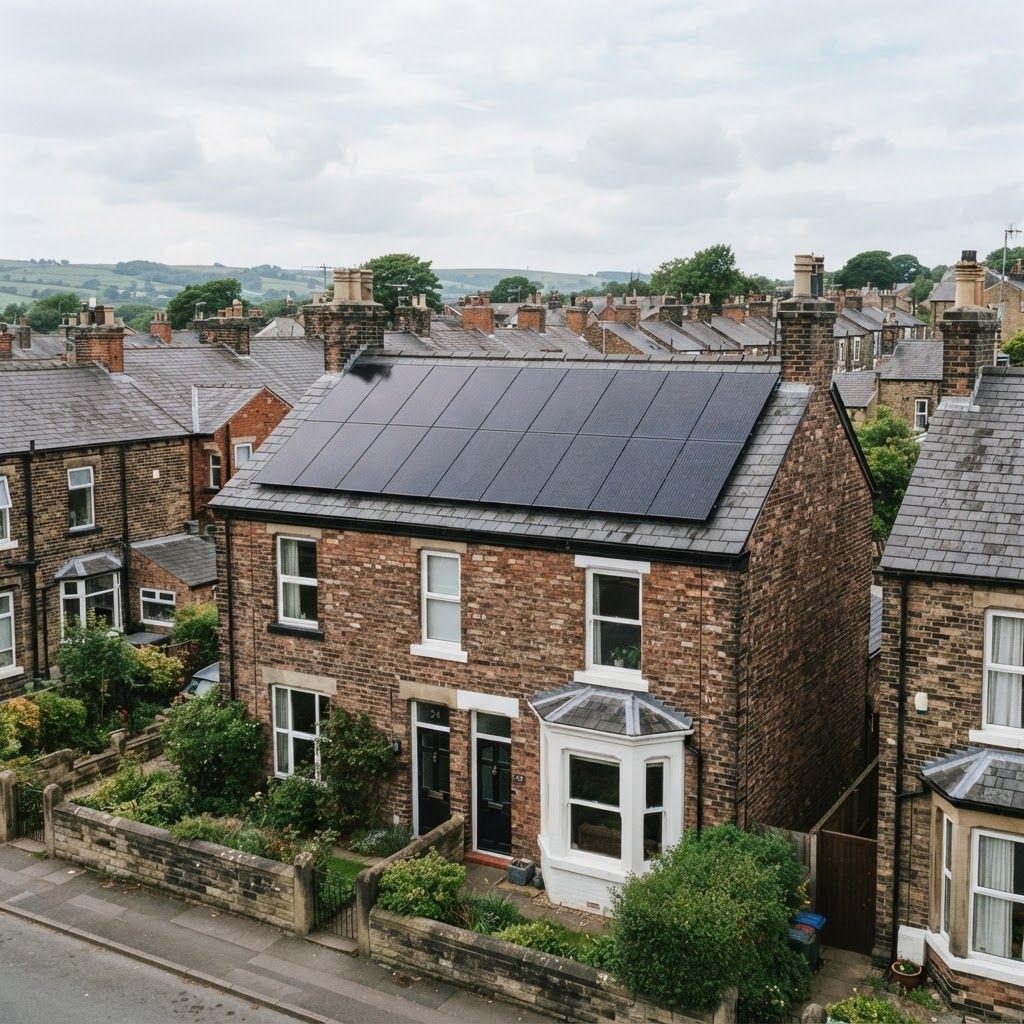
Why Solar Works in York Despite the Yorkshire Weather
The most persistent misconception about solar energy in northern England is that insufficient sunshine makes it unviable. This misunderstands the technology. Photovoltaic panels generate from daylight rather than direct sunshine, and they operate more efficiently at lower temperatures. York receives sufficient annual irradiance for solar to produce a strong financial return, and the difference in output between York and southern England is far smaller than most people assume, typically a modest percentage rather than a fundamental barrier.
What has genuinely transformed the economics is cost. Panel prices have fallen dramatically over the past decade while electricity prices have risen substantially. The result is that self-consumed solar generation now displaces grid electricity at a fraction of its cost, producing payback periods that make solar one of the more attractive capital investments available to a York household or business, particularly for organisations with significant daytime consumption.
How Solar Systems Are Configured
A typical installation comprises panels, mounting structure, an inverter converting direct current to alternating current, protection and isolation equipment, metering and monitoring, and increasingly a battery. Panel orientation and pitch affect output, with south-facing roofs producing most but east-west configurations generating a flatter profile across the day that often matches consumption better. Shading is the most damaging factor, and even partial shading from chimneys, trees or adjacent buildings can disproportionately reduce output unless mitigated through panel-level optimisation.
1. Accredited Domestic Solar Installers in York
York and the surrounding villages are served by accredited installers specialising in residential rooftop systems. Reputable providers conduct a physical survey rather than quoting from aerial imagery, assess roof condition and structural capacity, review historic consumption, and model output and financial return using conservative assumptions. Accreditation under the recognised microgeneration scheme is essential, as it is generally required for export payment eligibility and provides consumer protection.
2. Commercial and Industrial Solar Specialists
Businesses across York with substantial roof area, including warehouses, manufacturing units, retail premises and agricultural buildings, are served by commercial solar specialists. Commercial projects differ meaningfully from domestic work, requiring structural engineering assessment, three-phase electrical design, half-hourly consumption analysis, grid connection applications and consideration of capital allowances. Returns are frequently strong because commercial demand aligns closely with generation.
3. Solar and Battery Storage Integrators
Providers combining solar with battery storage address solar's principal limitation, which is that generation peaks in the middle of the day while household demand peaks in the evening. Batteries store surplus for later use, substantially increasing the proportion of generation consumed on site and thereby improving returns. Integrators also configure systems to charge from cheap off-peak tariffs, which adds further value independent of solar output.
4. Agricultural and Ground-Mounted Solar Developers
The farmland around York supports ground-mounted solar on land of lower agricultural value, either serving on-site demand for irrigation, grain drying, refrigeration or dairy operations, or exporting to the grid. Developers manage planning, grid connection and construction. Landowners considering long-term leases should take independent professional advice on lease terms, decommissioning obligations and the interaction with agricultural property tax reliefs.
5. Solar Thermal and Hot Water Specialists
Distinct from photovoltaics, solar thermal collectors heat water directly and can be efficient where hot water demand is high and consistent. Providers serving York install these systems for properties, hotels, care homes and leisure facilities. Photovoltaic systems have become more popular because of falling costs and greater flexibility, but solar thermal retains a role in specific high hot water demand applications.
6. Solar Design and Feasibility Consultants
Independent consultants provide feasibility studies, output modelling, financial appraisal and specification writing without selling equipment. For larger projects this independence is valuable, ensuring the design serves the client's consumption profile rather than the installer's preferred product range. Consultants also manage tender processes and verify that delivered systems match specification.
7. Solar Operations, Maintenance and Monitoring Providers
Solar systems are low maintenance but not maintenance free. Inverters have shorter lifespans than panels, connections degrade, monitoring fails silently and soiling reduces output. Maintenance providers serving York offer inspection, cleaning, electrical testing, inverter replacement and performance monitoring with alerting. Many underperforming systems in the region simply have an undetected fault, which routine monitoring would have identified within days.
8. Roofing Contractors Working With Solar Installations
Because solar arrays are expected to remain in place for twenty-five years or more, roof condition is a critical prerequisite. Roofing contractors around York work alongside solar installers to assess and where necessary repair or replace coverings before installation, and to handle integrated in-roof systems that sit flush with tiles. This is especially relevant in York given the age of much of the housing stock and the constraints applying in conservation areas.
9. Electrical Contractors and Grid Connection Specialists
Qualified electrical contractors handle the connection, protection, metering and certification work that solar installation requires, and manage applications to the network operator for connection approval. Grid capacity constraints affect parts of North Yorkshire, and larger installations may face export limitation or connection costs, so early engagement with a specialist prevents unwelcome discoveries after equipment has been ordered.
10. Community Solar Projects in the York Area
Community energy organisations in York develop solar installations on schools, community centres, sports facilities and other public buildings, funded through community share offers and reinvesting surpluses locally. For organisations lacking capital, these arrangements can deliver reduced electricity costs without upfront investment, while keeping ownership and benefit within the local area.
Specifying a System Properly
Provide installers with at least twelve months of consumption data, ideally half-hourly for commercial sites. Size the array to on-site consumption rather than maximum roof coverage, since exported electricity earns considerably less than self-consumed generation displaces. Insist on shading analysis and, where shading exists, panel-level optimisation. Compare inverter and panel warranties, which vary widely. Verify that quoted output figures use realistic irradiance data for the York area rather than optimistic national averages.
Costs, Returns and Planning
Domestic systems vary in cost with size, roof complexity and whether a battery is included, and typical payback periods have shortened considerably as electricity prices have risen. Commercial systems benefit from economies of scale and capital allowances. Most domestic rooftop solar falls within permitted development, but listed buildings and conservation areas in York require careful attention and often formal consent, so early consultation with the local authority is sensible. Export payments differ significantly between energy suppliers and should be compared as part of the overall financial case.
Making a Sound Decision
Solar in York is a well-proven, low-risk investment when properly specified and installed by an accredited provider. The failures that occur are almost always attributable to poor design, unrealistic projections or inadequate installation rather than to the technology or the climate. Obtain multiple detailed quotations, check references for comparable local installations, understand exactly what is guaranteed and for how long, and prioritise design competence over headline price. Systems chosen on that basis reliably deliver decades of reduced energy cost.
Want your brand featured in front of decision-makers? Publish a guest post or get a link insertion in our guides through AAMAX's guest post and link insertion service.
Helpful Links
 SponsoredAAMAX — Full-Service Digital Agency
Write for Us
Share your expertise with our readers. We welcome guest contributions from industry specialists.
Pitch your idea

