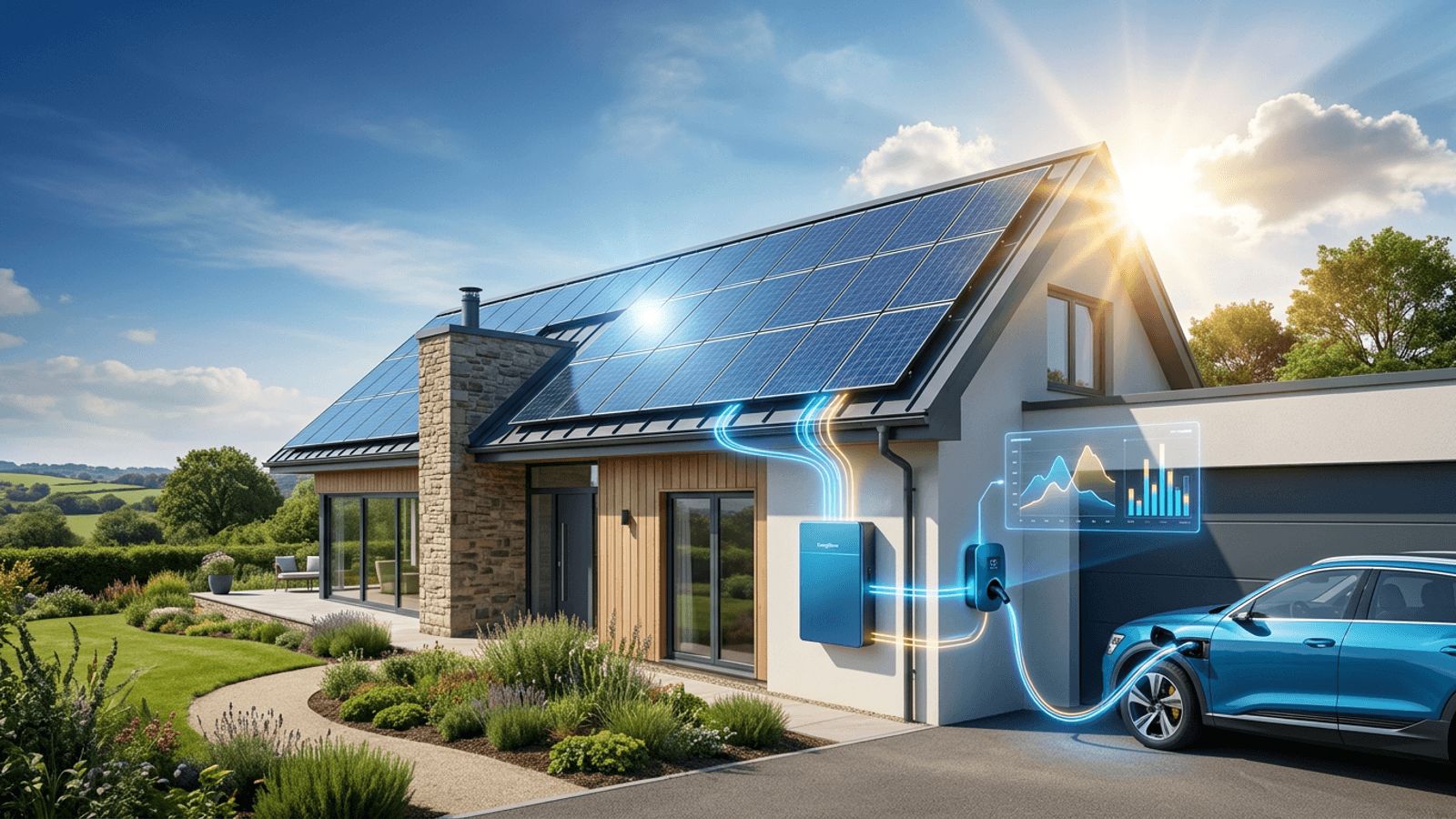
Does Solar Really Work in Stockton-on-Tees?
It is the first question almost every homeowner in the borough asks, and the answer is more encouraging than local weather folklore suggests. Photovoltaic panels generate electricity from daylight rather than direct heat, and they actually operate slightly more efficiently at cooler temperatures. Northern England receives less annual irradiance than the south coast, but the difference is a modest reduction in output, not a fundamental obstacle. A well-oriented roof in Stockton, Thornaby, Norton, Billingham or Yarm can produce a substantial share of a household's annual electricity demand.
What has genuinely changed the economics is not sunshine but price. Electricity costs have risen and remain volatile, panel and inverter hardware has become significantly cheaper, and battery storage has matured to the point where households and businesses can shift daytime generation into evening use. The result is that solar in the North East is now judged the same way as any other capital investment: by payback, by risk, and by the quality of the installer.
What a Good Solar Installation Involves
- Site survey and shading analysis. Roof pitch, orientation, structural condition and shading from chimneys, trees and neighbouring buildings.
- Correct sizing. Array capacity matched to actual consumption patterns rather than simply filling available roof space.
- Quality components. Panels, inverters, mounting systems and isolators with meaningful warranties and available spares.
- Battery consideration. Storage sized to evening load, not to marketing headlines.
- Electrical compliance and grid notification. Proper certification and network operator approval for export.
- Monitoring. Visibility of generation and consumption so problems are noticed rather than silently tolerated.
- Aftercare. Warranty administration, performance checks and a clear route to support.
Top 10 Best Solar Energy Companies in Stockton-on-Tees
1. Tees Valley Solar
A well-established domestic and commercial installer with a reputation for realistic projections. Tees Valley Solar bases quotations on measured consumption data and shading surveys rather than generic estimates, and will advise against installation where a roof genuinely does not suit. Customers consistently highlight tidy installations, thorough handover and responsive aftercare.
2. Riverside Solar and Battery
Specialists in combined photovoltaic and storage systems, Riverside focuses on maximising self-consumption so that generated electricity is used at home rather than exported cheaply. The team models different battery capacities against actual half-hourly usage and pairs systems with time-of-use tariffs, which frequently improves returns more than adding extra panels would.
3. Northgate Commercial Solar
An engineering-led contractor delivering large rooftop and ground-mounted arrays for warehouses, factories and public buildings across the Tees Valley. Northgate handles structural assessment, grid connection applications, half-hourly load modelling and phased installation around continuous operations, making it a natural fit for industrial sites on Preston Farm and beyond.
4. Castlegate Renewables
Castlegate offers whole-house energy packages combining solar, battery storage, air source heat pumps and electric vehicle charging under a single design. Its sequencing advice is a genuine differentiator: addressing insulation and consumption before sizing generation avoids the common mistake of installing a large system to power an inefficient home.
5. Thornaby Solar Installations
A local installer serving domestic customers with a straightforward, no-pressure sales approach. Thornaby is known for detailed written quotations that separate hardware, labour, scaffolding and certification costs, so homeowners can compare like with like across competing bids rather than guessing what a headline figure includes.
6. Billingham Energy Systems
Billingham combines electrical contracting depth with solar capability, which makes it well suited to properties needing distribution board upgrades, three-phase supplies or complex cable routing. The firm also handles retrofit repairs and inverter replacements on older arrays installed by companies no longer trading, a service in growing demand.
7. Teesmouth Solar Group
Working with landlords, housing providers and commercial portfolios, Teesmouth manages multi-property rollouts including surveying, tenant liaison, scheduling and consolidated reporting. Its process discipline suits organisations that need dozens of installations delivered predictably rather than a single bespoke project.
8. Yarm Solar and Roofing
An installer with genuine roofing expertise as well as electrical capability, Yarm addresses the underlying fabric before mounting anything on it. Combining necessary roof repairs or re-covering with panel installation saves scaffolding costs twice and avoids the awkward scenario of a new array sitting on a roof due for replacement.
9. Wynyard Solar Consultancy
An independent advisory practice that does not install, offering feasibility studies, tender specification, quotation review and post-installation performance auditing. For larger commercial schemes, having an impartial party write the specification and check the numbers frequently pays for itself several times over in improved pricing and avoided mistakes.
10. Norton Clean Power
A maintenance and monitoring specialist covering panel cleaning, inverter servicing, fault diagnosis, performance analysis and warranty claim support. As the local installed base ages, this kind of ongoing care matters increasingly: an unnoticed inverter fault or string failure can quietly erode returns for years before anyone investigates.
Understanding Costs, Savings and Payback
A typical domestic system in the borough involves upfront capital for panels, inverter, mounting, scaffolding, electrical work and certification, with batteries adding a substantial further cost. Savings arrive through two routes: electricity you no longer buy, and payment for exported electricity under a supplier export arrangement. Self-consumption is worth considerably more than export, which is why sizing and storage decisions matter so much. Households at home during the day, or with electric vehicles and heat pumps shifting load, achieve materially better returns than those consuming almost nothing between nine and five.
Be sceptical of quotations promising unusually short payback. Credible modelling includes panel degradation over time, inverter replacement partway through system life, realistic irradiance for the North East and honest assumptions about future electricity prices. Ask any installer to show the assumptions behind their figures.
Questions to Ask Before You Sign
Check certification under recognised installer schemes and confirm insurance-backed warranties. Ask who performs the installation, employed staff or subcontractors, and who you contact if a fault appears in year three. Request the specific make and model of panels, inverter and battery, along with warranty terms for each. Confirm that scaffolding, grid notification, certification and any necessary electrical upgrades are included in the price. Establish whether planning permission is required, which is unusual for standard domestic roof installations but can apply to listed buildings, conservation areas and ground-mounted schemes. Finally, ask for references from installations completed two or more years ago, because early enthusiasm tells you less than sustained performance.
Trends Worth Knowing
Battery adoption is rising sharply as time-of-use tariffs reward households that can charge cheaply overnight and discharge at peak. Electric vehicles are reshaping the calculation by adding large, flexible daytime load that solar can serve directly. Smart control platforms increasingly coordinate panels, batteries, heat pumps and chargers as one system rather than four separate purchases. And commercially, self-consumption on industrial rooftops has become one of the most reliable decarbonisation investments available, particularly for sites with strong daytime demand.
Final Thoughts
Solar power in Stockton-on-Tees has moved from novelty to sensible infrastructure. The borough is served by capable domestic installers, engineering-led commercial contractors, independent consultants and dedicated maintenance providers, which means buyers at every scale have real choice. Judge proposals on the honesty of their assumptions rather than the size of their promised savings, insist on proper certification and aftercare, and size the system to how you actually use electricity. Done properly, a solar installation on Teesside is a quietly excellent long-term investment.
Want your brand featured in front of decision-makers? Publish a guest post or get a link insertion in our guides through AAMAX's guest post and link insertion service.
Helpful Links
 SponsoredAAMAX — Full-Service Digital Agency
Write for Us
Share your expertise with our readers. We welcome guest contributions from industry specialists.
Pitch your idea