Why Solar Works in South Cambridgeshire
Eastern England receives among the highest levels of solar irradiance in the United Kingdom, and South Cambridgeshire benefits from that directly. Combined with large areas of south-facing agricultural roofing, extensive flat commercial roofs on business and science parks, and a domestic housing stock that includes both modern estates in Cambourne and Northstowe and older village properties, the district has considerable technical potential. Rising and volatile electricity prices have shifted the economics decisively, and payback periods on well-designed systems are now measured in years rather than decades.
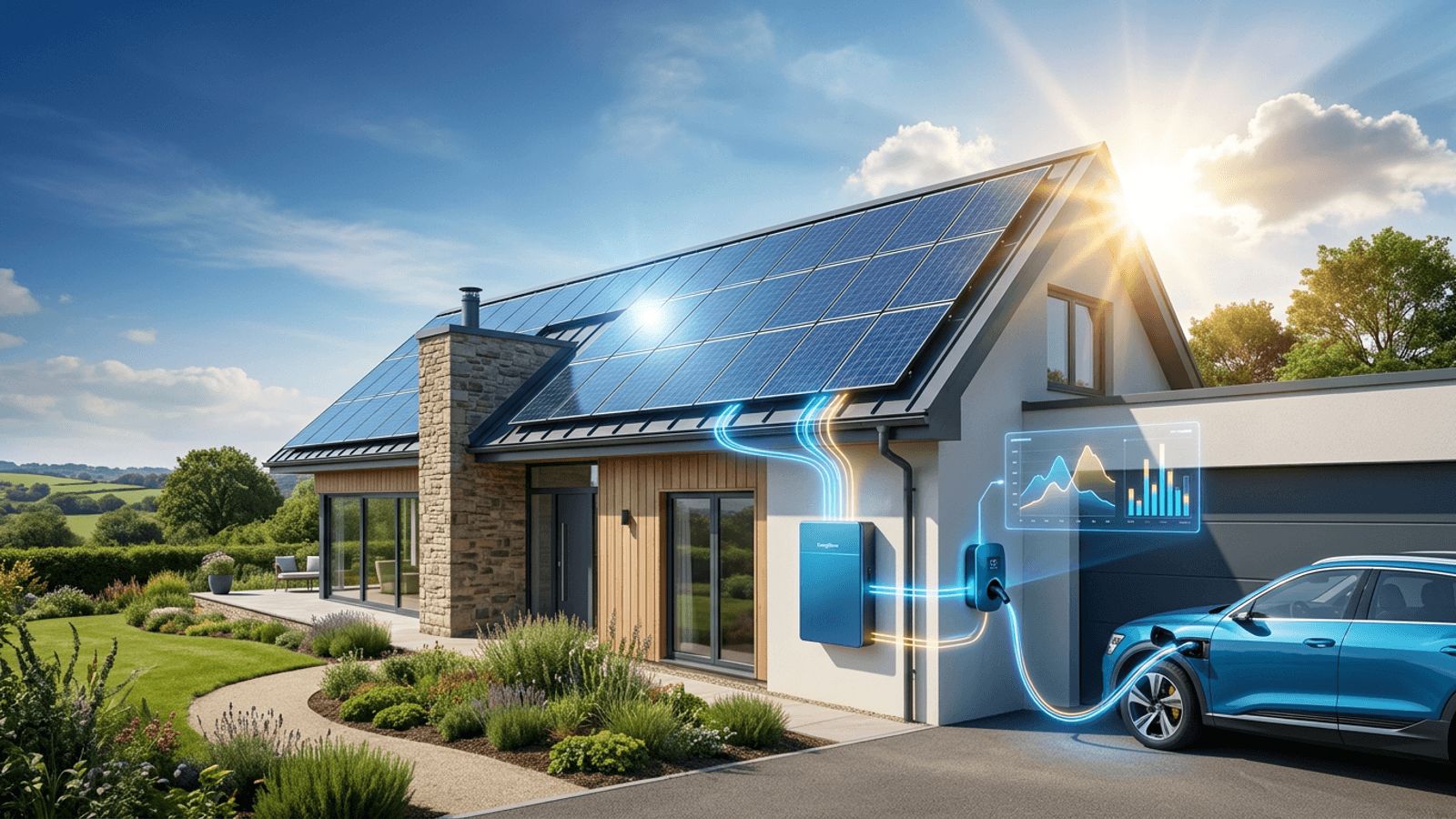
Solar has also changed in character. A modern installation is rarely just panels on a roof. It typically combines high-efficiency modules, string or hybrid inverters, battery storage to shift generation into evening consumption, monitoring platforms, and increasingly integration with electric vehicle charging and heat pumps so that self-generated electricity displaces both fuel and grid import. The quality of that system design, rather than the panel brand, is what determines the return.
How to Judge a Solar Installer
Accreditation under the Microgeneration Certification Scheme and membership of a recognised consumer code are non-negotiable for domestic and small commercial work, since they underpin both quality standards and eligibility for support schemes. Beyond that, look for evidence of proper design: a site-specific shading assessment, orientation and pitch analysis, annual yield estimate with stated methodology, structural check of the roof, and a realistic self-consumption assumption. Ask about electrical competence for the grid connection application, warranty terms on panels, inverters, batteries and workmanship, and whether performance monitoring and servicing are included.
The Top 10 Solar Energy Companies in South Cambridgeshire
1. Cambourne Solar Solutions
One of the district's most established installers, working across domestic, commercial and agricultural projects with in-house design, structural assessment and installation teams. Particularly experienced with large warehouse and laboratory roofs where loading, penetration and roof warranty considerations require careful engineering.
2. Granta Solar Developments
Focused on utility-scale and large commercial ground-mount arrays, Granta Solar Developments handles land agreements, planning, environmental assessment, grid connection and construction management, often co-locating battery storage to improve export economics and connection viability.
3. Shelford Rooftop Solar
A domestic specialist covering pitched and flat roofs, in-roof integrated systems for new build and conservation-sensitive installations in the district's many conservation areas, where panel positioning and visual impact require particular attention.
4. Linton Agricultural Solar
Serving farms and rural estates with barn and grain store roof arrays, ground-mount systems on lower-grade land, and installations sized around irrigation, grain drying and refrigeration loads. The company also advises on the tax and tenancy implications of on-farm generation.
5. Duxford Solar & Storage
Specialising in solar combined with battery systems, this company designs installations that maximise self-consumption rather than export, using load profiling to size storage appropriately and configuring tariff-aware charging to take advantage of time-of-use pricing.
6. Histon Solar Thermal & Hot Water
Alongside photovoltaic work, solar thermal remains effective for high hot water demand. This company installs flat plate and evacuated tube collectors for homes, care settings, sports facilities and food production sites where consistent hot water loads suit the technology.
7. Melbourn Solar Maintenance
A dedicated operations and maintenance provider covering panel cleaning, inverter servicing and replacement, string testing, thermal imaging fault detection, monitoring configuration and performance auditing for systems that are underperforming against their original modelling.
8. Sawston Commercial Solar Finance
Structuring funded solar for businesses through power purchase agreements, roof lease arrangements and asset finance, allowing organisations to install without upfront capital and purchase generated electricity at a fixed, typically below-grid rate.
9. Papworth Community Solar
Delivering community-owned installations on schools, village halls, sports pavilions and community buildings, funded through local share offers with surplus revenue directed to further local energy and fuel poverty projects.
10. Fulbourn Solar Carports & EV Integration
Building solar carport structures for business parks, workplaces and public car parks that generate electricity while providing sheltered parking, with integrated electric vehicle charging and load management to avoid grid reinforcement costs.
What a Good Proposal Contains
Comparing quotations is difficult unless proposals are properly specified. A credible document should state module make, model, wattage and quantity; inverter specification and configuration; battery capacity, usable capacity and cycle warranty; mounting system and roof fixing method; estimated annual generation with the modelling assumptions stated; expected self-consumption percentage and the basis for it; export arrangements and the tariff assumed; a full cost breakdown including scaffolding and electrical works; and warranty periods for each component and for workmanship. Proposals lacking these details make meaningful comparison impossible.
Common Pitfalls
Several problems recur across the district. Oversizing systems relative to actual consumption, which reduces returns where export rates are low. Optimistic self-consumption assumptions that inflate projected savings. Ignoring shading from trees, chimneys and neighbouring buildings, which can disproportionately affect string performance without optimisers. Installing batteries that are too large for the household load profile. And neglecting roof condition, since replacing tiles under an array is far more expensive than addressing it beforehand.
Choosing an Installer
Obtain at least three fully specified quotations, verify certification independently, request references for comparable local installations and inspect one if possible. Confirm who will carry out the electrical work and who submits the grid connection notification. Ask what happens if generation falls short of the modelled figure. South Cambridgeshire has a mature solar market with genuinely capable providers at every scale, and careful selection at the outset is what turns a solar installation into a long-term asset.
Want your brand featured in front of decision-makers? Publish a guest post or get a link insertion in our guides through AAMAX's guest post and link insertion service.
Helpful Links
 SponsoredAAMAX — Full-Service Digital Agency
Write for Us
Share your expertise with our readers. We welcome guest contributions from industry specialists.
Pitch your idea