

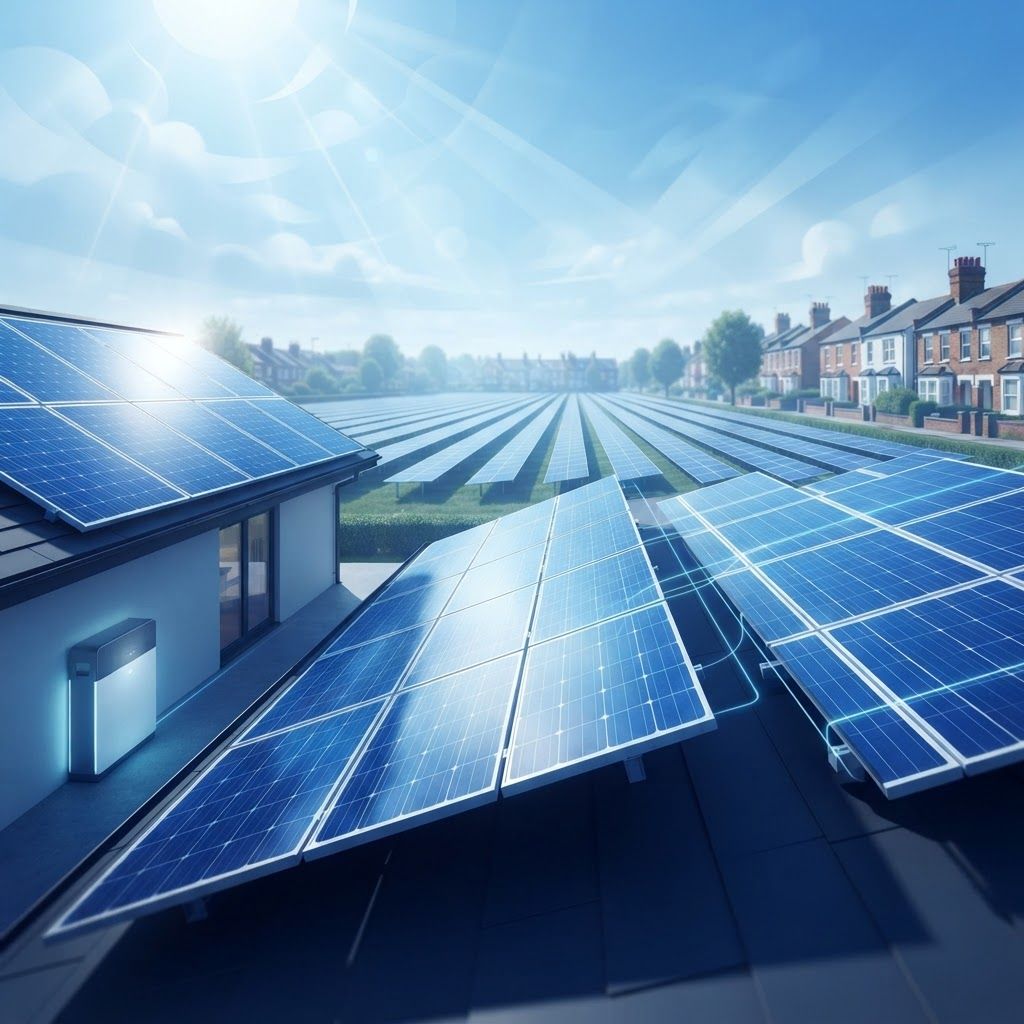
Solar Energy in Preston: Better Suited Than People Assume
There is a persistent belief in the North West that solar power does not work in a cloudy climate. It is inaccurate. Photovoltaic panels generate from diffuse daylight, not direct sunshine, and modern modules perform efficiently at the cooler ambient temperatures typical of Lancashire, where excessive heat actually reduces output. Preston receives sufficient annual irradiance to make well-designed systems financially attractive, particularly given the substantial increase in grid electricity prices in recent years.
What has changed the economics most decisively is the combination of falling module prices, improved inverter technology and affordable lithium battery storage. A domestic array that once took well over a decade to pay back can now do so considerably faster, while commercial installations with high daytime consumption often achieve returns that compare favourably with other capital projects.
Ten Solar Companies Serving Preston
1. Sun Solar Energy Solutions. A regional installer covering domestic and small commercial photovoltaic systems with battery storage, offering site survey, design, installation and monitoring under recognised accreditation schemes.
2. Emtec Energy. Delivers commercial-scale solar alongside broader mechanical, electrical and electric vehicle charging services, which suits industrial clients wanting a single contractor for an integrated energy project.
3. Forrest. Strong in social housing and public sector retrofit, combining rooftop solar with insulation and heating upgrades across large property portfolios, an important segment in Preston and the surrounding boroughs.
4. Solar Fast. A North West installer known for rapid domestic deployment, offering panel and battery packages with financing options and workmanship guarantees.
5. Project Solar UK. A national installer with extensive North West coverage, notable for long product warranties and standardised system packages that appeal to homeowners wanting predictability.
6. Egg and comparable integrated energy retailers. Providers combining solar, battery and electric vehicle charger installation with smart tariffs, allowing households to optimise self-consumption and off-peak charging together.
7. Local Lancashire electrical contractors with solar divisions. Long-established electrical firms that have added photovoltaics have a distinct advantage: they understand distribution board work, earthing, network operator applications and metering, which is where poor installations typically fail.
8. Ground-mount and agricultural solar developers. Companies working with Lancashire landowners on field-scale arrays and farm building installations, often paired with battery storage and used to offset high-load operations such as dairy and cold storage.
9. Battery storage and retrofit specialists. Firms adding storage to existing arrays, an increasingly common project as households with older feed-in tariff systems seek to increase self-consumption rather than export cheaply.
10. Solar operations and maintenance providers. Specialists offering panel cleaning, inverter servicing, performance monitoring, string testing and fault rectification, which protects long-term yield on systems that are frequently installed and then forgotten.
What a Good Solar Installation Involves
Design begins with consumption, not roof size. An installer should analyse half-hourly or at minimum annual usage data and daily load patterns before proposing capacity. A system generating far more than a property consumes during daylight hours delivers weaker returns unless paired with storage or a favourable export arrangement.
Roof assessment follows: orientation, pitch, shading from chimneys, trees and neighbouring buildings, structural capacity and covering condition. South-facing is optimal but east and west split arrays often suit household consumption better by extending generation across morning and evening.
Electrical design covers inverter sizing and type, string configuration or optimisers where shading exists, protection devices, earthing and network operator notification or application. Battery integration adds decisions about capacity, charge and discharge rates and whether backup during outages is required.
Commissioning and documentation matter more than most buyers realise. Proper handover includes performance certification, warranty registration, monitoring access and clear explanation of how to use the system to maximise self-consumption.
Trends in Solar Adoption
Battery pairing is now the default rather than an upgrade. Storage transforms the value proposition by shifting daytime generation into evening use, and combined with time-of-use tariffs it enables cheap overnight grid charging when generation is low.
Electric vehicle integration is accelerating. Charging a vehicle from surplus solar generation is one of the highest-value uses available, and smart chargers that respond to generation are becoming standard specification.
Commercial rooftop deployment is growing fastest. Preston's industrial estates offer large, unshaded, structurally suitable roofs above businesses that consume power precisely when the sun shines, which is close to ideal for solar economics.
Finally, quality scrutiny has increased. As the market has expanded, so has variability in installation standards, and buyers are becoming appropriately more demanding about certification, warranties and independent design verification.
How to Choose a Solar Installer
Insist on Microgeneration Certification Scheme accreditation, which is required for export arrangements and grant eligibility and provides recourse through consumer codes. Confirm the installer, not just the products, is certified.
Compare quotations on equivalent terms: panel wattage and manufacturer, inverter brand, battery chemistry and usable capacity, scaffolding, network application, and whether monitoring hardware is included. Headline prices are frequently not comparable.
Ask for a shading analysis and an estimated annual yield with the assumptions shown. Also ask what proportion of generation the installer expects you to self-consume, since that figure drives the entire financial case.
Check warranty structure carefully. Panels, inverters, batteries and workmanship carry separate terms, and inverters typically fail first. Establish who honours each warranty and what happens if the installer ceases trading.
Final Thoughts
Solar in Preston is no longer an environmental statement requiring financial sacrifice; for most suitable properties it is a straightforward investment with a defensible return. The companies above span domestic installation, commercial engineering, agricultural ground-mount and long-term maintenance. Specify the system around your actual consumption, use accredited installers, and pair generation with storage, and solar becomes one of the most dependable energy decisions available in the city.
Want your brand featured in front of decision-makers? Publish a guest post or get a link insertion in our guides through AAMAX's guest post and link insertion service.
Helpful Links
 SponsoredAAMAX — Full-Service Digital Agency
Write for Us
Share your expertise with our readers. We welcome guest contributions from industry specialists.
Pitch your idea

