Solar Energy in Oldham: Setting Realistic Expectations
Solar photovoltaic installation has become one of the most popular home improvements in Oldham, and for sound reasons. System costs have fallen dramatically over the past decade while electricity prices have risen sharply, shifting the economics decisively. A well-designed domestic installation now typically pays back within a reasonable period and then continues generating for a further two decades or more.
A common concern in the north-west is whether there is sufficient sunlight to make solar worthwhile. Solar panels generate from daylight rather than direct sunshine, so they produce meaningful output on overcast days. Oldham receives somewhat less annual irradiance than southern England, but the difference is smaller than most people assume, and modern panel efficiency more than compensates. Cooler ambient temperatures actually improve panel efficiency slightly, partially offsetting lower irradiance.
The more important local variables are roof orientation, pitch, and shading. South-facing roofs perform best, though east and west orientations remain viable and can suit household consumption patterns better by spreading generation across morning and evening. Oldham's dense terraced streets often create shading from neighbouring properties, chimneys, and trees, which makes proper shading assessment essential rather than optional.
What a Solar Installation Involves
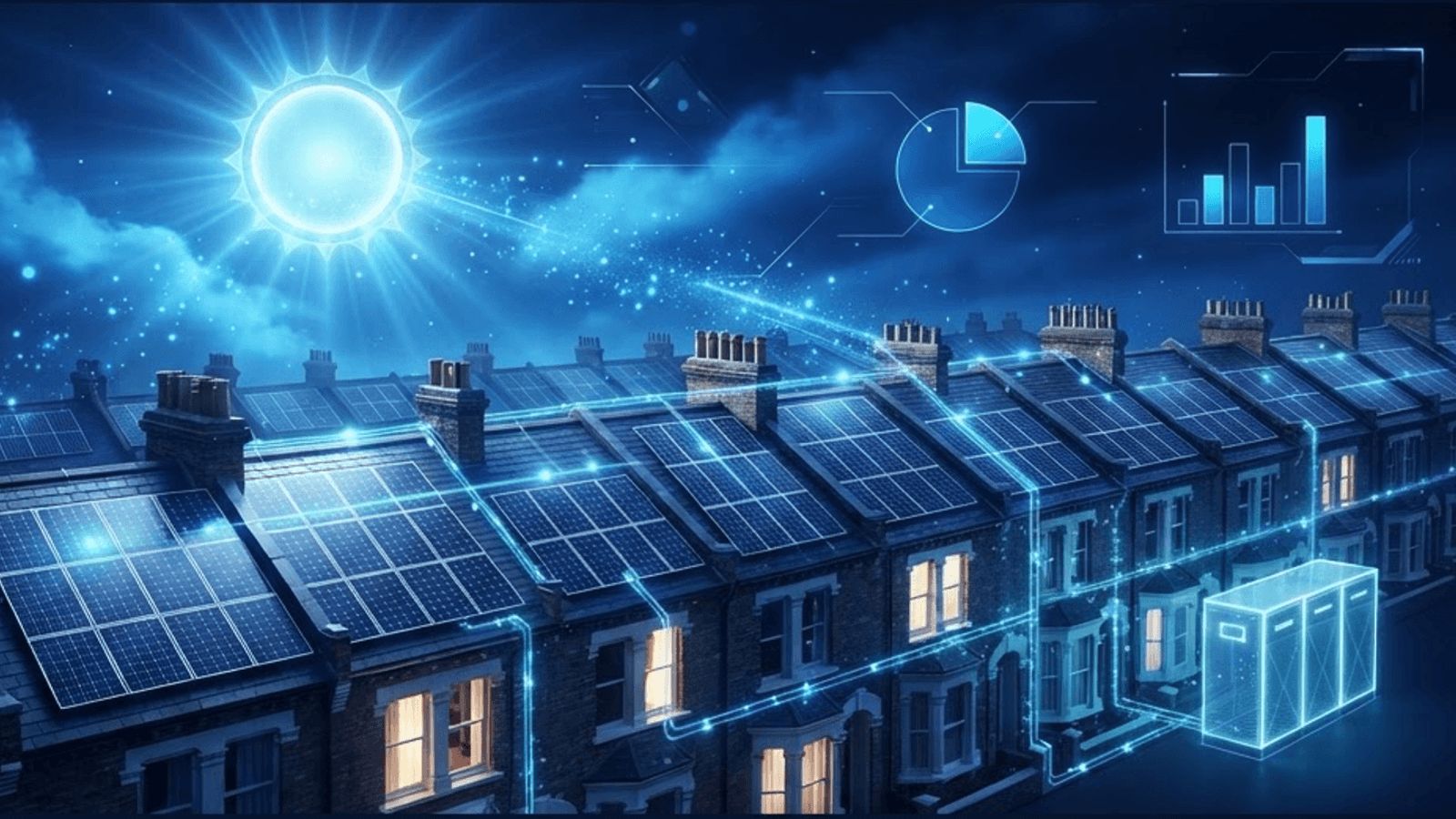
A complete domestic system comprises photovoltaic panels, mounting hardware appropriate to the roof covering, an inverter converting direct current to alternating current, protective isolation and metering equipment, and increasingly a battery storage unit. Optimisers or microinverters may be specified where partial shading affects part of the array, allowing individual panels to perform independently rather than dragging down a whole string.
The process begins with a desktop assessment and consumption review, followed by a site survey covering roof condition, structural capacity, electrical infrastructure, and shading. A proper proposal then models expected annual generation, the proportion likely to be consumed on site, and the resulting savings and export income. Installation typically takes one to two days for a domestic system, followed by commissioning, notification to the distribution network operator, and registration for export payments.
Battery storage has become a common addition. Batteries allow generation produced during the day to be used in the evening, substantially increasing self-consumption. Combined with a time-of-use electricity tariff, batteries can also be charged with cheap overnight electricity and discharged during expensive peak periods, generating savings independent of solar output.
Leading Solar Energy Companies Serving Oldham
1. Sun Solar Group provides domestic and commercial solar photovoltaic installation across the north-west with integrated battery storage. The company covers design, structural verification, installation, and network notification, and works on both individual homes and larger commercial roofs.
2. Solar Fast serves Greater Manchester with residential and business solar and storage installations, designing systems around measured consumption rather than generic sizing. Its focus on accurate generation modelling helps customers understand what returns to expect before committing.
3. Custom Solar concentrates on commercial and industrial photovoltaic projects including large rooftop arrays, solar carports, and ground-mounted systems. Oldham's warehousing, distribution, and manufacturing premises with high daytime electricity demand are particularly well suited to this scale of installation.
4. Eco Efficient Energy combines solar photovoltaic with insulation, ventilation, and heat pump services, offering a whole-property approach. For older Oldham housing, addressing efficiency alongside generation delivers considerably better overall outcomes than solar alone.
5. Green Building Renewables installs solar photovoltaic, battery storage, heat pumps, and electric vehicle charging through a regional delivery model. Households planning to electrify heating and transport alongside generation benefit from coordinated design across all three.
6. Project Solar UK offers domestic solar installations with long-term product and performance warranties, appealing to homeowners who prioritise warranty security and after-sales support over lowest initial price.
7. Egg provides solar photovoltaic and battery installations with a digital-first customer journey, transparent pricing, and finance options. Customers who prefer to research and specify online before a survey often find this approach convenient.
8. Solar Together Greater Manchester operates as a group-buying scheme facilitated at city region level, allowing residents to access competitively tendered installation through vetted suppliers. It offers price advantages and quality assurance for homeowners who prefer a structured procurement route.
9. E.ON Energy Solutions delivers solar and storage projects for commercial and public sector clients, with capability spanning generation, storage, energy management, and long-term service arrangements. Larger sites and public estate projects typically require this scale.
10. Absolute Solar and Wind serves commercial and community clients across the north with solar photovoltaic and associated technologies, including projects for schools, community buildings, and industrial premises where funding structures and long-term performance guarantees matter.
Understanding Costs and Returns
Domestic system pricing depends primarily on size, roof complexity, panel and inverter specification, and whether battery storage is included. Scaffolding requirements on terraced or three-storey property add cost, as does non-standard roof covering. Value added tax on qualifying domestic installations of solar and battery equipment is currently zero-rated, which represents a meaningful saving.
Returns come from three sources: electricity you generate and use yourself, which avoids purchase at full retail rate and represents the most valuable output; electricity exported to the grid, paid under the Smart Export Guarantee at rates that vary considerably between suppliers; and in the case of batteries, potential income from flexibility services. Because self-consumption is worth substantially more than export, sizing a system to match household consumption and adding storage typically improves returns more than simply maximising array size.
For commercial installations, the case is often stronger because business electricity consumption aligns well with daytime generation, meaning most output is self-consumed. Capital allowances provide additional benefit, and businesses with sustainability reporting obligations gain non-financial value from onsite generation.
Verifying Installer Quality
Microgeneration Certification Scheme accreditation is the essential baseline. It is required to register for the Smart Export Guarantee and provides a design and installation standard framework. Membership of a consumer code such as the Renewable Energy Consumer Code or HIES offers deposit protection and independent dispute resolution, which matters given the sums involved.
Look for a proposal that includes shading analysis using appropriate survey tools, confirmation of roof structural adequacy, a clear equipment specification with named manufacturers and model numbers, modelled annual generation based on your actual roof geometry, and a realistic self-consumption assumption. Be cautious of quotes that promise savings without reference to your consumption data, or that model generation as though the roof were unshaded and ideally oriented.
Check warranty detail carefully. Panels typically carry a product warranty and a separate performance warranty guaranteeing output degradation limits. Inverters have shorter warranties than panels and will likely need replacement within the system's life, so factor that in. Workmanship warranties should cover roof weathertightness, and it is worth confirming what insurance stands behind them if the installer ceases trading.
Practical Considerations for Oldham Homes
Confirm roof condition before installing. Panels typically last twenty-five years or more, so a roof needing recovering within that period should ideally be addressed first, avoiding the cost of removing and refitting the array. Most domestic installations fall within permitted development rights, but conservation areas and listed buildings, including parts of the Saddleworth villages, may require planning consent, and flat-roof or ground-mounted arrays have different rules.
Consider future electrification when specifying. If you expect to install a heat pump or electric vehicle charger, sizing the system and electrical infrastructure with that in mind avoids costly rework. Obtain at least three detailed quotations, compare them on specification and modelled output rather than headline price, and ask each installer to explain the assumptions behind their generation figures. The best installers welcome that scrutiny.
Want your brand featured in front of decision-makers? Publish a guest post or get a link insertion in our guides through AAMAX's guest post and link insertion service.
Helpful Links
 SponsoredAAMAX — Full-Service Digital Agency
Write for Us
Share your expertise with our readers. We welcome guest contributions from industry specialists.
Pitch your idea