Why Solar Works in Herefordshire
A persistent misconception holds that the UK receives insufficient sunlight for solar to be worthwhile. The physics say otherwise. Photovoltaic panels generate from daylight rather than direct heat, and in fact operate more efficiently at cooler temperatures. Herefordshire's annual solar irradiance is comparable to much of central Europe where solar has been deployed at enormous scale, and the county sits in a relatively favourable part of the UK, benefiting from its westerly and southerly position.
What makes solar particularly compelling here is not just resource but building stock and land use. Herefordshire has an exceptional quantity of large, unshaded, south-facing agricultural roofs on barns, grain stores, packhouses and industrial units. It has businesses with high daytime electricity consumption from refrigeration, processing and irrigation, matching solar's generation profile almost perfectly. And it has land where lower-grade agricultural ground can host ground-mounted arrays alongside continued sheep grazing and biodiversity improvement.
Understanding Solar System Design
A solar installation comprises several elements. The panels themselves, usually monocrystalline modules, convert daylight to direct current. An inverter converts that to alternating current usable in the building, either as a single string inverter, multiple inverters or microinverters attached to individual panels for better performance under partial shading. Mounting systems vary between on-roof rails, in-roof integrated systems that sit flush and suit new build or re-roofing, and ground-mounted frames.
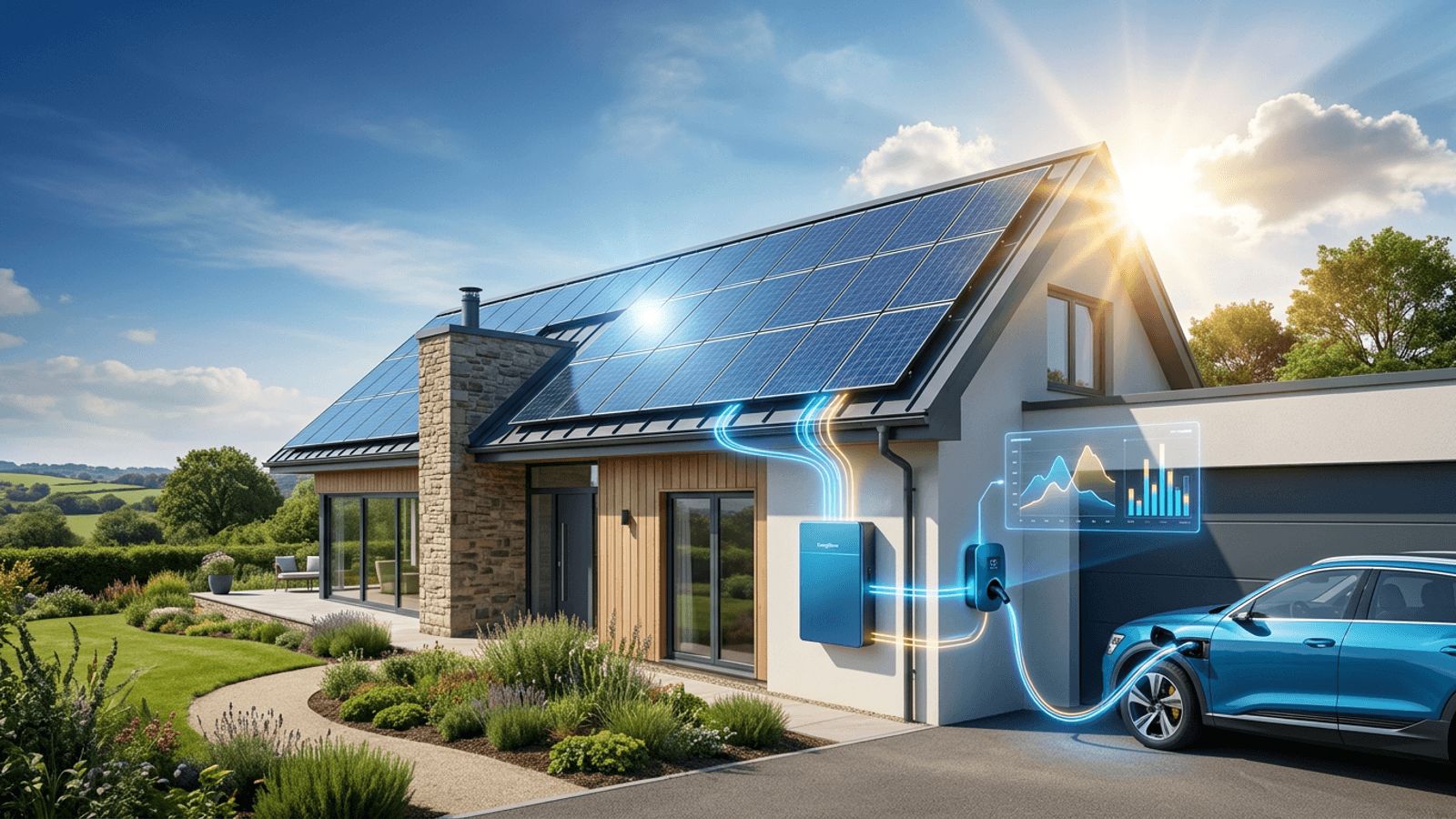
Optional additions substantially affect the economics. Battery storage captures generation for evening use, raising self-consumption from perhaps thirty per cent to seventy per cent or more for a typical household. Solar diverters send surplus generation to an immersion heater. Electric vehicle chargers with solar integration charge preferentially from surplus. Monitoring systems let owners verify performance, which matters because an underperforming array can go unnoticed for years without it.
1. Wye Valley Solar
A well-established installer covering domestic and small commercial work, Wye Valley Solar handles roof-mounted photovoltaic systems, battery storage and electric vehicle charging. Its process includes site survey, shading analysis, structural assessment, generation modelling and grid application. Clients frequently comment on the realism of its generation estimates, which set expectations accurately rather than overselling.
2. Marches Agricultural Solar
Specialising in large agricultural rooftop installations, this company designs systems for barns, livestock buildings, grain stores and packhouses. Its expertise includes structural loading assessment on older agricultural buildings, asbestos roof considerations, and sizing systems to match on-site consumption profiles including grain drying, refrigeration and milking equipment. Maximising self-consumption rather than export is central to its design philosophy.
3. Golden Valley Solar Farms
Operating at utility scale, this developer delivers ground-mounted solar projects on agricultural land. Its work spans site identification based on grid availability and land classification, landowner lease negotiation, environmental and landscape impact assessment, community engagement, planning applications, construction and long-term operation. It emphasises dual land use through continued grazing and habitat creation between and beneath panel rows.
4. Herefordshire Solar and Battery Group
This company focuses on integrated generation and storage, designing systems that maximise self-consumption and enable participation in time-of-use tariffs. Its work includes retrofit battery installation for households with existing solar, whole-home energy management systems, and commercial storage for peak demand reduction. It also advises on backup power configurations, valuable in a county where rural power outages are not uncommon.
5. Leominster Solar Installations
Serving north Herefordshire, this installer handles domestic and small business systems with a strong emphasis on straightforward service and local accountability. Its work covers standard roof arrays, in-roof integrated systems for properties undergoing re-roofing, and ground-mounted arrays for properties with unsuitable roofs but available land. Fixed quotations following a proper survey give customers cost certainty.
6. Ross-on-Wye Commercial Solar
Concentrating on business installations, this company delivers systems for industrial units, offices, retail premises, holiday accommodation and community buildings. Its services include energy consumption analysis, financial appraisal covering payback and internal rate of return, capital allowance advice, power purchase agreement options for businesses preferring no upfront capital outlay, and half-hourly generation modelling against actual load data.
7. Cathedral Solar Maintenance and Repair
Addressing an underserved segment, this company services existing installations rather than selling new ones. Work includes performance diagnostics, inverter replacement, panel cleaning, bird proofing, isolator and cabling inspection, and repairs following storm damage. With many local arrays now more than a decade old and reaching the point of first inverter failure, independent maintenance expertise is increasingly valuable.
8. Border Counties Solar Thermal and Hybrid
While photovoltaic dominates, solar thermal remains efficient for hot water, and this company installs both, including hybrid panels generating electricity and heat simultaneously. It advises on integration with existing heating systems, cylinder specification and combination with heat pumps. Its offering suits properties with high hot water demand such as guest houses and care facilities.
9. Ledbury Off-Grid Solar Specialists
Serving properties without mains electricity connection, this company designs standalone solar systems with substantial battery banks, backup generation and careful load management. Its clients include remote farm buildings, glamping and camping sites, mobile catering operations, water pumping installations and remote monitoring equipment. Off-grid design demands a different discipline, prioritising winter reliability over annual yield.
10. Herefordshire Community Solar Initiative
This community organisation funds solar installations on schools, village halls, churches and community buildings through local share offers and grants. Beyond generation, it delivers education programmes and reinvests surpluses in local energy efficiency work. Its projects demonstrate solar on buildings whose owners lack capital, unlocking installations that would otherwise never happen.
Costs, Returns and Realistic Expectations
Solar economics have improved substantially as panel prices have fallen while electricity prices have risen. The key determinant of return is self-consumption, because avoiding buying electricity is worth considerably more than exporting surplus. A household consuming most generation on site achieves a much shorter payback than one exporting the majority.
System sizing should therefore start from consumption data rather than roof capacity. Oversizing an array without storage or a matching load profile simply produces cheap exported power. Panel degradation is real but modest, typically well under one per cent annually, with most manufacturers warranting substantial output after twenty-five years. Inverters have shorter lives and should be budgeted as a replacement cost during the system lifetime. Roof condition matters too, since installing panels over a roof needing replacement within a decade creates avoidable future cost.
Practical Considerations
Most domestic roof-mounted solar falls within permitted development, subject to conditions on projection and positioning, though listed buildings, conservation areas and areas of outstanding natural beauty require consent. Ground-mounted arrays above modest size need planning permission. Grid connection requires notification or, for larger systems, formal application, and constrained network capacity in parts of the county can limit permitted export.
Choose installers certified under the Microgeneration Certification Scheme, which is required for export tariff eligibility, and confirm membership of a consumer protection scheme. Insist on a written performance estimate based on your actual roof orientation, pitch and shading rather than generic figures, and ask for the underlying assumptions.
Final Thoughts
Solar has become the default renewable choice for Herefordshire property owners, and the county's combination of large agricultural roofs, high daytime commercial loads, available land and expensive off-grid heating makes the case unusually strong. The companies profiled span domestic retrofit, agricultural rooftop, utility-scale development, off-grid design and independent maintenance. The best outcomes come from sizing systems around genuine consumption, considering storage seriously, verifying grid capacity early and choosing certified installers who provide honest, site-specific performance estimates.
Want your brand featured in front of decision-makers? Publish a guest post or get a link insertion in our guides through AAMAX's guest post and link insertion service.
Helpful Links
 SponsoredAAMAX — Full-Service Digital Agency
Write for Us
Share your expertise with our readers. We welcome guest contributions from industry specialists.
Pitch your idea