

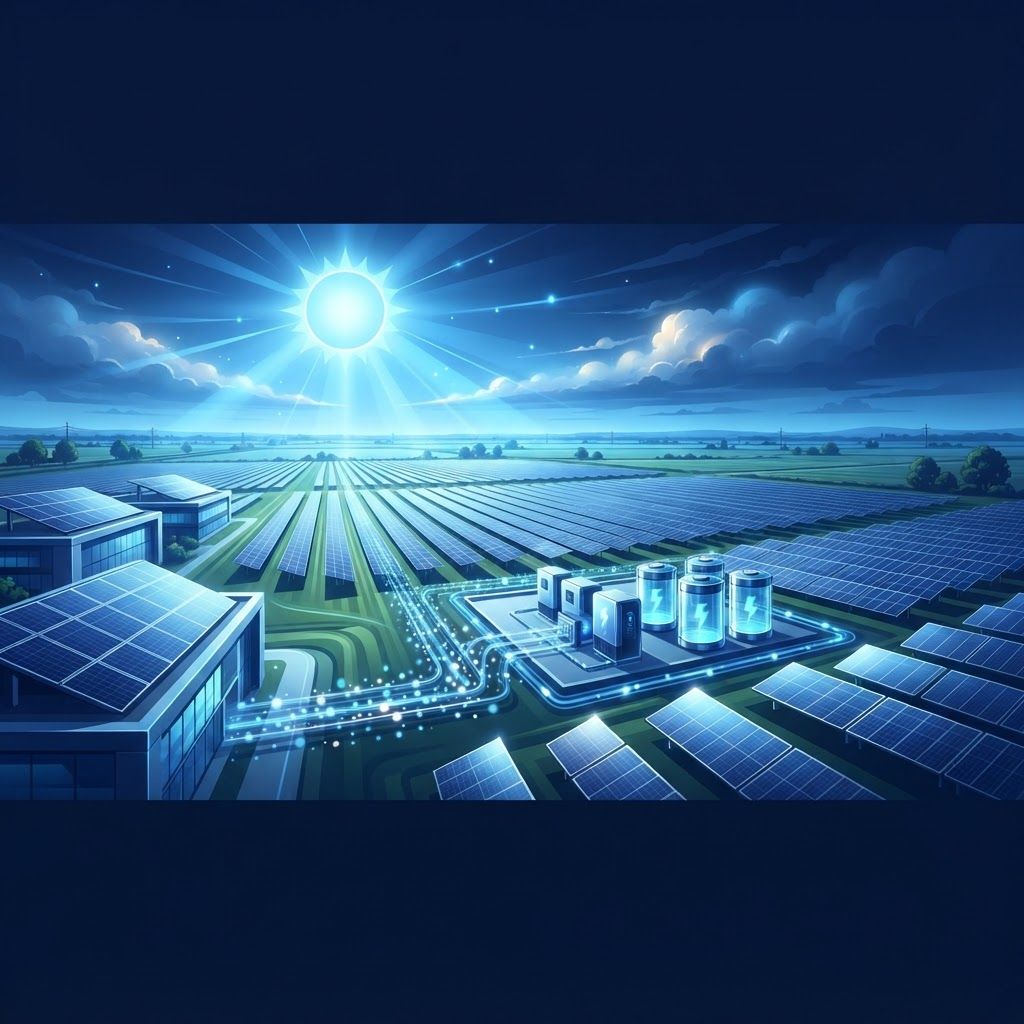
Solar Potential in East Lindsey
Lincolnshire consistently records some of the highest irradiance levels in northern England, and East Lindsey benefits from flat, largely unshaded terrain with extensive south-facing roof area on agricultural, industrial and residential buildings. These conditions have made the district one of the more active solar markets in the region.
Two distinct segments have developed. Utility-scale ground-mounted solar farms occupy larger parcels of land, typically connected directly to the distribution network under long-term leases. Behind-the-meter installations on homes, farms, warehouses, holiday parks and commercial premises reduce purchased electricity and, increasingly, charge batteries and electric vehicles.
How Solar Systems Work
A photovoltaic system converts sunlight into direct current electricity, which an inverter converts to alternating current for use on site. Any surplus can be exported to the grid or stored in a battery. Monitoring equipment tracks generation and consumption, allowing users to shift discretionary loads such as water heating, refrigeration cycles or vehicle charging into daylight hours.
Panel efficiency has improved substantially, with modern modules generating meaningfully more output per square metre than those installed a decade ago. Inverter technology has also advanced, with hybrid inverters now handling solar, battery and grid interaction in a single unit, and optimisers or micro-inverters mitigating the impact of partial shading.
System sizing should be driven by consumption pattern rather than roof area alone. A system that generates far more than the site uses during daylight hours delivers a lower return unless paired with storage or a favourable export arrangement.
Ten Solar Companies Serving East Lindsey
1. Wolds Solar Installations handles residential and small commercial rooftop systems, providing shading analysis, generation modelling and full electrical certification.
2. Fenland Solar Developments concentrates on ground-mounted solar farms, managing land agreements, grid applications, planning consent and construction delivery.
3. Coastal Renewable Energy serves holiday parks, hotels and leisure sites along the coast, where high summer daytime demand aligns unusually well with peak solar generation.
4. Lindsey Agri Solar specialises in agricultural applications, including large barn and packhouse rooftops, irrigation pump loads and cold store demand reduction.
5. Marshside Solar and Storage integrates photovoltaic arrays with lithium battery systems, focusing on maximising self-consumption and providing backup during grid outages.
6. Louth Electrical and Solar combines a traditional electrical contracting business with solar capability, useful where installations require distribution board upgrades or three-phase work.
7. Horncastle Green Roofing offers combined roof replacement and integrated solar installation, an efficient approach for older buildings needing both.
8. Sandhill Solar Maintenance provides operations and maintenance services including panel cleaning, inverter servicing, performance monitoring and fault rectification for existing arrays.
9. Trinity Energy Advisory supports commercial clients with feasibility studies, financial modelling, procurement and power purchase agreement negotiation.
10. Alford Community Solar facilitates shared community installations on village halls, schools and community buildings, supported by local funding and volunteer participation.
Costs, Returns and Financing
Installation costs vary with system size, roof complexity, mounting type and whether battery storage is included. Larger commercial systems achieve a lower cost per kilowatt than small domestic arrays due to economies of scale.
Returns depend heavily on how much generated electricity is consumed on site. Because purchased electricity costs considerably more per unit than the typical export payment, self-consumption is where the value lies. Businesses operating during daylight hours therefore see faster payback than households that are empty during the day, unless storage is added.
Financing options include outright purchase, asset finance and lease arrangements, and power purchase agreements where a third party funds and owns the system while the site buys the electricity at an agreed rate. Each has different balance sheet, tax and control implications, and for commercial installations capital allowances may be available.
Planning and Regulatory Considerations
Most domestic rooftop installations fall within permitted development, though restrictions apply in conservation areas, on listed buildings and within the Lincolnshire Wolds National Landscape. Ground-mounted arrays above modest size and all commercial-scale developments require planning permission.
All grid-connected systems must be notified to or approved by the distribution network operator. Smaller systems generally use a notification process after installation, while larger arrays require an application and formal connection offer before work begins, and in constrained areas an export limitation device may be required.
Installers should be certified under a recognised competent person scheme, and the installation must comply with current wiring regulations with appropriate electrical certification issued on completion.
Maintenance and Longevity
Solar systems are low maintenance but not maintenance free. Panels typically carry performance warranties extending twenty five years or more, though inverters usually require replacement within ten to fifteen years and should be budgeted accordingly.
In East Lindsey, agricultural dust and coastal salt deposition can reduce output, making periodic cleaning worthwhile on larger arrays. Monitoring systems that alert on underperformance are valuable, as a failed string can go unnoticed for months and quietly erode returns.
Choosing an Installer
Obtain at least three quotations based on the same specification so that comparison is meaningful. Check certification, insurance, and workmanship warranty terms. Ask for generation estimates prepared using recognised modelling software with location-specific irradiance data, and be sceptical of projections that appear markedly higher than others.
References from comparable local installations are particularly useful. A company that has installed successfully on similar farm buildings or coastal properties will understand the practical constraints far better than one working from a generic template.
Want your brand featured in front of decision-makers? Publish a guest post or get a link insertion in our guides through AAMAX's guest post and link insertion service.
Helpful Links
 SponsoredAAMAX — Full-Service Digital Agency
Write for Us
Share your expertise with our readers. We welcome guest contributions from industry specialists.
Pitch your idea

