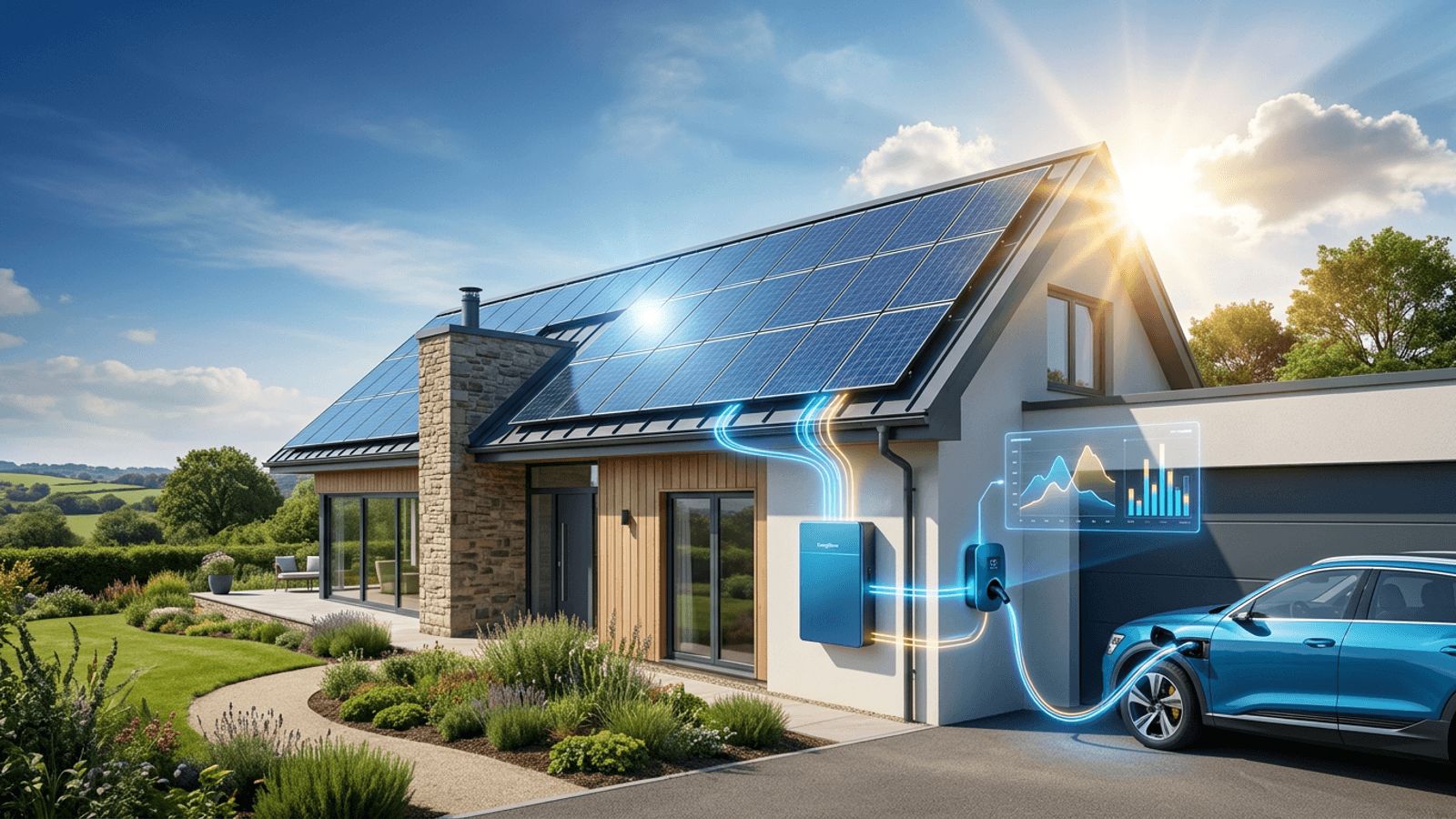
Why Solar Works in Chelmsford
A persistent misconception holds that solar generation requires a Mediterranean climate. In practice, photovoltaic panels respond to light rather than heat, and actually operate slightly more efficiently at lower temperatures. The East of England receives among the highest levels of solar irradiance in the United Kingdom, and Essex specifically benefits from relatively low rainfall and cloud cover by national standards.
Chelmsford's building stock adds to the case. The city and its surrounding districts contain a high proportion of post-war and modern housing with simple pitched roofs of adequate area, unencumbered by conservation restrictions and free of the complex roof geometry that complicates installation on older properties. Suburban and village housing typically has minimal overshadowing. Commercial estates around the city offer extensive flat and shallow-pitched industrial roofs.
Combined with electricity prices that have remained substantially above historic levels and export tariffs that now pay meaningfully for surplus generation, the financial case for solar in Chelmsford has rarely been stronger.
How Solar Systems Are Configured
A domestic installation comprises panels, mounting, an inverter, protection and isolation equipment, monitoring and often battery storage. Panel choice involves trade-offs between efficiency, appearance and cost. Monocrystalline panels dominate the current market, with all-black variants commanding a premium for aesthetic reasons. Efficiency matters most where roof area is limited, since higher efficiency panels generate more from the same footprint.
Inverter architecture is a more consequential choice than many buyers appreciate. String inverters are cost-effective and reliable but the output of a string is influenced by its weakest panel, making shading problematic. Optimisers or microinverters allow panels to perform independently, which is valuable on roofs with partial shading from chimneys, dormers, aerials or neighbouring trees, and additionally provides per-panel monitoring.
Battery storage capacity should be sized against actual evening and overnight consumption rather than to a round number. Oversized batteries cycle incompletely and extend payback unnecessarily; undersized batteries leave generation unused.
The Ten Leading Solar Providers Serving Chelmsford
Octopus Energy combines solar and battery installation with the export tariffs and time-of-use products that determine much of the financial outcome. Its integrated approach, where hardware, supply and tariff work together, produces better economics for many households than assembling these separately, and its export rates have been among the more competitive available.
Project Solar UK operates nationally with substantial Essex activity, offering domestic solar and storage with extended warranty terms. Long warranty coverage on both panels and workmanship addresses the principal consumer concern about a technology expected to last decades.
Solar Fast serves the East of England including Chelmsford with domestic and commercial installation, and is valued for regional presence that supports responsive survey, installation scheduling and aftercare.
E.ON Next delivers solar and battery installations to Essex customers alongside energy supply, offering the accountability of a single established provider across generation and tariff.
British Gas provides solar installation through its national engineering operation, appealing to customers who prioritise the service infrastructure and financial stability of a major provider.
Green Building Renewables covers the region with accredited solar, storage and heat pump installation, suiting customers pursuing multiple technologies under coordinated design.
Egg offers solar and storage packages with financing options across the region, addressing the upfront capital barrier that prevents many otherwise suitable households from proceeding.
Sunsave provides solar and battery installation with bundled warranty and monitoring arrangements, and has focused on simplifying what many consumers find a confusing purchase decision.
Custom Solar and comparable commercial specialists serve the Essex business market with larger rooftop and ground-mounted installations, bringing the electrical engineering and grid connection expertise that commercial-scale projects require.
Local accredited installers across the Chelmsford area, certified under the Microgeneration Certification Scheme, remain a strong option for many households. Established local electrical contractors who have added solar capability frequently combine competitive pricing with genuine accountability, since their reputation depends on local word of mouth.
Assessing a Solar Quotation Properly
Comparing solar quotations on total price alone is the most common purchasing error. A properly comparable assessment requires several specific elements.
First, the estimated annual generation should be calculated using the standard methodology, accounting for roof orientation, pitch, location irradiance and measured shading. Quotations presenting generation figures without stating the calculation basis should be treated cautiously.
Second, the self-consumption assumption drives the savings figure. A household consuming little during daylight hours will export most generation and save less than one with high daytime use, unless storage shifts the profile. Quotations assuming implausibly high self-consumption overstate savings substantially.
Third, equipment specification should be stated precisely: panel manufacturer and model, inverter manufacturer and model, battery chemistry and usable rather than nominal capacity. Warranty terms should distinguish product warranty, performance warranty and workmanship guarantee, with the identity of the warranting party clear.
Fourth, the scope should confirm scaffolding, electrical works, grid notification, building regulation compliance, roof condition assessment and monitoring setup. Items excluded from an attractive headline price frequently reappear later.
Regulatory and Practical Requirements
Most domestic rooftop solar in Chelmsford proceeds under permitted development rights, subject to conditions on projection, positioning and prominence. Listed buildings and conservation areas require specific consent, and parts of central Chelmsford and several surrounding villages are affected.
Grid notification is required, and installers handle this as standard. Systems above certain thresholds require prior approval from the distribution network operator rather than simple notification, which can introduce delay in areas with constrained capacity.
Roof condition warrants attention before installation. Panels have a service life measured in decades, and mounting a system on a roof covering that will need replacement within a few years creates avoidable cost and disruption. A competent surveyor will raise this.
Solar for Chelmsford Businesses
Commercial solar economics are frequently stronger than domestic. Industrial roofs offer large areas, business consumption typically peaks during generation hours producing high self-consumption, and capital allowances improve the after-tax position.
Beyond financial return, Essex businesses increasingly require renewable generation to satisfy customer procurement criteria, supply chain emissions requirements and reporting obligations. Warehousing, food production, manufacturing and automotive operations around Chelmsford have been notably active, and several have combined solar with storage and vehicle charging to serve fleet electrification.
Performance Expectations and Maintenance
Solar installations require little maintenance but benefit from attention. Panels self-clean adequately in most conditions, though installations under trees or near agricultural activity may need occasional cleaning. Inverters have a shorter service life than panels and should be expected to require replacement once during the system's life.
Monitoring is the most valuable maintenance tool. Systems that report generation allow underperformance to be identified promptly, and unnoticed faults are the principal cause of lost value over a system's life. Chelmsford installers offering monitoring with alerting provide genuinely useful protection.
Realistic expectations matter. Generation varies enormously between summer and winter in the United Kingdom, and annual figures rather than peak-day performance are the meaningful measure. Panel output degrades gradually, typically retaining well above eighty percent of initial capacity after twenty-five years, which makes solar one of the more predictable long-term investments available to a household.
Want your brand featured in front of decision-makers? Publish a guest post or get a link insertion in our guides through AAMAX's guest post and link insertion service.
Helpful Links
 SponsoredAAMAX — Full-Service Digital Agency
Write for Us
Share your expertise with our readers. We welcome guest contributions from industry specialists.
Pitch your idea