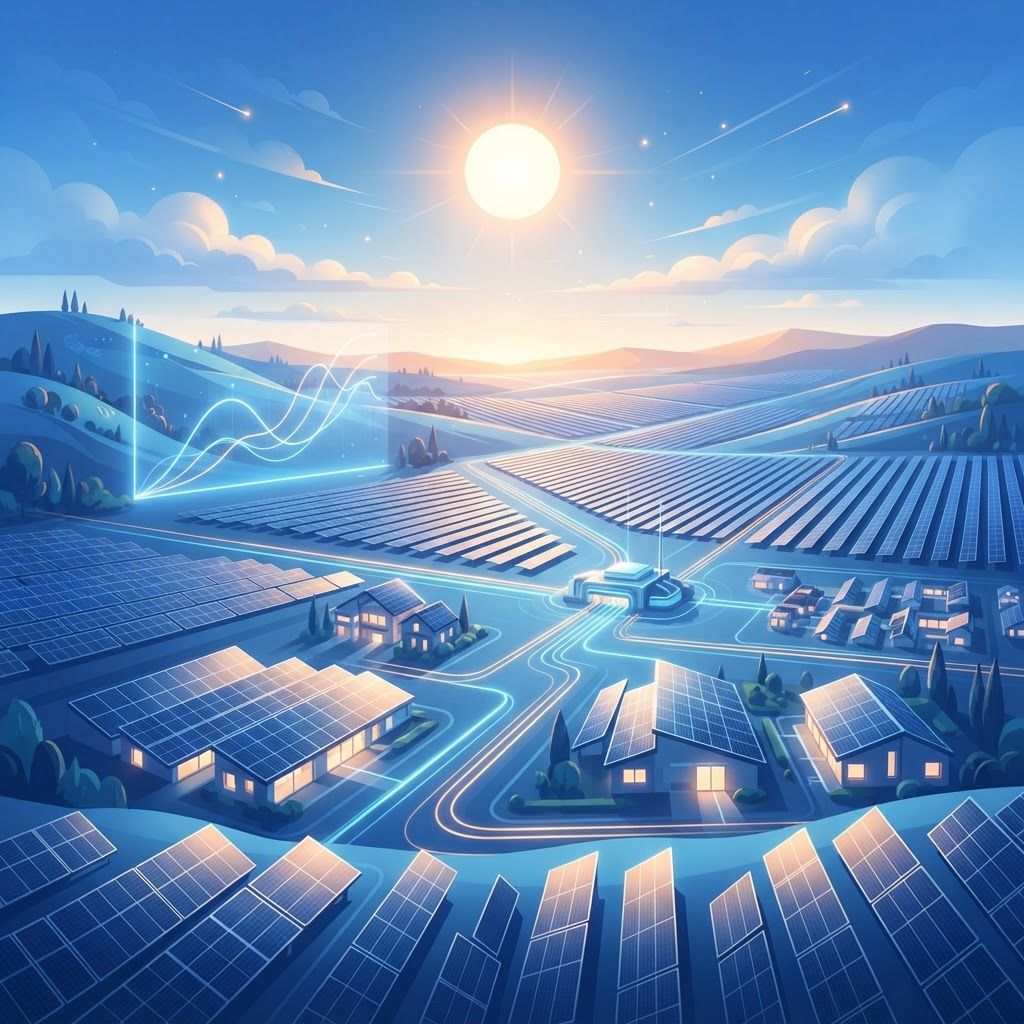
Why Solar Works in Broadland
East Anglia enjoys some of the highest levels of solar irradiance in the United Kingdom, and Norfolk in particular benefits from relatively low rainfall and long summer daylight hours. Combined with large expanses of south-facing agricultural buildings, warehouse roofs and open farmland, this makes Broadland unusually well suited to photovoltaic generation.
The economics have also improved dramatically. Panel costs have fallen substantially over the past decade while efficiency has risen, and battery storage has become affordable enough to change the value proposition entirely. Where earlier installations depended on export payments, modern systems are usually designed around self-consumption, which is where the strongest financial returns now lie.
The Different Types of Solar Installation
Domestic rooftop systems remain the most common, typically sized between three and six kilowatts and increasingly paired with a home battery and electric vehicle charger. Commercial rooftop installations on warehouses, factories and retail units are considerably larger and often deliver the best returns because generation aligns well with daytime business demand.
Agricultural installations use barn and shed roofs, which are frequently large, unshaded and structurally suitable. Ground-mounted arrays on lower-grade farmland represent the largest category by capacity, ranging from small private schemes to substantial solar farms feeding the distribution network. Finally, solar carports and canopies are gaining traction at business parks where roof space is limited but parking is plentiful.
The Ten Leading Solar Companies in Broadland
1. Broadland Solar Energy is the district's largest solar specialist, covering domestic, commercial and agricultural projects. Its reputation rests on rigorous site surveys, honest yield modelling and clean installation work, and it maintains an in-house maintenance team rather than subcontracting aftercare.
2. Wensum Photovoltaics focuses on commercial and industrial rooftops. The company specialises in maximising self-consumption through detailed load profiling, ensuring that generated power displaces expensive imported electricity rather than being exported at low value.
3. Yare Agricultural Solar works exclusively with farms and rural estates. Barn roof arrays, irrigation pump supply, grain drying loads and ground-mounted schemes on marginal land are its core work, and it understands the seasonal demand patterns that shape agricultural energy use.
4. Thorpe Solar and Storage integrates photovoltaics with battery systems and smart controls. Time-of-use tariff optimisation, peak shaving and backup supply are its areas of strength, and the firm is experienced in configuring systems that respond automatically to price signals.
5. Aylsham Renewable Installations serves the north of the district with a friendly domestic-focused service. Clear quotations, realistic generation estimates and careful roof work have earned it strong word-of-mouth among homeowners in the market towns and surrounding villages.
6. Broads Solar Farms develops and manages utility-scale ground-mounted projects. Site selection, grid connection, planning support and landowner agreements are handled end to end, and the company places emphasis on biodiversity enhancement within its sites.
7. Rackheath Commercial Solar works with businesses on the district's industrial estates, offering both capital purchase and funded models where a third party owns the system and the occupier buys the power at a reduced rate. This removes the upfront cost barrier for many businesses.
8. Sprowston Solar Maintenance concentrates on operations and maintenance rather than installation. Panel cleaning, inverter servicing, string testing and performance monitoring recover output lost to soiling and faults, often paying for themselves several times over.
9. Brundall Solar Design Consultancy provides independent technical advice without selling hardware. Feasibility studies, tender evaluation and post-installation performance audits help clients make objective decisions and hold contractors to account.
10. Reepham Community Solar develops shared solar projects on community buildings and village halls, funded through local investment. Beyond generating power, these schemes build practical understanding of renewable energy within the community.
Trends in the Solar Sector
Battery storage has moved from optional extra to near-standard component. Without storage, much generation occurs when demand is low; with it, self-consumption rates often rise from around a third to well over two thirds, transforming payback calculations.
Panel technology continues to improve, with higher-efficiency cells and bifacial modules that capture reflected light from surfaces beneath. For ground-mounted systems on light-coloured ground, bifacial gains can be meaningful.
Grid export constraints have become a practical issue in parts of Norfolk, with distribution network operators applying export limits to new connections. Well-designed systems accommodate this through storage and demand shifting rather than simply accepting curtailment. Meanwhile, integration with heat pumps and electric vehicle charging is creating genuinely coordinated home and business energy systems rather than isolated installations.
How to Choose a Solar Installer
Obtain at least three quotations and compare them carefully on specification, not just price. Check the panel and inverter brands, warranty periods and, crucially, the predicted annual generation figure, which should be based on a site-specific assessment rather than a generic estimate.
Verify relevant certification and membership of recognised consumer protection schemes, and confirm the installer carries appropriate insurance. Ask about roof condition assessment, because installing on a roof nearing the end of its life creates expensive problems later. Establish what maintenance is recommended and what it costs.
Finally, be sceptical of unusually optimistic return projections. Reputable installers present conservative figures and explain the assumptions behind them, including electricity price scenarios and system degradation over time.
Final Thoughts
Solar energy offers Broadland households, farms and businesses a practical way to reduce costs and emissions simultaneously. The district is well served by installers with genuine technical capability across domestic, commercial and agricultural applications. Careful system design matched to actual consumption patterns, combined with proper aftercare, is what turns a solar installation from a good idea into a genuinely rewarding investment.
Want your brand featured in front of decision-makers? Publish a guest post or get a link insertion in our guides through AAMAX's guest post and link insertion service.
Helpful Links
 SponsoredAAMAX — Full-Service Digital Agency
Write for Us
Share your expertise with our readers. We welcome guest contributions from industry specialists.
Pitch your idea