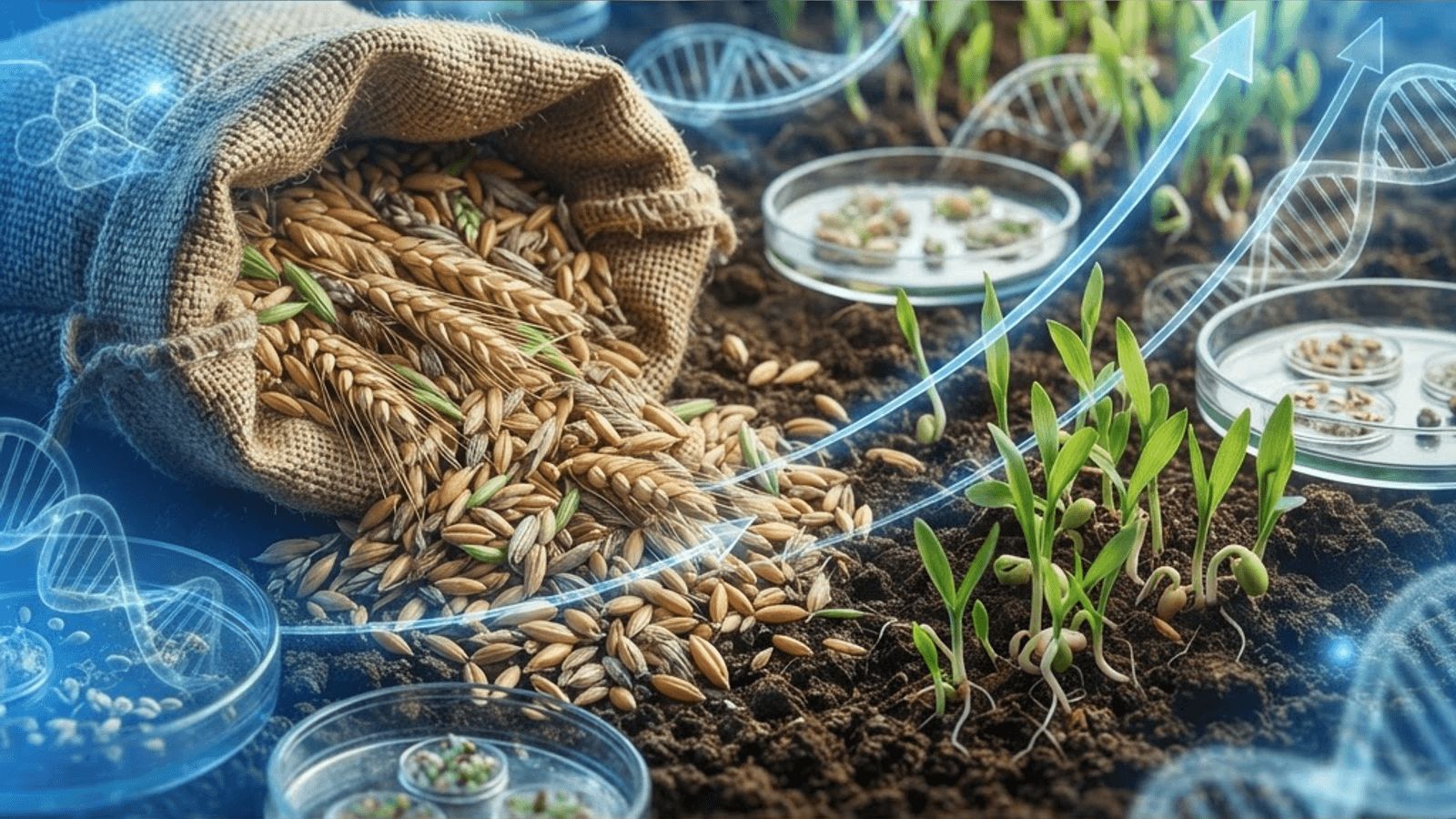
Why Seed Matters More Than Farmers Often Realise
Seed is one of the smallest line items on a typical farm budget in Fermanagh and Omagh and one of the most influential. A grass sward established today may remain in production for eight, ten or fifteen years, determining forage yield, feed quality and ultimately livestock performance throughout that period. Choosing a cheap mixture to save a modest amount per acre can cost many times that in reduced output over the life of the ley.
The district's climate is exceptionally well suited to grass. High rainfall, mild winters and a long growing season allow yields that farmers in drier regions cannot match. The constraint is not growth potential but sward quality, since older permanent pasture drifts toward less productive species and weed grasses over time, losing a substantial proportion of its potential output.
The Seed Categories That Matter Locally
Perennial ryegrass dominates, available in diploid and tetraploid forms and in early, intermediate and late heading varieties. Diploids produce denser swards with better persistence under grazing, while tetraploids offer higher sugar content and palatability. Blending heading dates extends the grazing and cutting window.
Clover, particularly white clover for grazing and red clover for silage, has returned to prominence because it fixes atmospheric nitrogen, reducing bought in fertiliser requirements substantially. Multi species swards incorporating plantain, chicory and various legumes have attracted strong interest for their drought resilience, deep rooting, mineral content and potential animal health benefits.
Forage crops including kale, swedes, stubble turnips and fodder beet support winter feeding and outwintering systems. Cereals are grown mainly as wholecrop or for on farm feed. Environmental mixes for pollinators, wild bird cover and buffer strips have grown rapidly alongside agri environment scheme participation.
Ten Leading Seed Companies and Merchants
1. Erne Grass Seed Company formulates grazing and silage mixtures using recommended list varieties selected specifically for high rainfall conditions and heavy soils typical of the lakelands.
2. Sperrin Forage Seeds serves the Omagh area with grass, clover and forage crop seed, and provides practical agronomy advice on establishment timing and sward management for upland and marginal ground.
3. Tyrone Agricultural Seed Merchants operates as a broad line merchant supplying seed alongside fertiliser, lime and crop protection, allowing farmers to plan a complete reseeding programme through one supplier.
4. Lakeland Clover and Legume Specialists focuses on nitrogen fixing systems, supplying white and red clover, inoculation where required and management guidance to help farms genuinely reduce fertiliser dependence.
5. Fermanagh Multi Species Sward Supply provides diverse herbal ley mixtures combining grasses, legumes and herbs, supporting farms pursuing resilience, reduced inputs and improved soil structure.
6. Clogher Valley Cereal and Wholecrop Seed supplies spring and winter cereal seed for wholecrop silage and home mixed feed, along with advice on variety choice for the district's shorter, wetter harvest window.
7. Drumquin Environmental Seed Mixes formulates pollinator, wild bird cover, buffer strip and wildflower meadow mixtures using appropriate species for farms participating in environmental schemes.
8. Omagh Amenity and Sports Turf Seed addresses the non agricultural market, supplying hard wearing and fine turf mixtures to sports clubs, councils, golf courses and landscapers across the district.
9. Westside Cover Crop and Soil Health Seed supplies catch crops and cover crop mixtures that protect soil over winter, capture residual nutrients, reduce erosion and add organic matter.
10. Enniskillen Horticultural and Vegetable Seed serves market gardeners, community growing projects, schools and domestic gardeners with vegetable, herb and flower seed suited to the local climate.
The Economics of Reseeding
Reseeding is an investment decision, and the figures are usually compelling. A well established new ley can produce substantially more dry matter per hectare than a tired old pasture, with better digestibility and higher response to applied nutrients. Because livestock convert higher quality forage more efficiently, the gain flows through directly to liveweight gain or milk yield.
Timing matters greatly. Late summer and early autumn reseeding generally works well in this district, giving establishment in warm soil with reliable moisture before winter. Spring reseeding is possible but sacrifices grazing during the peak growth period. Soil testing beforehand is essential, since a new sward sown into soil with poor pH or low phosphorus will never reach its potential regardless of variety quality.
Establishment method depends on conditions. Full cultivation gives the cleanest result and allows lime and nutrient incorporation. Direct drilling and overseeding are cheaper and less disruptive but require good weed control and careful management. Rolling after sowing to ensure seed to soil contact is routinely underestimated in importance.
Variety Selection and Recommended Lists
Independent recommended lists provide trial data on yield, quality, disease resistance and ground cover for grass varieties tested under local conditions. Using these lists rather than unnamed generic mixtures is one of the simplest improvements a farmer can make. Merchants who publish the exact varieties and proportions in their mixtures, rather than describing them only in general terms, demonstrate confidence in their formulation.
Seed certification is also important. Certified seed carries guarantees on varietal purity, germination rate and freedom from contaminating weed seeds. Uncertified or farm saved grass seed can introduce persistent weed problems that take years to resolve.
Environmental and Policy Drivers
Nutrient management regulation and ambitions to reduce agricultural emissions have both increased interest in clover and multi species swards. Reducing manufactured nitrogen lowers both cost and emissions, while diverse rooting improves soil structure and water infiltration on heavy ground. Agri environment funding has further encouraged environmental seed mixes, creating a distinct market segment that barely existed a generation ago.
Final Thoughts
Seed supply in Fermanagh and Omagh has moved well beyond simply selling bags of grass. The best merchants combine certified, clearly specified varieties with genuine agronomic advice on soil condition, establishment and subsequent management. Given how long a sward remains in the ground, investing in quality seed and proper establishment is one of the highest return decisions available to any livestock farm.
Want your brand featured in front of decision-makers? Publish a guest post or get a link insertion in our guides through AAMAX's guest post and link insertion service.
Helpful Links
 SponsoredAAMAX — Full-Service Digital Agency
Write for Us
Share your expertise with our readers. We welcome guest contributions from industry specialists.
Pitch your idea