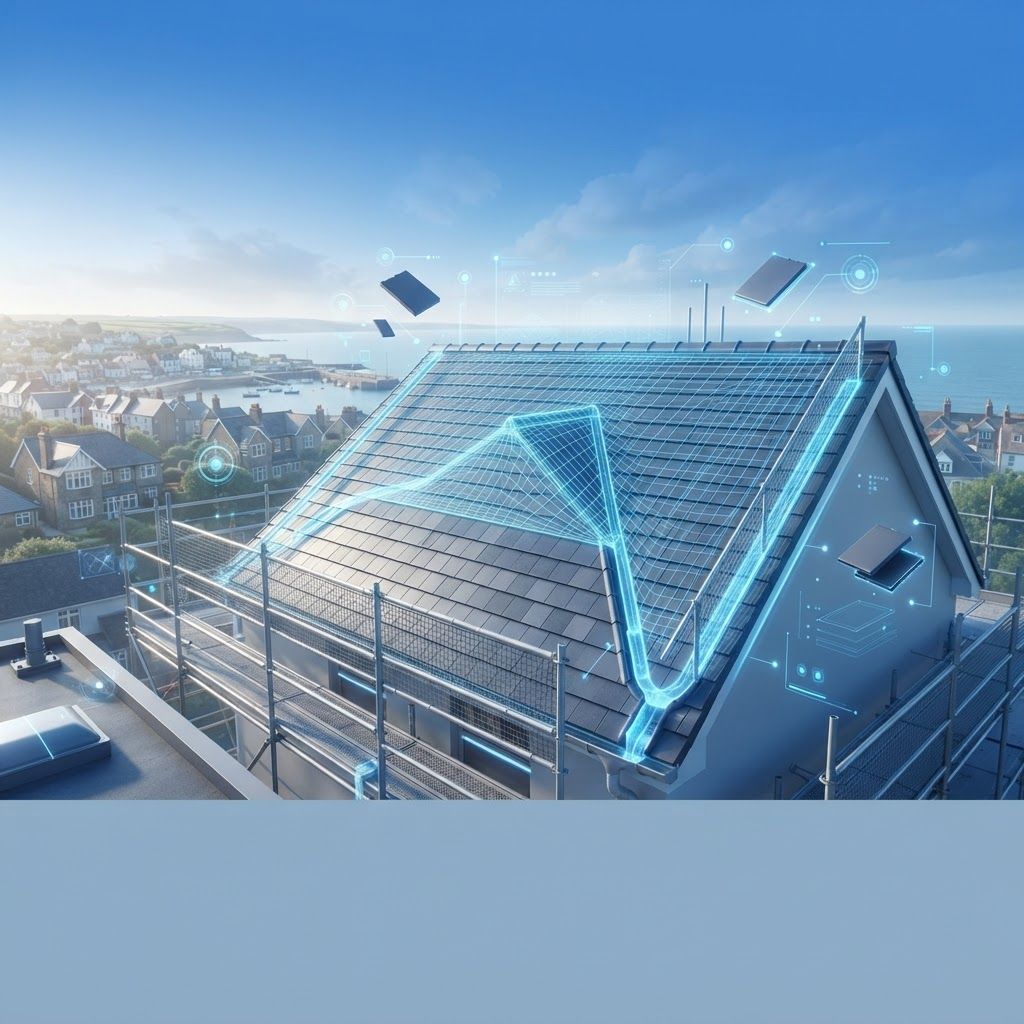
Roofing Conditions Along the Arun Coast
Few building elements work harder in Arun than the roof. The district's exposure to prevailing south-westerly winds coming off the English Channel means roofs face sustained uplift pressure, particularly at ridges, verges, and eaves where wind loading concentrates. Salt-laden air corrodes ferrous fixings and degrades some flashing materials faster than inland equivalents. Driving rain penetrates at angles that vertical-fall assumptions do not account for, testing underlay and lap detailing severely.
The building stock adds further complexity. Arundel and older parts of Littlehampton contain slate and clay-tiled roofs, sometimes original, where matching materials and respecting historic detailing matter. Post-war housing across Rustington and Angmering typically has concrete interlocking tiles now reaching the end of their expected service life. Bungalows and extensions across the district feature flat roofs, historically covered in felt and now increasingly in modern single-ply or liquid systems. Coastal properties often have chimney stacks and parapets that suffer disproportionately from weather exposure.
The Ten Leading Roofing Companies in Arun
Arun Roofing Contractors is one of the district's most established firms, covering pitched and flat roofing, re-roofing, repairs, and associated leadwork. The business carries out proper survey work before quoting, including loft inspection to assess underlay, timber condition, and ventilation, which frequently reveals issues invisible from ground level.
Coastal Roofing Sussex specialises in exposed seafront properties. Enhanced fixing specifications, mechanically fixed ridge and verge systems rather than mortar bedding, stainless steel fixings to resist salt corrosion, and reinforced eaves detailing address the specific failure modes coastal roofs experience.
Bognor Regis Flat Roofing concentrates on flat and low-pitch roofs. Modern EPDM rubber membranes, single-ply systems, and liquid-applied waterproofing offer service lives far exceeding traditional felt, and the firm's detailing around upstands, outlets, and abutments is where its quality shows.
Arundel Heritage Roofing works on period, listed, and conservation-area buildings. Natural slate, handmade clay tiles, traditional leadwork, and lime-based bedding require skills that have become scarce, and the firm is comfortable working within conservation constraints and sourcing appropriate reclaimed or matched materials.
Littlehampton Roof Repairs focuses on repair rather than replacement. Slipped and broken tiles, failed flashings, ridge re-bedding, valley repairs, and leak tracing form its core work, and the firm is honest about when repair remains viable and when replacement is the more economical course.
Sussex Chimney and Leadwork specialises in the details where most roof leaks actually originate. Chimney repointing and flaunching, lead flashing and soaker replacement, valley lining, parapet detailing, and abutment work are its territory. Skilled leadwork, properly welted and fixed to allow thermal movement, is a genuinely specialist craft.
Rustington Guttering and Roofline handles rainwater goods and roofline components. Gutter replacement and realignment, fascia and soffit renewal, and downpipe and drainage connection prevent the water damage that failed guttering inflicts on walls and foundations, a common problem across Arun's older housing.
Felpham Roof Cleaning and Coating provides maintenance rather than construction. Moss removal, biocide treatment, and gutter clearance extend roof life meaningfully. The firm is refreshingly candid about roof coatings, which are heavily marketed and frequently unsuitable, advising against them where they would trap moisture or void guarantees.
Barnham Rural Roofing serves inland villages, agricultural buildings, and outbuildings. Profiled metal sheeting, fibre cement, corrugated systems, and large-span structures require different equipment and expertise from domestic roofing, and the firm handles both.
Angmering Green Roofing installs living roofs and integrated solar systems. Sedum and wildflower roofs on garden buildings, extensions, and garages provide insulation, biodiversity, and stormwater attenuation, while in-roof solar integration achieves a flusher, more weathertight result than surface-mounted panels.
Materials and Systems Explained
Pitched roof coverings in Arun typically fall into several categories. Natural slate offers exceptional longevity, often exceeding a century, at a higher initial cost. Clay tiles, both plain and interlocking, weather attractively and last many decades. Concrete tiles are more economical but heavier and generally shorter-lived. Metal roofing, in standing seam or profiled forms, suits contemporary architecture and low pitches.
Flat roofing has improved dramatically. EPDM rubber membranes are typically installed in single sheets with few or no joints and carry long warranties. Single-ply PVC and TPO systems are hot-air welded, producing homogeneous seams. Liquid-applied systems suit complex geometry with many penetrations. Traditional built-up felt remains in use but is now generally the least durable option.
Beneath the covering, the underlay, battens, ventilation, and insulation matter as much as the visible surface. Poor ventilation causes condensation and timber decay, a problem frequently created when insulation is upgraded without addressing airflow, and one that Arun's humid coastal conditions make worse.
Trends and Regulatory Change
Insulation and ventilation standards have tightened considerably. Re-roofing now typically triggers thermal upgrade requirements under Building Regulations, and correct implementation demands attention to airflow paths, vapour control, and eaves detailing to avoid creating condensation problems.
Solar integration has grown rapidly. In-roof mounting systems that replace tiles rather than sitting above them are increasingly specified, particularly on re-roofing projects where the two works can be combined efficiently.
Green and blue roofs are appearing more often, driven by biodiversity requirements and stormwater management policy. On flat extensions and garden buildings across Arun they are now a realistic mainstream option.
Drone surveying has changed inspection practice, allowing detailed assessment without scaffolding and producing photographic evidence homeowners can actually examine before authorising work.
Choosing a Roofing Contractor
Roofing attracts more rogue trading than almost any other domestic trade, largely because defects are invisible from ground level and homeowners cannot verify workmanship. Protect yourself accordingly.
Look for membership of a recognised body such as the National Federation of Roofing Contractors or a manufacturer-approved installer scheme, which usually enables insurance-backed guarantees. Confirm public liability insurance and appropriate cover for work at height, and verify that scaffolding will be properly erected rather than ladders used for extensive work.
Insist on a written specification naming tile or membrane manufacturer and model, underlay type, fixing specification, and ventilation provision. Request photographs during the work, particularly of concealed elements such as underlay laps, flashings, and timber repairs. Never pay substantially in advance, and be extremely wary of unsolicited approaches claiming to have spotted a problem from the road.
Finally, ask about guarantees in detail: what is covered, for how long, whether it is insurance-backed, and what maintenance conditions apply. On Arun's exposed coastline, a properly specified and installed roof is one of the highest-value investments a homeowner can make.
Want your brand featured in front of decision-makers? Publish a guest post or get a link insertion in our guides through AAMAX's guest post and link insertion service.
Helpful Links
 SponsoredAAMAX — Full-Service Digital Agency
Write for Us
Share your expertise with our readers. We welcome guest contributions from industry specialists.
Pitch your idea