

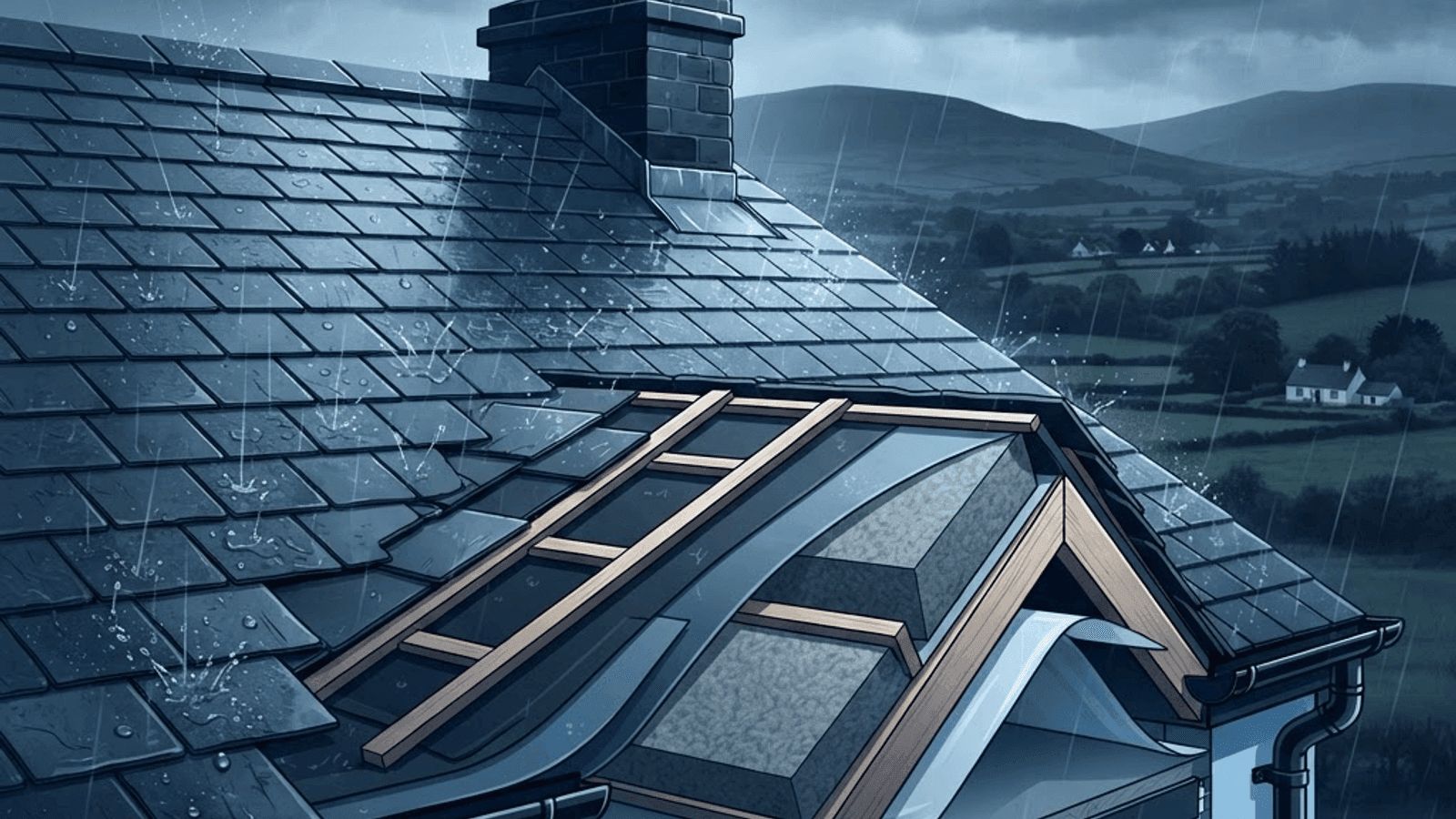
The Roof as a Building's First Defence
Few building elements work harder in Mid Ulster than the roof. The district experiences persistent rainfall, frequent strong winds sweeping across Lough Neagh and over the Sperrins, driving rain from the prevailing south west, and freeze thaw cycles through winter. A roof that would perform adequately in a sheltered inland English county can fail within years here if detailing and fixing specification are not appropriate to the exposure.
That reality has produced a roofing sector with real practical knowledge. Local contractors understand wind uplift, the importance of mechanical fixing rather than reliance on mortar bedding, and the ventilation requirements that prevent condensation forming within roof structures during long damp periods.
Roof Types and Materials
Pitched roofing dominates domestic construction. Natural slate remains the traditional choice, valued for longevity that can exceed a century when properly installed and maintained. Fibre cement slate offers a lighter and more economical alternative with a similar appearance. Concrete and clay tiles are widely used, with interlocking profiles providing good weather resistance on exposed sites.
Flat roofing has improved dramatically. Modern single ply membranes, reinforced bitumen systems and liquid applied coatings substantially outperform the felt roofs that gave flat construction a poor reputation. Rubber membrane systems have become popular for extensions and dormers because they can be installed in a single seamless sheet.
Metal roofing, particularly standing seam zinc, aluminium and steel systems, is increasingly used on contemporary rural dwellings and agricultural buildings. It handles exposure well and suits the modern architectural language that has become common in the district's new builds.
Ten Roofing Contractors Across Mid Ulster
Mid Ulster Roofing Contractors covers new roofs, re-roofing and repair across slate, tile and flat systems with full scaffolding provision. Cookstown Slating and Tiling specialises in natural slate work, including heritage and conservation projects.
Dungannon Flat Roof Systems focuses on single ply membrane and liquid applied roofing for extensions and commercial buildings. Magherafelt Roof Repairs handles storm damage, leak diagnosis and targeted repair rather than unnecessary full replacement.
Sperrin Industrial Roofing works on agricultural and industrial buildings, including composite panel systems and roof light replacement. Blackwater Guttering and Rainwater installs and maintains gutters, downpipes and fascia systems, which are as important as the roof covering itself.
Torrent Metal Roofing provides standing seam zinc and aluminium installation for contemporary residential and commercial projects. Clogher Valley Heritage Roofing undertakes traditional lead work, stone slate and conservation appropriate detailing.
Ulster Roofline and Cladding covers soffit, fascia, dry verge systems and external wall cladding. Mid Ulster Roof Inspections completes the list, offering surveys, drone assessment and condition reporting for property purchasers and owners.
Trends and Technical Developments
Solar integration has become mainstream, with photovoltaic panels either mounted above the covering or integrated as roof tiles. Coordination between roofer and electrical installer is essential, as poorly executed penetrations are a frequent source of leaks.
Insulation and ventilation strategy has grown more sophisticated. Warm roof construction, where insulation sits above the structural deck, avoids many condensation risks associated with older cold roof designs. Breathable membranes and properly sized ventilation paths are now standard practice in competent installations.
Drone surveying has changed inspection practice, allowing detailed assessment without scaffolding and producing photographic evidence that helps homeowners understand exactly what is being recommended. Green roofs and rainwater harvesting are also appearing more frequently, driven by drainage and sustainability considerations.
Recognising Quality Workmanship
Several indicators separate durable roofing from work that will fail early. Mechanical fixing of ridge and verge tiles using dry systems outperforms mortar bedding, which cracks and washes out over time in wet windy conditions. Correct nail specification and adequate slate headlap matter enormously on exposed sites.
Lead work quality around chimneys, valleys and abutments is a reliable indicator of a skilled contractor, since these details cause the majority of leaks. Proper underlay with adequate support and correctly formed drips into gutters prevents water tracking back into the structure.
Beware of unsolicited approaches offering roof repairs, a persistent problem in rural districts. Legitimate contractors provide written quotations, verifiable local references and proper insurance documentation.
Maintenance and Longevity
Roofs benefit greatly from modest routine attention. Clearing gutters and valleys of debris prevents overflow and saturation of walls. Inspecting after severe storms catches displaced slates before water ingress damages timbers and ceilings. Checking flashings, chimney pointing and roof light seals periodically extends service life considerably.
Mid Ulster's roofing contractors work in demanding conditions and the best of them have developed detailing standards well above minimum requirements as a result. Choosing on demonstrated quality rather than lowest price is nowhere more justified than in roofing, where the cost of failure extends far beyond the roof itself.
Repair or Replace
One of the most common questions homeowners face is whether a tired roof needs replacing or simply repairing. The answer usually turns on the condition of the fixings and underlay rather than the covering. Natural slate frequently outlives the nails holding it, producing widespread slippage even though the slates themselves remain sound. In those cases, stripping and re-roofing using the salvaged slate can be economical and preserves the building's appearance.
Where deterioration is localised, such as a failed valley, cracked flashing or a small area of storm damage, targeted repair is entirely appropriate and considerably cheaper. A reputable contractor will say so rather than recommending full replacement by default.
Timing also matters. Planning a re-roof for spring or summer allows better working conditions and reduces the risk of exposure during removal. Combining the work with insulation upgrades, roof light installation or solar provision while scaffolding is already erected reduces overall cost meaningfully.
Want your brand featured in front of decision-makers? Publish a guest post or get a link insertion in our guides through AAMAX's guest post and link insertion service.
Helpful Links
 SponsoredAAMAX — Full-Service Digital Agency
Write for Us
Share your expertise with our readers. We welcome guest contributions from industry specialists.
Pitch your idea

