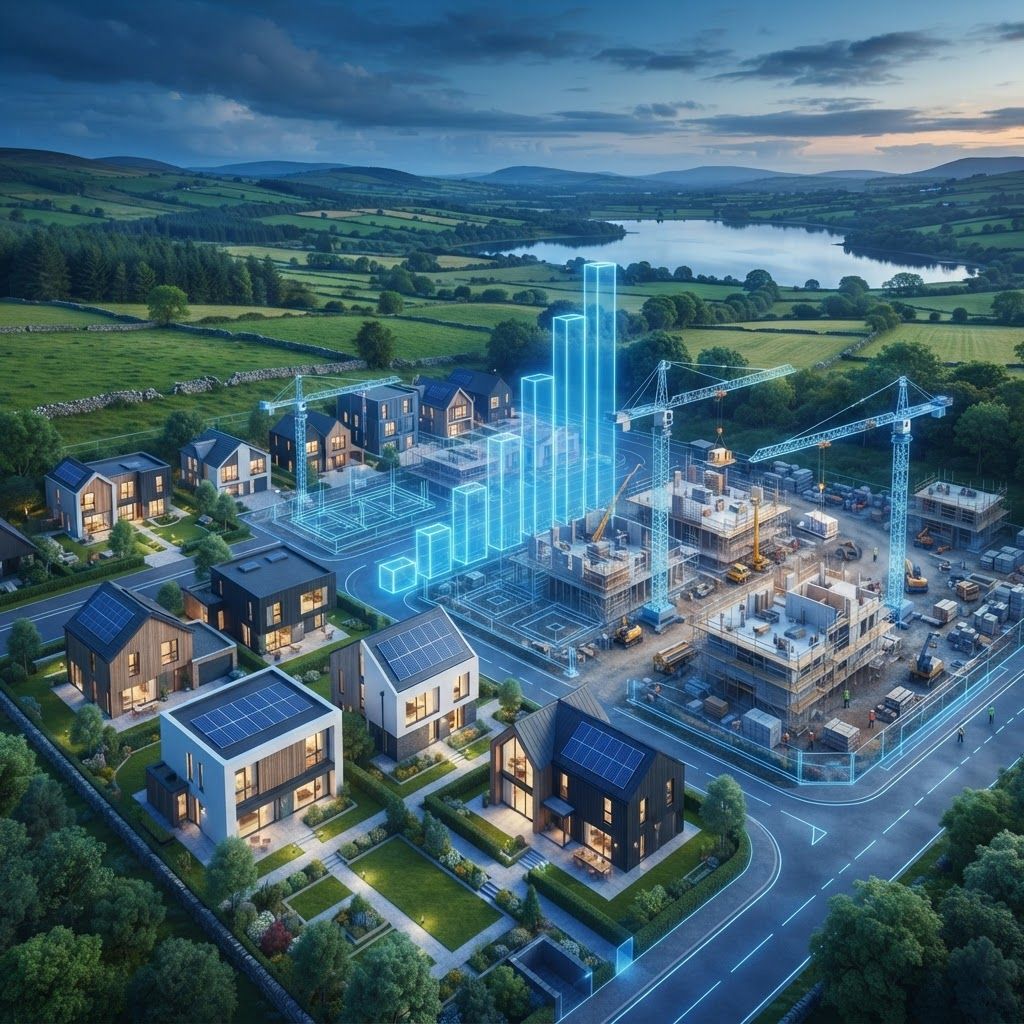
A District Building for the Future
Residential development in Fermanagh and Omagh operates under conditions that differ markedly from those in Belfast or Derry. Land is more available but planning policy is more protective, particularly around the Erne lakelands, the Sperrins Area of Outstanding Natural Beauty and the many conservation areas within historic market towns. Development here is rarely about volume. It is about appropriate scale, sympathetic design and delivering homes that suit a dispersed rural population.
Demand has nonetheless been strong. Household formation, returning families, remote working and a shortage of modern stock have combined to keep new homes selling quickly in Enniskillen, Omagh, Dromore, Irvinestown, Fintona and Lisnaskea. Developers have responded with a mix of detached family housing, semi-detached starter homes, bungalows suited to downsizers and, increasingly, small apartment schemes close to town centres.
What Defines a Quality Developer
Buyers in the district have become considerably more discerning. Energy performance is now a primary purchase criterion rather than a technical afterthought. Rising heating costs and exposed rural locations mean that airtightness, insulation depth, heat pump specification, mechanical ventilation and glazing quality directly affect affordability of ownership. Developers achieving genuinely high energy performance certificates hold a clear market advantage.
Build quality and warranty provision matter equally. Structural warranties, professional consultant certificates where applicable, and a developer's willingness to handle snagging promptly separate the reliable from the merely competent. A strong developer provides a clear snagging process, a named contact after completion and a documented approach to defects during the warranty period.
Placemaking is the third differentiator. The best schemes in the district include usable open space, safe pedestrian routes, sensible parking provision, native landscaping and drainage designed for genuine Northern Irish rainfall. Developments that feel like places rather than collections of houses retain value more effectively.
The Ten Leading Residential Developers
1. Erne Valley Homes has built a reputation for family housing on the edge of Enniskillen, combining traditional external finishes with contemporary internal layouts. Its schemes are noted for generous plot sizes, mature landscaping and consistently high energy ratings achieved through fabric-first construction.
2. Omagh Developments Group focuses on medium-sized estates around Omagh, with a product range spanning townhouses to detached homes. Its strength is phased delivery, which allows buyers to see completed earlier phases before committing to later ones, and a well-regarded customer care team.
3. Sperrin Country Builders specialises in rural one-off housing and replacement dwellings, working closely with clients through planning, design and construction. Its expertise in navigating rural planning policy in sensitive landscape areas makes it a frequent choice for self-builders in west Tyrone.
4. Lakeland Property Developments concentrates on waterside and near-water housing around the Erne system. Sensitive siting, flood resilience, high-performance glazing to capture views and careful management of drainage and wastewater are hallmarks of its schemes.
5. Drumragh Construction delivers starter and second-time-buyer housing at accessible price points, achieved through efficient standardised design rather than reduced specification. It has consistently supported first-time buyers, which has made it an important part of local housing supply.
6. Clogher Valley Homes works across the southern part of the district producing bungalows and single-storey living designed for downsizers and accessibility. Level thresholds, wider doorways, wet rooms and future adaptability are designed in from the outset rather than retrofitted.
7. Strule Regeneration Developments specialises in brownfield and town centre sites, converting redundant commercial buildings and infilling underused land. Its work supports town centre vitality and has delivered apartments and mews housing within walking distance of services.
8. Fermanagh Heritage Restoration takes on historic and listed properties, barn conversions and traditional stone buildings. Conservation-grade workmanship, lime mortars, breathable construction and careful upgrading of thermal performance without damaging historic fabric define its output.
9. Tyrone Sustainable Housing pursues low-energy and near-passive construction, delivering homes with very low heating demand through high insulation levels, exceptional airtightness, heat recovery ventilation and air source heat pumps. Running-cost modelling is presented to buyers as standard.
10. Enniskillen Custom Build Partners operates a serviced-plot and custom-build model, providing infrastructure and a menu of house types that purchasers can adapt. It offers a middle path between buying an off-the-shelf new build and managing a full self-build project.
Trends in Local Residential Development
Energy standards continue to tighten, and developers are moving decisively away from oil heating toward air source heat pumps, underfloor heating and photovoltaic arrays. In a district with significant off-gas-grid housing, this transition has substantial implications for long-term affordability.
Modern methods of construction are gaining ground. Timber frame has long been common in Northern Ireland, and closed-panel systems, factory-fitted insulation and off-site manufactured components are reducing build times and improving quality consistency, which matters in a climate with limited dry construction windows.
Design is responding to changed living patterns. Home offices, improved broadband provision, larger utility and boot rooms suited to rural life, and flexible ground floor spaces that can serve multigenerational households now appear routinely in local layouts.
Biodiversity and drainage requirements are also increasing. Sustainable drainage systems, permeable surfacing, attenuation ponds, native hedgerow retention and wildlife-friendly landscaping are becoming standard expectations rather than optional extras.
What Buyers Should Check
Inspect the specification document line by line. Insulation values, heating system type, ventilation strategy, glazing specification, kitchen and bathroom allowances and external works should all be defined in writing. Verbal assurances at a show home carry little weight later.
Review the warranty provider and understand exactly what is covered and for how long. Ask about the snagging process, who carries it out, and the typical timescale for resolution. Speak to residents in earlier phases of the same development, as their experience of aftercare is the most reliable indicator available.
Examine the site layout rather than just the house. Consider orientation for daylight and solar gain, proximity to future phases, parking arrangements, refuse access, broadband provision and who will maintain shared areas once the developer leaves. Management company arrangements and associated charges should be clarified before reservation.
Finally, verify planning conditions. Occupancy restrictions, landscaping obligations and phasing conditions can all affect a property, and a solicitor experienced in local new-build conveyancing will identify issues that a general practitioner might miss.
Looking Forward
Residential development in Fermanagh and Omagh will continue to balance growth against landscape protection. Expect more emphasis on energy performance, more town centre regeneration, continued strength in rural custom build and a gradual shift toward homes designed for longer occupancy and lower running costs. For buyers, the district offers something increasingly rare: new housing with genuine space, set in outstanding surroundings, at prices well below the regional hotspots.
Want your brand featured in front of decision-makers? Publish a guest post or get a link insertion in our guides through AAMAX's guest post and link insertion service.
Helpful Links
 SponsoredAAMAX — Full-Service Digital Agency
Write for Us
Share your expertise with our readers. We welcome guest contributions from industry specialists.
Pitch your idea