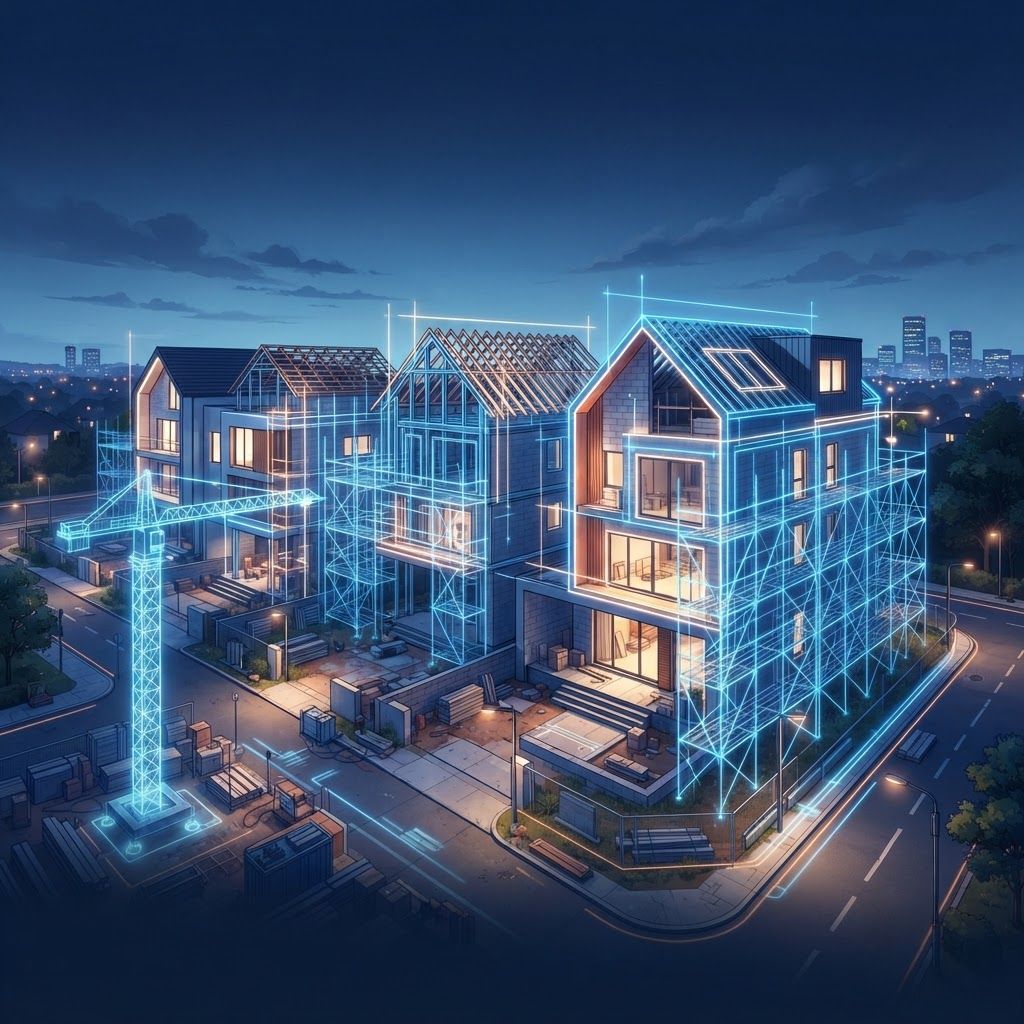
Warrington's Residential Landscape
Few towns in the North West have a housing story as layered as Warrington's. The town centre and inner districts contain dense Victorian and Edwardian terraces built around the wire, brewing and chemical industries. Surrounding them are substantial post-war council estates, then the significant expansion driven by new town designation in the 1960s and 1970s, which created areas such as Birchwood and Westbrook with their distinctive planned layouts. More recently, major development at Chapelford Village, Omega and various brownfield sites has added thousands of modern homes.
This variety creates unusually broad demand for residential construction. On any given week, local firms are building new estate housing, extending 1930s semis, converting Victorian terraces into flats, retrofitting insulation into solid-wall properties and delivering entirely bespoke self-build homes in the surrounding Cheshire villages.
The Different Types of Residential Builder
National volume housebuilders deliver large estate developments with standardised house types, sales suites, NHBC warranties and predictable specification tiers.
Regional developers work on smaller sites, often brownfield or infill, with more design variation and a stronger local identity.
Custom and self-build contractors construct individual homes to a client's architectural design, managing the process from foundations to handover.
Extension and renovation specialists serve the existing housing stock, which represents the majority of residential construction activity by volume of transactions.
Social and affordable housing contractors deliver schemes for housing associations and the local authority, working to specific space and sustainability standards.
Barratt Homes and David Wilson Homes
Barratt Developments, operating through Barratt Homes and its David Wilson Homes brand, is one of the most active housebuilders in the North West. Its developments typically offer a graduated range from two-bedroom starter homes through to larger detached family houses, with David Wilson positioned at the more premium end with higher specification kitchens, larger room proportions and more generous plots.
The appeal for buyers is process certainty: a defined build programme, staged inspections, ten-year structural warranty cover, and a customer service framework for post-completion snagging. The trade-off, as with all volume housebuilding, is limited flexibility on layout beyond the available options and upgrades.
Taylor Wimpey
Taylor Wimpey has a long-standing presence across Cheshire and the wider North West, with a portfolio that tends to emphasise family housing and community layout considerations such as green space provision, cycle routes and school proximity. Its homes are generally delivered with strong energy performance credentials, reflecting the industry-wide shift toward improved fabric standards, air tightness and low-carbon heating readiness.
Its buyer support offering, including part exchange and assisted move arrangements, is frequently used by families upsizing within Warrington who need to coordinate a sale with a purchase.
Bellway Homes
Bellway is another significant regional player, known for a broad range spanning apartments through to substantial detached houses. Its developments often include a mix of tenures, with affordable housing delivered alongside open market sales through partnerships with housing associations. Bellway has been notably active on brownfield regeneration, which is directly relevant in Warrington given the volume of former industrial land available for residential conversion.
Redrow Homes
Redrow has built its reputation on the Heritage Collection, a range of traditionally styled homes drawing on Arts and Crafts influences with bay windows, brick detailing and pitched roof forms. This design-led positioning appeals to buyers who want the practical advantages of a new build, including efficiency and warranty cover, without the uniform contemporary appearance common elsewhere.
Interiors typically feature open-plan kitchen and dining spaces, generous glazing and dedicated home working areas, reflecting how household requirements have shifted in recent years.
Regional and Local Developers
Alongside the national names, Warrington supports a healthy population of regional developers working on smaller sites of perhaps five to fifty homes. These schemes are often infill plots, converted commercial buildings or brownfield parcels too small to interest volume builders.
Their advantage is responsiveness and design individuality. Buyers frequently get more input on internal finishes, and the developer's reputation is directly tied to the local market rather than a national brand, which tends to sharpen attention to quality. For buyers seeking something distinctive within Warrington rather than on its expanding fringes, this segment is often the most rewarding.
Extension and Renovation Builders
By volume of projects, extension and renovation work dominates residential construction in Warrington. The town's large stock of terraced, semi-detached and 1970s housing offers substantial improvement potential, and with moving costs high, many households choose to extend rather than relocate.
Common projects include rear single-storey extensions with bifold or sliding glazing, side return infills on terraces, two-storey side extensions, loft conversions with rear dormers, and garage conversions into home offices or additional living space. Established local builders in this space coordinate structural engineers, building control inspections, party wall matters and planning or permitted development confirmation.
The quality distinction here comes down to detail: proper foundation design for the ground conditions, correct steel beam sizing and fire protection, adequate insulation and air tightness at junctions, thoughtful drainage, and clean integration between old and new structure so the extension does not read as an afterthought.
Custom Build and Self-Build Contractors
Self-build remains a smaller but growing part of the market, particularly in the villages surrounding Warrington such as Grappenhall, Stockton Heath, Lymm and Culcheth where individual plots occasionally become available. Contractors specialising in this work manage a bespoke architectural design through groundworks, superstructure, envelope, services and finishes.
These projects typically achieve higher performance standards than volume housebuilding, with timber frame or structural insulated panel systems, triple glazing, mechanical ventilation with heat recovery, air source heat pumps and solar photovoltaics increasingly standard. They demand more client involvement and carry more financial risk, but deliver homes precisely matched to requirements.
Social and Affordable Housing Delivery
Contractors delivering for housing associations and the local authority work to particular standards covering space, accessibility and sustainability. Much of this work in Warrington involves both new build schemes and large-scale retrofit programmes, including external wall insulation, window replacement, heating system upgrades and fire safety improvements across existing stock. It is a substantial and steady part of the local construction economy.
Trends in Residential Construction
Energy performance is transforming the sector. The direction of regulation is clearly toward very low carbon homes, which means heat pumps replacing gas boilers, significantly improved insulation and air tightness, waste water heat recovery and solar generation as normal specification rather than upgrade.
Modern methods of construction are gaining ground, with offsite panelised systems, factory-built bathroom pods and precision-engineered timber frames reducing site duration and improving consistency. Retrofit is arguably the bigger opportunity, given that most Warrington homes were built long before current standards, and the specialist skills required for retrofitting solid-wall properties without creating damp problems are in high demand.
Design preferences have shifted too, with home working space, better natural light, flexible ground floor layouts and usable outdoor space now consistently prioritised by buyers.
How to Choose a Residential Builder
For new build purchases, visit completed developments rather than only show homes, speak to residents where possible, and check warranty provider and customer satisfaction records. Understand exactly what is included in the base price versus upgrades.
For extensions and renovations, verify insurance and relevant trade memberships, request references for similar projects and inspect completed work. Insist on a detailed written specification, a clear payment schedule tied to milestones and a defined variations process. Confirm who is responsible for building control and planning submissions.
Across both routes, be wary of quotations well below the field. In residential construction that almost always indicates omitted scope rather than efficiency, and the difference surfaces later as unwelcome extras.
Final Thoughts
Warrington's residential construction sector serves an exceptionally varied housing stock, from Victorian terraces through new town estates to contemporary developments. National housebuilders provide scale, warranty security and predictable process; regional developers offer character and flexibility; local extension specialists unlock value in existing homes; and custom build contractors deliver bespoke performance. Choosing the right category first, then selecting carefully within it, is the most reliable route to a home that performs well and holds its value.
Want your brand featured in front of decision-makers? Publish a guest post or get a link insertion in our guides through AAMAX's guest post and link insertion service.
Helpful Links
 SponsoredAAMAX — Full-Service Digital Agency
Write for Us
Share your expertise with our readers. We welcome guest contributions from industry specialists.
Pitch your idea