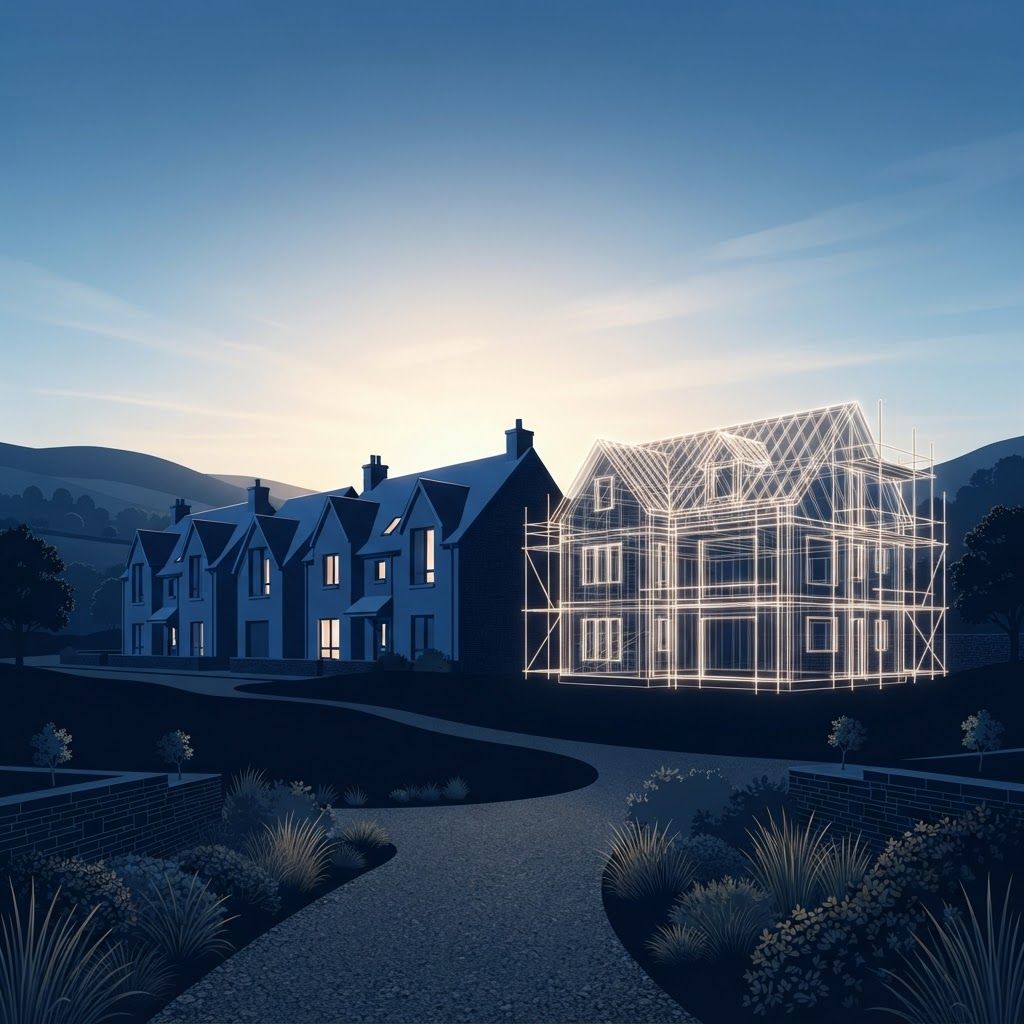
The Renfrewshire Housing Picture
Residential construction in Renfrewshire has been notably active for over a decade. The region's appeal is straightforward: proximity to Glasgow and its employment market, direct motorway and rail links, Glasgow Airport for international travel, established schools, and considerably better value per square metre than comparable west end or East Renfrewshire locations. Bishopton in particular has seen one of Scotland's largest new community developments on former industrial land, while Erskine, Linwood and the edges of Paisley have all absorbed substantial new housing.
Alongside volume development sits a healthy market in individual builds and major refurbishment. Renfrewshire's housing stock spans Victorian and Edwardian sandstone properties, interwar and post-war suburban homes, tenement flats and rural cottages in the western villages. Each type demands different construction knowledge, which is why the region supports both large developers and highly specialised smaller builders.
1. Barratt Homes and David Wilson Homes
Operating as part of the largest housebuilding group in the United Kingdom, these brands have delivered substantial developments across the west of Scotland including Renfrewshire. Their strengths are process consistency, structural warranty provision, energy-efficient standard specifications and the practical convenience of buying a complete home with predictable timescales. David Wilson positions at a higher specification level, while Barratt covers a broader price range including first-time buyer housing.
2. Taylor Wimpey
Taylor Wimpey has been a consistent presence in Scottish residential development, with a reputation for well-planned layouts and attention to placemaking rather than simply maximising plot numbers. Its developments typically include landscaping, footpath connectivity and a mix of house types that supports varied household needs. Customer service processes and post-completion snagging procedures are formalised, which matters more than buyers often anticipate.
3. Bellway Homes
Bellway delivers a wide range of house types across Scotland and has been active in the Renfrewshire and wider Glasgow area. Its appeal lies in specification flexibility, with buyers able to select finishes and options at an early stage, and in part exchange and assisted move schemes that simplify chain management. Build quality is backed by structural warranty and a defined defects period.
4. Persimmon Homes and Charles Church
Persimmon operates at volume across Scotland, with Charles Church serving its premium segment. The group's scale supports competitive pricing, and its developments frequently include affordable housing contributions that broaden access. Buyers should engage actively with the pre-completion inspection process, as thorough snagging at handover is the single most effective way to secure a well-finished new home from any volume builder.
5. Cala Homes
Cala focuses on the upper end of the Scottish market, with larger house types, higher specification finishes and generally more generous plots. Its developments in the west of Scotland attract buyers relocating from urban Glasgow who want family space without sacrificing commuting convenience. Design detailing, kitchen and bathroom specification and landscaping standards are typically a clear step above volume housebuilding.
6. Housing Associations and Social Housing Contractors
A major and often overlooked part of Renfrewshire's residential construction is delivered by housing associations working with contractors on new affordable homes and estate regeneration. Modern social housing in the region is built to high energy standards, frequently exceeding private specification on insulation and heating efficiency. Associations such as those operating in Paisley and Linwood have delivered notable regeneration alongside community facilities.
7. Self-Build and Custom Home Contractors
For those buying a plot in the rural west of Renfrewshire, around Lochwinnoch, Kilbarchan, Houston or Bridge of Weir, custom builders deliver individually designed homes. These contractors coordinate architectural design, building warrant applications, structural engineering, utility connections and construction. Timber frame and structural insulated panel construction are increasingly popular, offering faster weathertight completion and excellent thermal performance suited to Scottish conditions.
8. Extension and Whole-House Refurbishment Builders
Many Renfrewshire households choose to improve rather than move, and specialist refurbishment builders serve this market. Their work spans rear and wraparound extensions, loft conversions with dormers, structural reconfiguration of ground floors, complete rewiring and replumbing, and full replacement of kitchens and bathrooms. Working in occupied properties requires organisation and consideration that new build sites do not demand, and the best firms manage this well.
9. Tenement and Traditional Property Specialists
Paisley and Renfrew contain significant traditional stock where construction methods differ fundamentally from modern building. Specialists in this field handle sandstone repair and indenting, lime mortar repointing, slate roof renewal, timber sash and case window restoration, and breathable internal insulation systems that avoid trapping moisture. Applying inappropriate modern materials to solid stone walls causes damp and decay, making genuine traditional expertise essential rather than optional.
10. Timber Frame and Modern Methods of Construction Suppliers
Scotland has a strong timber frame tradition, and offsite manufactured systems are increasingly used across Renfrewshire. Factory-produced wall panels, floor cassettes and roof trusses reduce on-site time, improve dimensional accuracy and limit weather-related delay, which is a significant advantage in the west of Scotland climate. Modular and volumetric construction is also gaining ground on larger sites where repetition suits factory production.
Warranties, Warrants and Legal Protection
New homes should carry a recognised structural warranty covering major defects for ten years, with a shorter builder liability period for finishes and services. All construction requires a building warrant from the local authority before starting, and a completion certificate afterwards, which is essential for future sale. For custom builds and extensions, ensure the contract defines specification, programme, staged payments against verified progress and a retention held until snagging is complete.
Energy Standards and Future-Proofing
Scottish building standards for new homes have tightened considerably, and new construction now emphasises airtightness, high insulation levels, mechanical ventilation with heat recovery, and low-carbon heating rather than gas boilers. Air source heat pumps have become standard on many developments. For buyers, this means lower running costs, but it also means understanding how to operate a heat pump system correctly, since it behaves differently from a conventional boiler.
Practical Advice for Buyers and Self-Builders
Visit completed phases of any development rather than only the show home, and speak to residents about build quality and after-sales response. For self-build, secure detailed ground investigation and a fixed-price contract wherever possible, and budget a contingency of at least ten per cent. For refurbishment, commission a survey before committing, since older Renfrewshire properties commonly reveal wiring, roof and dampness issues that reshape budgets. In all cases, appoint contractors with verifiable local completions rather than relying on marketing alone.
Want your brand featured in front of decision-makers? Publish a guest post or get a link insertion in our guides through AAMAX's guest post and link insertion service.
Helpful Links
 SponsoredAAMAX — Full-Service Digital Agency
Write for Us
Share your expertise with our readers. We welcome guest contributions from industry specialists.
Pitch your idea