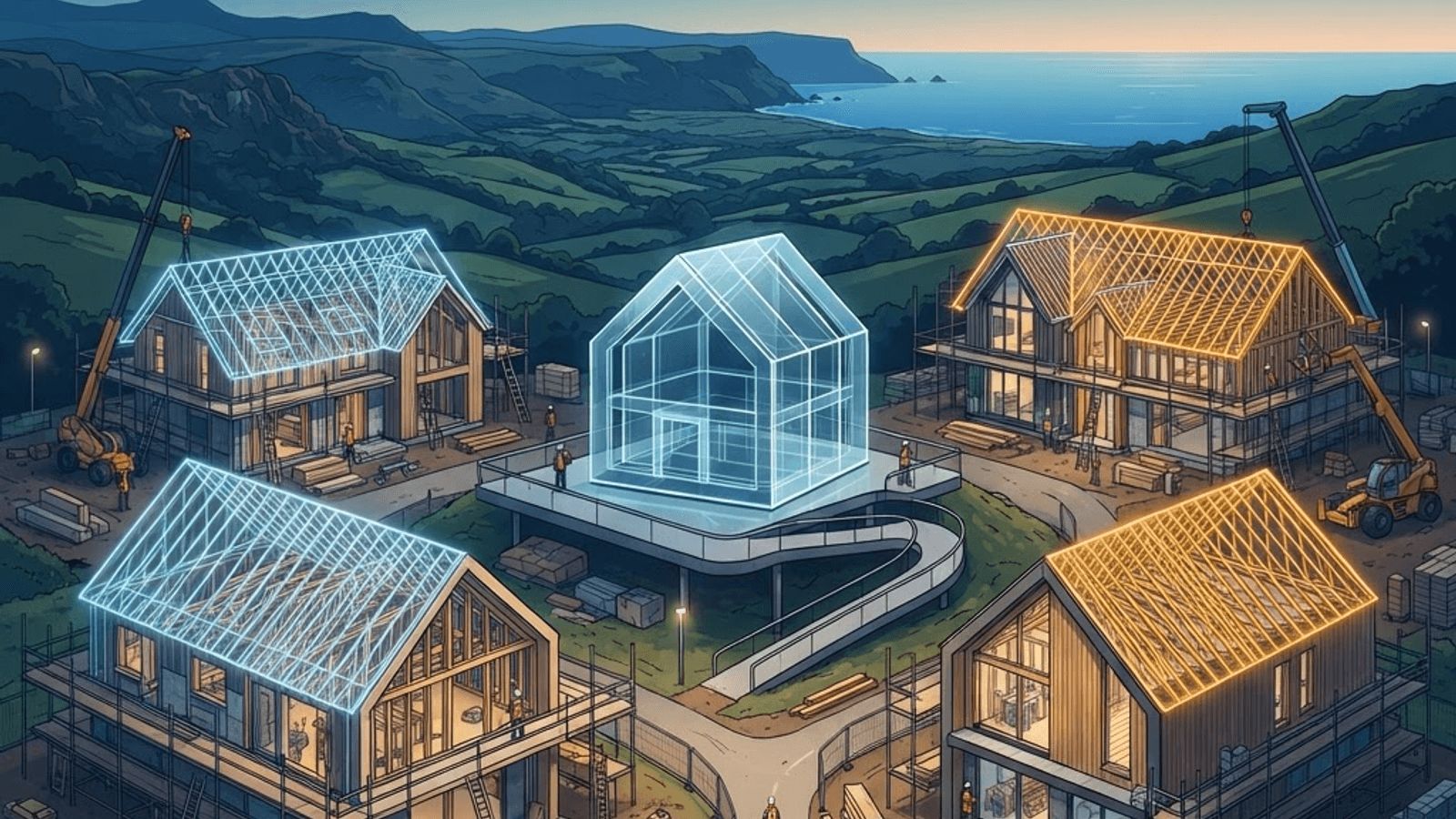
Housebuilding in Pembrokeshire Today
Residential construction in Pembrokeshire operates under distinctive conditions. The county combines significant housing demand, driven partly by the attractiveness of the coast and partly by local need, with unusually tight planning constraints. A third of the county lies within the Pembrokeshire Coast National Park, where development is carefully controlled to protect landscape character, and much of the remainder falls under policies balancing rural housing need against conservation.
The result is a market where quality and appropriateness matter more than volume. Large-scale estate development is limited compared with the South Wales valleys or the M4 corridor. Instead, the county's residential construction sector is characterised by individual self-build homes, small developments, barn conversions, replacement dwellings and extensions to existing properties.
The Planning Dimension
Anyone building in Pembrokeshire should understand that planning is usually the longest and most uncertain part of the process. Within the national park, design guidance favours forms, materials and scales sympathetic to local vernacular — slate roofs, render or stone walls, modest massing, and careful siting that avoids skyline prominence. Contemporary design is not prohibited, but it must be demonstrably high quality and contextually justified.
Outside the park, Pembrokeshire County Council applies its local development plan, with particular attention to sustainable location, highway access, drainage and landscape impact. Welsh planning policy also incorporates a distinctive one planet development route for genuinely low-impact rural dwellings, which some applicants in the county have pursued successfully.
Builders experienced locally can advise realistically on what will gain consent, which frequently saves applicants from expensive designs that were never going to be approved.
The Top 10 Residential Construction Options in Pembrokeshire
1. Established Local Housebuilders — Firms with long trading histories in the county, delivering individual homes and small developments. Their strongest asset is accumulated local knowledge: which subcontractors are reliable, how ground conditions vary across the county, what building control will expect, and how to detail buildings for coastal exposure. They typically work on a traditional contract with an architect-produced design.
2. Self-Build Specialist Contractors — Pembrokeshire has an active self-build community, and contractors specialising in this market guide clients through the process, from site appraisal and design coordination to construction and warranty provision. Self-build offers considerable cost and customisation advantages, but requires more client involvement, and a contractor experienced in supporting first-time self-builders is invaluable.
3. Timber Frame Construction Companies — Off-site manufactured timber frame is well suited to Welsh conditions. The structure is erected and made weathertight rapidly, reducing exposure to the county's frequent rainfall, and factory manufacture delivers consistent thermal performance and airtightness. Insulation levels achievable with timber frame systems make meeting current Welsh Building Regulations energy standards more straightforward.
4. Barn Conversion Specialists — Converting redundant agricultural buildings is a significant Pembrokeshire specialism. The work demands sensitivity to the original structure, expertise in stabilising historic stonework, and careful integration of insulation and services without destroying character. Planning policy generally supports conversion over demolition, making this an attractive route to a distinctive home.
5. Eco and Low-Energy Home Builders — A growing segment, delivering homes to Passivhaus or comparable low-energy standards using natural materials, high insulation levels, mechanical ventilation with heat recovery, and renewable technologies. Pembrokeshire's exposure suits wind and solar generation, and rising energy costs have moved low-energy building from niche interest to mainstream consideration.
6. Extension and Home Improvement Contractors — Given planning constraints on new dwellings, many Pembrokeshire households extend rather than move. Contractors specialising in extensions, loft conversions, garage conversions and reconfiguration deliver the majority of residential construction spend in the county by volume.
7. National and Regional Volume Housebuilders — Larger developers deliver estate schemes in and around the county's main towns, particularly Haverfordwest, Pembroke Dock and Milford Haven. These homes come with structural warranties, standardised specifications and predictable pricing. Buyers trade customisation for certainty and the protections that come with new build warranty schemes.
8. Stone and Traditional Craft Builders — Pembrokeshire's building heritage is substantially stone based, and craftspeople skilled in traditional stonework, lime mortar and slate roofing maintain and extend that tradition. This expertise is essential for work on older properties, where inappropriate modern materials cause damp and decay, and is increasingly valued in new build within sensitive landscapes.
9. Modular and Prefabricated Home Suppliers — Factory-built modular homes delivered to site offer speed and cost certainty. Quality has improved substantially, and modern modular homes meet full building regulation standards. Site access is the main constraint in Pembrokeshire, as delivering large modules along narrow rural lanes requires careful route assessment.
10. Renovation and Restoration Contractors — Bringing existing housing stock up to modern standards, including thermal upgrades, rewiring, replumbing, damp remediation and full refurbishment. With a considerable proportion of the county's housing predating modern construction standards, this work represents a substantial and growing share of the residential market.
Building for the Coastal Environment
Specification matters enormously near the coast. Stainless steel or appropriately coated fixings resist salt corrosion where galvanised alternatives fail within years. Render systems must tolerate wind-driven rain, which in Pembrokeshire can be severe on exposed western elevations. Window and door systems need appropriate weather ratings, and roof detailing must account for uplift under high wind loading.
Drainage deserves particular attention. Welsh regulations require sustainable drainage systems on most new developments, meaning surface water must be managed on site through permeable surfaces, soakaways or attenuation rather than discharged to sewers. On clay soils this requires careful design.
Managing a Residential Project Successfully
Start with realistic budgeting, including a contingency of at least ten to fifteen per cent for unforeseen work, which on rural sites is genuinely likely. Commission a proper site investigation before finalising foundation design, as unexpected ground conditions are among the most common sources of cost overrun.
Choose a builder on demonstrated quality rather than price alone, verify insurance and warranty provision, and agree a written contract with staged payments tied to completed and inspected work. Visit previous projects and speak to past clients directly. In a county the size of Pembrokeshire, reputations are well known within the trade, and asking around locally will tell you a great deal that no brochure will.
Want your brand featured in front of decision-makers? Publish a guest post or get a link insertion in our guides through AAMAX's guest post and link insertion service.
Helpful Links
 SponsoredAAMAX — Full-Service Digital Agency
Write for Us
Share your expertise with our readers. We welcome guest contributions from industry specialists.
Pitch your idea