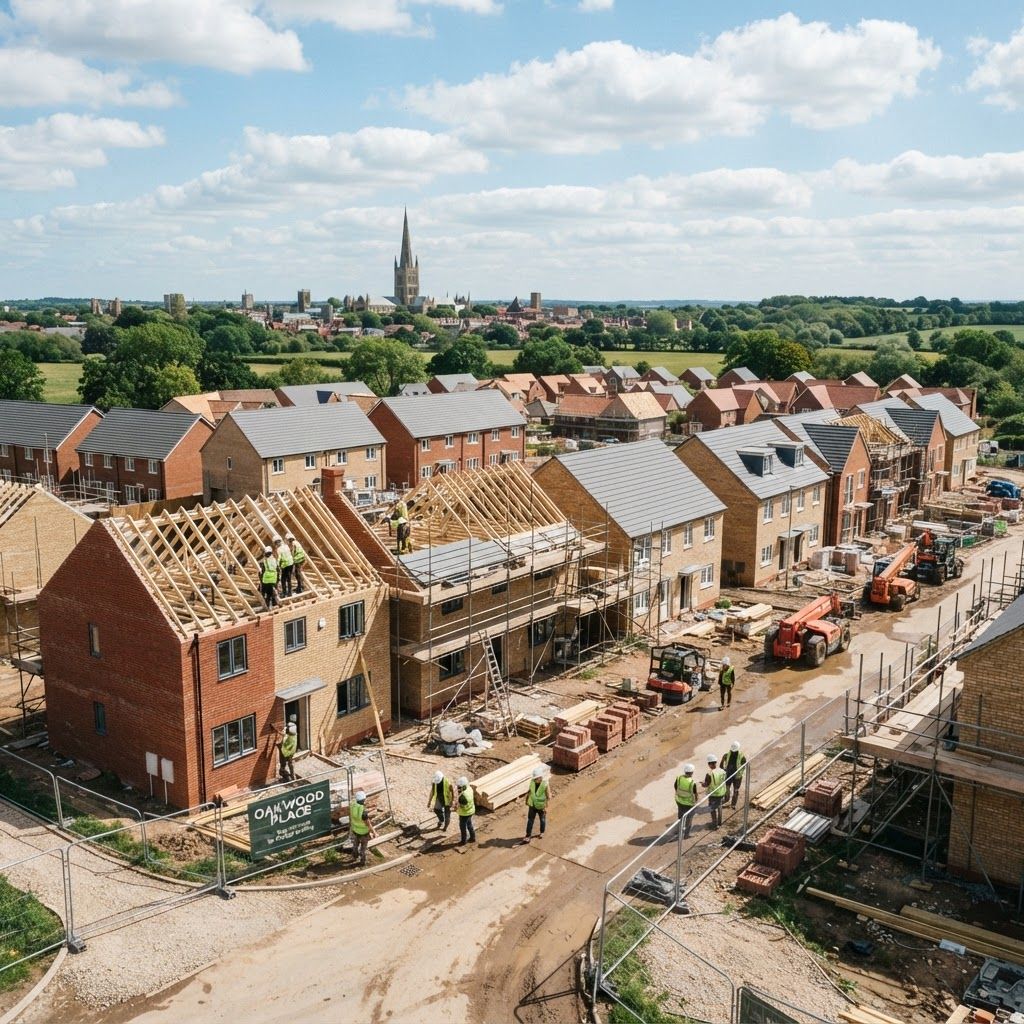
Residential Building in Norwich
Housebuilding in and around Norwich operates in a market shaped by unusual constraints. The city has strong demand driven by two universities, a substantial healthcare and research sector around the hospital and research park, and steady inward migration from more expensive regions. At the same time, the historic core limits where and how new housing can be built, and Norfolk's planning framework protects significant areas of landscape and heritage.
The result is a residential construction sector working across three quite different types of project: new build on allocated sites and infill plots, substantial extension and remodelling of existing homes, and conversion or renovation of older buildings. Companies tend to specialise, and matching the right builder to the right project type is the most important decision a client makes.
Understanding the Housing Stock
Norwich's residential fabric is genuinely varied. The Golden Triangle and Heigham areas are dominated by Victorian and Edwardian terraces, typically solid wall construction with suspended timber floors and limited insulation. The interwar suburbs brought cavity walls and larger plots. Post-war estates introduced system-built and non-traditional construction, some of which requires specialist assessment. And recent decades have delivered timber frame and modern masonry to progressively higher thermal standards.
Each type carries characteristic issues. Solid wall properties suffer damp problems when treated with inappropriate impermeable materials. Cavity walls may have failed or bridged insulation. Older extensions frequently have inadequate foundations. An experienced Norwich residential builder recognises these patterns quickly, which prevents expensive misdiagnosis.
The Ten Leading Residential Construction Companies in Norwich
1. Norwich Homes Construction. Builds individual new homes and small developments across the city and surrounding villages, handling projects from groundworks through to completion with in-house site management.
2. Anglia Residential Builders. Focuses on large-scale extensions, remodelling, and whole-house renovation. Its strength is working in occupied properties with phasing that keeps families living on site where possible.
3. Norfolk Timber Frame Homes. Specialises in timber frame construction, which offers speed of erection, excellent thermal performance, and reduced site disruption. Increasingly popular for self-build projects in the county.
4. Broadland Self Build Services. Supports self-builders with a range of involvement from shell construction to full turnkey delivery, including help navigating planning, warranties, and staged mortgage finance.
5. Wensum Heritage Restoration. Undertakes restoration and sympathetic modernisation of period and listed homes, using lime plaster, traditional joinery, and breathable construction methods appropriate to older fabric.
6. Eastern Passive House Builders. Delivers very low-energy homes built to rigorous airtightness and insulation standards, with mechanical ventilation and heat recovery. Running costs on these houses are a fraction of conventional new builds.
7. City Loft and Extension Company. Concentrates on loft conversions and single and double storey extensions, the most common form of residential construction in Norwich given the difficulty of finding building plots.
8. Norwich Barn Conversion Specialists. Converts agricultural buildings into homes, a significant market in rural Norfolk. This work combines heritage sensitivity with substantial structural and services engineering.
9. Norfolk Modular Housing. Uses off-site manufactured units assembled on site, cutting build programmes considerably and improving quality control by moving work into a factory environment.
10. Anglia Retrofit and Insulation. Focuses on upgrading existing homes with insulation, airtightness improvement, glazing, and low-carbon heating. Given the age of Norwich housing, this is arguably the most impactful residential construction work happening in the city.
Planning and Regulation
Many residential projects fall under permitted development rights and need no planning application, but the limits are specific and easily exceeded. Extensions beyond certain depths and heights, changes to the front elevation, and work in conservation areas or on listed buildings all require permission.
Norwich has extensive conservation area coverage and a large number of listed buildings, and consent requirements there are considerably stricter. Work carried out without required consent on a listed building is a criminal offence, not merely a planning breach, which is why heritage-experienced contractors are worth their premium.
Building regulations apply regardless of whether planning permission is needed. Structural work, drainage, insulation, ventilation, fire safety, and electrical installation all require compliance and inspection. A competent contractor manages this process, but the legal responsibility ultimately sits with the homeowner.
Warranties and Protection
New homes should carry a structural warranty covering major defects, and lenders generally require one before offering a mortgage. Self-builders need to arrange this at the outset, not retrospectively.
For extensions and renovation, insurance-backed guarantees provide protection if a contractor ceases trading. This is worth having on any substantial project, since the guarantee is only as good as the company standing behind it.
Site insurance during construction is often overlooked. A partially built structure is vulnerable to weather, theft, and damage, and standard household policies rarely cover it adequately.
Energy Performance and Future Requirements
Building standards continue to tighten, and homes built today must achieve thermal performance far beyond what was acceptable a decade ago. Heat pumps are increasingly the default heating specification for new homes, and their effectiveness depends entirely on building fabric being genuinely well insulated and airtight.
For existing Norwich homes, a fabric-first approach makes sense: insulation and airtightness before heating system replacement. Installing a heat pump in a poorly insulated Victorian terrace produces disappointing results and high running costs, whereas the same investment in fabric improvement delivers immediate benefit.
Budgeting Realistically
Construction costs have risen significantly and remain volatile. A contingency of at least ten to fifteen percent is prudent on new build and considerably more on renovation, where opening up an existing structure regularly reveals unexpected conditions.
Costs beyond the building contract catch people out: professional fees for architects and engineers, planning and building control charges, utility connections, landscaping, and finishes. A total project budget rather than a build cost is the only figure that means anything.
Want your brand featured in front of decision-makers? Publish a guest post or get a link insertion in our guides through AAMAX's guest post and link insertion service.
Helpful Links
 SponsoredAAMAX — Full-Service Digital Agency
Write for Us
Share your expertise with our readers. We welcome guest contributions from industry specialists.
Pitch your idea