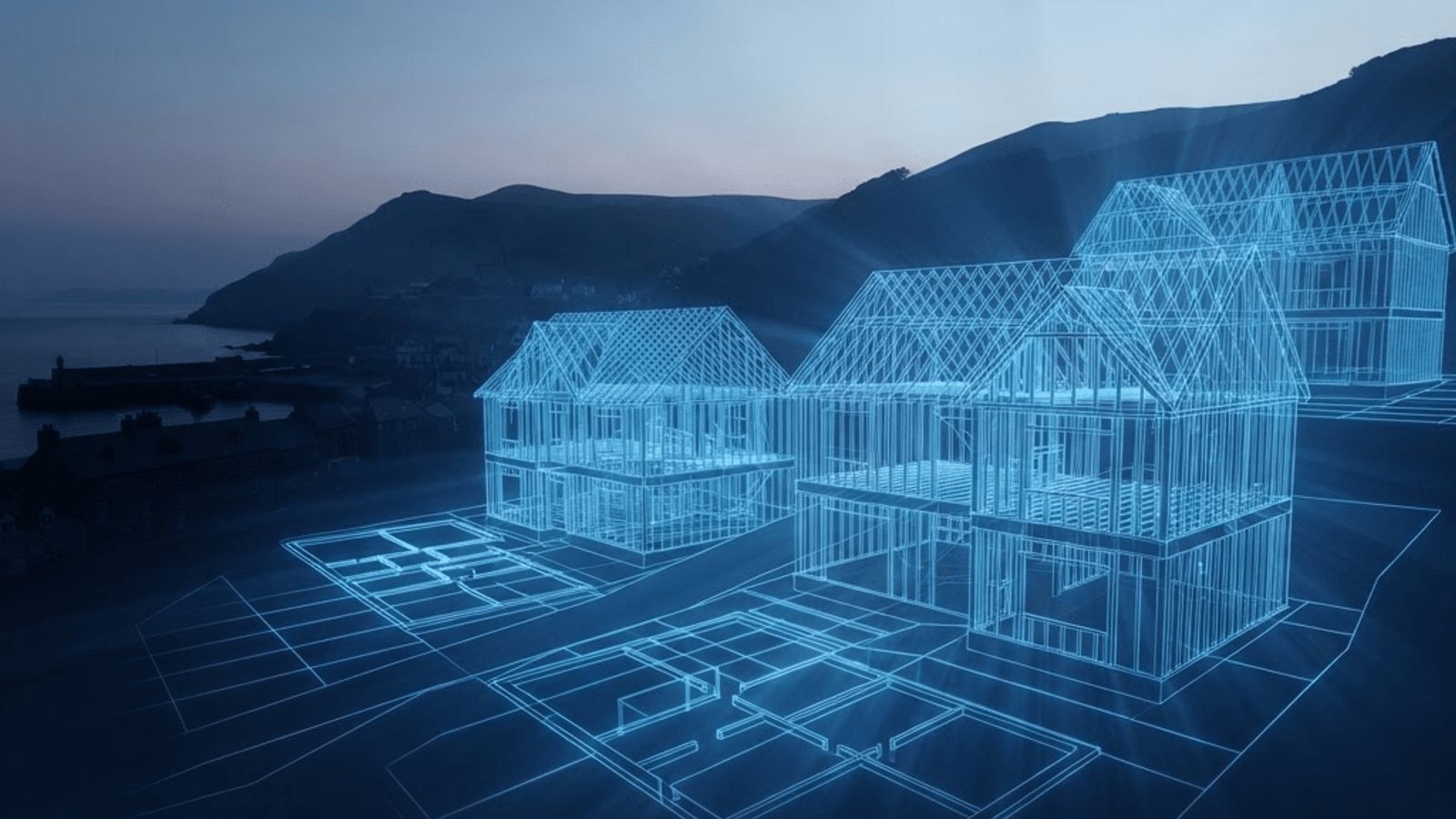
Residential Building in Conwy Today
Housing demand across Conwy is shaped by forces that pull in different directions. The coastal strip around Llandudno, Rhos-on-Sea, Colwyn Bay and Abergele attracts retirees, second-home buyers and holiday letting investors. The inland valleys and market towns such as Llanrwst serve families and agricultural communities seeking affordable, practical homes. Meanwhile, planning policy increasingly prioritises sustainable development and affordable housing provision, and building regulations in Wales set energy efficiency standards that now exceed those in England in several respects.
The result is a residential construction sector that must be both technically capable and commercially adaptable. The categories below represent the principal routes through which homes are delivered across the county.
1. Volume and Regional Housebuilders
Larger housebuilders deliver estate developments, typically on allocated sites near the coastal towns and larger settlements. Their strength lies in standardised house types, established supply chains and the financial capacity to fund infrastructure, roads and drainage in advance of sales. Buyers benefit from structural warranties, energy-efficient specifications built to current regulations, and the certainty of a completed product. The trade-off is limited design flexibility beyond a defined range of options.
2. Bespoke and Custom Home Builders
Bespoke builders create individual homes designed around a specific site and client brief. In Conwy this is particularly compelling because so many plots have exceptional outlook, whether across the estuary, towards the Carneddau mountains or along the coast. A well-designed bespoke home orientates its principal glazing towards those views while managing solar gain, wind exposure and privacy. These builders typically work closely with architects from the outset and deliver a small number of projects each year.
3. Self-Build Support Contractors
Self-building has grown steadily in Wales, supported by improved lending products and greater availability of technical guidance. Support contractors offer flexible arrangements, from delivering a weathertight shell that the client then completes internally, to full turnkey construction with the client managing only the design. This approach allows homeowners to control cost by contributing labour to finishing trades while leaving structural and regulated work to professionals.
4. Timber Frame and Modern Method Builders
Timber frame construction suits Welsh conditions well. Panels are manufactured under factory conditions and erected rapidly on site, which shortens the period during which the structure is exposed to weather, a genuine advantage in a region with high annual rainfall. Closed-panel systems with factory-installed insulation achieve excellent thermal performance and airtightness. Structural insulated panels and other modern methods of construction are increasingly used for the same reasons.
5. Traditional Stone and Masonry Builders
Traditional Welsh construction using local stone remains highly valued, both for its appearance and because planning authorities in conservation areas and within the national park often require materials sympathetic to local vernacular. Skilled masons working with random rubble, coursed stone and lime mortar are in demand for new builds designed to sit within historic settings, as well as for extensions to existing stone properties.
6. Barn and Building Conversion Specialists
Converting redundant agricultural buildings into dwellings is a well-established route to rural housing across the Conwy Valley. Conversions demand a particular skill set: assessing the structural viability of existing stonework, introducing insulation without trapping moisture in solid walls, forming new openings without compromising stability, and integrating modern services discreetly. Successful conversions retain the character that made the building worth converting in the first place.
7. Coastal and Exposed Site Specialists
Homes within reach of the Irish Sea face relentless wind-driven rain and salt-laden air. Builders experienced in these conditions specify marine-grade fixings, enhanced rainscreen detailing, robust window and door systems with high weather-tightness ratings, and render systems designed for severe exposure. They also understand that standard details adequate for inland sites frequently fail here within a few years.
8. Low Energy and Passive House Builders
Low energy construction has advanced considerably in North Wales. Builders working to Passive House principles or equivalent standards achieve very high insulation levels, rigorous airtightness, elimination of thermal bridging and mechanical ventilation with heat recovery. In a county with cold, damp winters and rising energy costs, the running cost savings are substantial, and the improvement in comfort and indoor air quality is immediately noticeable to occupants.
9. Retrofit and Deep Renovation Contractors
A large proportion of Conwy's housing stock predates modern insulation standards, and much of it is solid wall construction. Deep retrofit contractors improve these homes through internal or external wall insulation, roof and floor upgrades, window replacement and heating system modernisation. Moisture management is the central technical challenge; insulating a solid stone wall incorrectly can cause interstitial condensation and serious fabric damage. Competent retrofit specialists assess each building individually rather than applying a standard package.
10. Holiday Home and Letting Property Builders
Tourism is central to Conwy's economy, and there is consistent demand for holiday accommodation construction and refurbishment. This work has distinct requirements: durable finishes that withstand high turnover, compliance with fire safety and licensing standards for let properties, efficient heating that can be managed remotely, and rapid project delivery scheduled around the tourist season. Builders in this niche understand that every week of delay carries direct commercial cost.
Regulatory Context in Wales
Building regulations in Wales diverge from those in England in several important areas, particularly regarding energy performance and the requirement for automatic fire suppression systems in new dwellings. Sustainable drainage approval is required for most new developments, meaning surface water must be managed on site rather than simply discharged to sewers. Planning constraints vary significantly between the county borough area and land within Eryri National Park. A residential builder who works in Conwy regularly will anticipate all of these; one who does not may encounter costly surprises.
Cost, Programme and Realistic Expectations
Construction costs in North Wales are influenced by material transport distances, the availability of skilled trades and the complexity of individual sites. Sloping plots, poor ground conditions and restricted access all add meaningfully to groundworks costs. Clients should build a genuine contingency into their budget, typically a substantial percentage of the contract value, and should expect weather-related programme variation given the region's rainfall. A builder who provides honest, well-evidenced cost and programme advice at the outset is worth considerably more than one who quotes optimistically and revises upward later.
The Direction of Residential Construction
Several trends are reshaping housebuilding across Conwy. Heat pumps are rapidly replacing fossil fuel heating in new homes, supported by improved fabric performance that makes low temperature heating viable. Solar photovoltaic installation combined with battery storage is becoming a standard specification rather than an upgrade. Electric vehicle charging provision is now an expected feature. Alongside this, there is growing interest in low carbon materials, including timber structures, sheep wool and wood fibre insulation, and lime-based finishes that suit both the climate and the character of Welsh building traditions.
Want your brand featured in front of decision-makers? Publish a guest post or get a link insertion in our guides through AAMAX's guest post and link insertion service.
Helpful Links
 SponsoredAAMAX — Full-Service Digital Agency
Write for Us
Share your expertise with our readers. We welcome guest contributions from industry specialists.
Pitch your idea