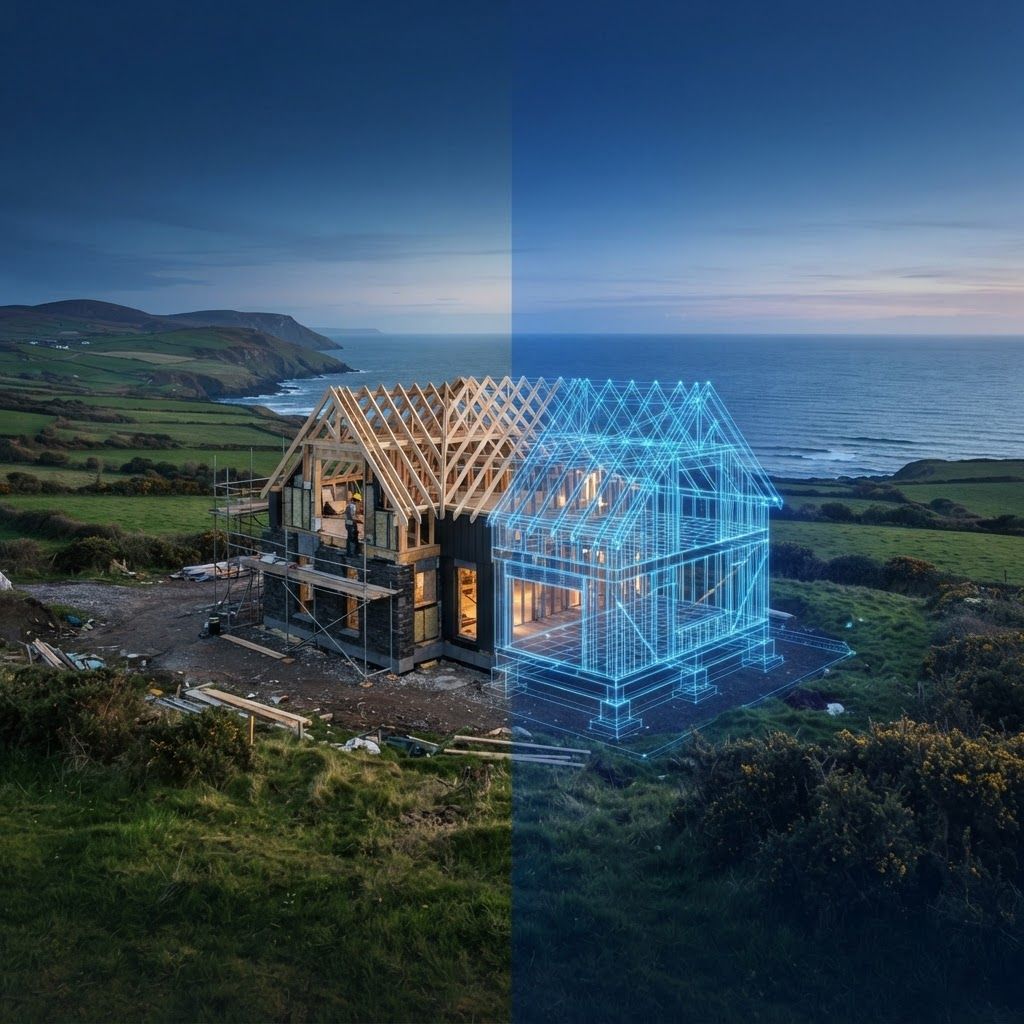
Building a Home on the Causeway Coast
There are few more appealing places in Ireland to build a home than the Causeway Coast and Glens. Sites overlooking the Atlantic, tucked into the shelter of a glen, or set within walking distance of Portstewart Strand carry obvious appeal. But building here demands more than an attractive plot. The combination of exposed coastal conditions, protected landscape designations, rural planning policy and dispersed infrastructure means that self-builders and developers need contractors who genuinely understand the region.
Wind-driven rain is the defining technical challenge. Rainfall arriving horizontally at speed penetrates details that would perform perfectly inland. Salt-laden air corrodes inadequately specified fixings, rainwater goods and external metalwork. Exposure also affects thermal performance, since wind washing through poorly sealed insulation dramatically increases heat loss. The best residential builders in the borough design and detail for these conditions as a matter of routine.
The Ten Residential Construction Specialisms
1. Custom Self-Build Contractors
Self-build remains strong across rural Northern Ireland, and contractors serving this market guide clients from site purchase through design, planning, construction and completion. They typically work on an open-book or fixed-price basis and coordinate architects, engineers and trades on the client's behalf. Their value lies in translating a homeowner's aspirations into a buildable, compliant and affordable scheme.
2. Timber Frame and Offsite Manufacture Builders
Timber frame construction has a significant share of the Northern Ireland housing market, offering rapid weathertight enclosure, excellent thermal performance and factory-controlled quality. Panels are manufactured offsite and erected in days, which is a meaningful advantage in a climate with limited dry weather windows. Structural insulated panels and closed-panel systems take this further, arriving with insulation and services routes already integrated.
3. Traditional Masonry Housebuilders
Cavity wall masonry remains the most familiar construction method in the borough and performs excellently when detailed properly. Full-fill or partial-fill insulation, correctly installed cavity trays, appropriate wall ties and careful attention to junctions determine long-term performance. Masonry also offers thermal mass and a robustness that many clients value on exposed coastal sites.
4. Passive House and Low-Energy Specialists
Certified passive house and near-passive construction is growing steadily as energy costs climb. These builders achieve extremely low heating demand through very high insulation levels, triple glazing, rigorous airtightness and mechanical ventilation with heat recovery. Achieving certification requires a level of workmanship discipline well beyond standard practice, particularly around airtightness membrane detailing and thermal bridge elimination.
5. Residential Developers and Housing Schemes
Volume and small-scale developers deliver housing estates, infill sites and apartment schemes around Coleraine, Portrush, Limavady and Ballymoney. Their work involves site acquisition, planning promotion, infrastructure provision and phased construction. Demand in the borough is influenced strongly by both local household formation and the second-home and holiday-let market along the coast.
6. Home Extension and Structural Alteration Builders
Extending is often more practical than moving, particularly given property availability in desirable coastal locations. These builders handle rear and side extensions, wrap-around extensions, two-storey additions and internal reconfiguration involving structural steel. Successfully marrying new work to existing construction, matching materials and managing occupied-site disruption are their core competencies.
7. Loft, Garage and Outbuilding Conversion Specialists
Converting existing space is the most cost-efficient way to gain accommodation. Loft conversions require careful structural design to transfer loads, adequate head height, compliant stair access and fire separation. Garage and outbuilding conversions demand attention to insulation, damp-proofing and ventilation, since these structures were rarely built to habitable standards originally.
8. Rural and Agricultural Dwelling Builders
Building in the countryside in Northern Ireland is governed by specific rural planning policy, and contractors experienced in this area understand what is achievable. They work with sites that may lack mains drainage, requiring wastewater treatment systems, and may need private water supplies, access improvements and considerable groundworks. Their knowledge of what planners will accept in terms of siting, scale and materials saves clients significant time.
9. Coastal and Exposed-Site Construction Experts
Sites within sight of the Atlantic require specific technical responses. These include rendered or slate-hung rainscreen walls, stainless steel fixings throughout, robust window and door specifications rated for high wind loads, enhanced flashing details and careful roof design to resist uplift. Builders experienced on such sites also plan construction sequencing around weather windows, knowing that a partially enclosed building can suffer badly in a storm.
10. Property Restoration and Barn Conversion Contractors
The borough has a stock of traditional stone farmhouses, cottages and agricultural buildings suitable for sympathetic conversion. This work requires knowledge of lime mortar, breathable construction, solid wall insulation strategies that avoid interstitial condensation, and structural stabilisation of aged masonry. Done well, these conversions produce homes of enormous character; done badly, they trap moisture and deteriorate rapidly.
Understanding Build Cost Drivers
Several factors move residential construction costs substantially in this borough. Site conditions are foremost, as rock excavation, poor ground requiring engineered foundations, or steep slopes needing retaining structures can add considerably before anything visible is built. Access matters too, since restricted rural lanes limit deliveries and may require smaller plant. Services connections can be expensive where mains water, electricity or drainage are distant. Specification choices, particularly glazing area, roof complexity and external finishes, drive cost significantly. Finally, project management quality affects cost through waste, rework and programme overrun.
The Planning and Regulatory Path
Most new homes require full planning permission from the council, with rural sites assessed against countryside policy. Sites within the Area of Outstanding Natural Beauty face additional design scrutiny regarding scale, materials and landscape impact. Building control approval covers structural adequacy, fire safety, energy performance, ventilation and accessibility. An energy performance assessment is required, and increasingly stringent standards are pushing specifications towards better insulation and low-carbon heating such as air source heat pumps.
Selecting and Working With Your Builder
Ask to see completed homes, ideally including one occupied for several years so you can ask the owner about how it has performed. Confirm insurance cover and, for new homes, whether structural warranty is provided. Agree a clear payment schedule tied to completed stages rather than dates, and retain a percentage until defects are rectified. Maintain regular site meetings with written records, as verbal agreements cause most disputes. Visit the site frequently during first fix, when insulation, membranes and services are visible but will soon be concealed.
Building for the Next Fifty Years
A home built well in the Causeway Coast and Glens should shrug off Atlantic storms, cost little to heat and require minimal maintenance. Achieving that outcome depends less on headline specification and more on the quality of detailing and workmanship at every junction. Choosing a builder with genuine local experience and a visible commitment to that standard is the most reliable route to a home that endures.
Want your brand featured in front of decision-makers? Publish a guest post or get a link insertion in our guides through AAMAX's guest post and link insertion service.
Helpful Links
 SponsoredAAMAX — Full-Service Digital Agency
Write for Us
Share your expertise with our readers. We welcome guest contributions from industry specialists.
Pitch your idea