

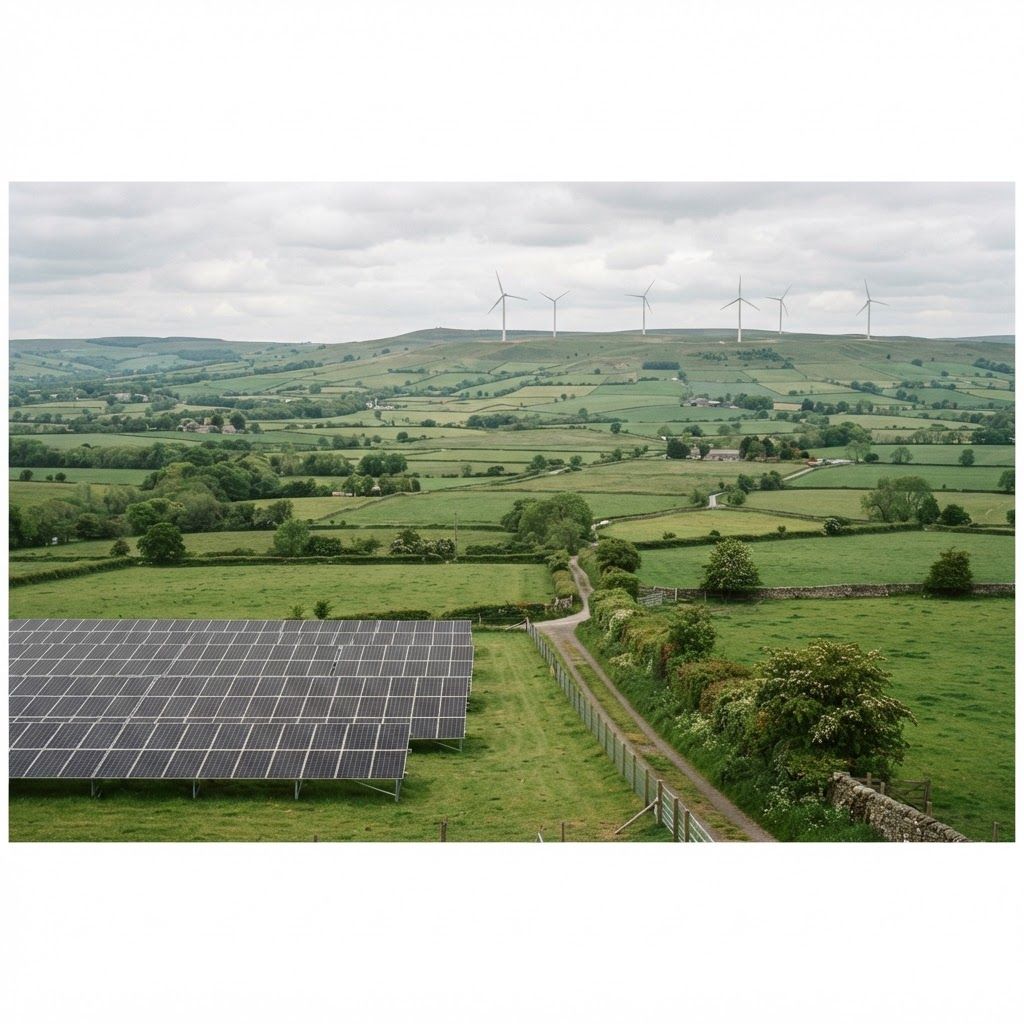
York's Position in the Energy Transition
North Yorkshire occupies an unusually significant place in the United Kingdom's energy system. The county hosts major generation infrastructure, extensive agricultural land suitable for solar and biomass, coastal and upland areas with strong wind resource, and a growing cluster of engineering and environmental expertise. York itself functions as a commercial and technical hub for this activity, with consultancies, installers, developers and research capability concentrated in and around the city.
Demand has shifted from environmental preference to economic necessity. Volatile wholesale energy prices have made on-site generation and efficiency measures financially compelling rather than merely virtuous. Corporate reporting expectations now require credible emissions data and reduction plans, particularly for businesses supplying larger organisations. Building regulations and planning policy increasingly require low-carbon heating and generation in new development. The result is that renewable energy has moved from a specialist procurement category into mainstream business and household investment.
The Main Technologies Explained
Solar photovoltaic systems generate electricity from daylight and suit most roofs and many ground-mounted sites, with output well matched to daytime commercial demand. Wind generation, at scale, remains the most productive renewable resource in exposed Yorkshire locations. Air and ground source heat pumps provide efficient heating by moving rather than generating heat, and perform best in reasonably well-insulated buildings. Biomass boilers use wood fuel and remain relevant for rural properties and agricultural buildings off the gas network. Battery storage captures generation for later use and enables participation in grid flexibility markets. Anaerobic digestion converts agricultural and food waste into gas and heat, which fits the surrounding farming economy particularly well.
1. Solar Installation Companies Serving York
A well-established group of accredited solar installers operates across York and North Yorkshire, delivering domestic rooftop systems, commercial roof arrays on warehouses and industrial units, and ground-mounted schemes on agricultural land. Quality providers begin with a genuine site assessment covering roof structure, orientation, shading and consumption patterns, then size the system to on-site demand rather than to available roof area, which produces materially better financial returns.
2. Heat Pump Installers and Low Carbon Heating Specialists
Heat pump installation has expanded rapidly around York, supported by grant funding and rising interest in alternatives to gas and oil heating. Competent installers conduct room-by-room heat loss calculations, assess and where necessary upgrade emitters and pipework, and design systems to operate at low flow temperatures. This design discipline is what separates a heat pump that performs efficiently from one that disappoints, and buyers should insist on seeing the calculations.
3. Wind Energy Developers Active in North Yorkshire
Developers operating in the region assess sites, manage planning applications, arrange grid connection and finance, and deliver wind projects ranging from single turbines serving farms and industrial sites to larger commercial schemes. Landowners around York are frequently approached about options and leases, and independent professional advice is strongly advisable before committing land for the decades these arrangements typically span.
4. Battery Storage and Energy Flexibility Providers
Battery storage has become central to renewable strategy because it decouples generation from consumption. Providers serving York install domestic batteries alongside solar, commercial systems for peak charge avoidance, and grid-scale projects participating in balancing markets. For businesses with high daytime demand or expensive capacity charges, storage frequently improves project economics more than additional generation would.
5. Biomass and Bioenergy Specialists
Biomass remains practical for rural properties, farms and estates around York with buildings that are difficult to heat efficiently and no mains gas connection. Specialists supply and maintain boilers, manage fuel supply chains and advise on compliance with air quality requirements. Reliable local fuel supply is the critical factor in long-term viability, and prospective buyers should examine it closely before installation.
6. Anaerobic Digestion and Agricultural Energy Developers
The agricultural land surrounding York supports anaerobic digestion projects converting slurry, crop material and food waste into biogas, with digestate returned to land as fertiliser. Developers handle feedstock agreements, planning, construction and operation. These projects suit larger farming enterprises and require careful attention to feedstock security, planning conditions and the interaction with agricultural support schemes.
7. Energy Consultancies and Net Zero Advisers in York
Consultancies based in and around York advise organisations on energy strategy, carbon footprint measurement, reduction pathways, procurement and reporting. Their independence is valuable because they have no interest in selling a particular technology, and their usual conclusion is instructive: efficiency measures such as insulation, lighting, controls and behaviour change frequently deliver better returns than generation and should generally be addressed first.
8. Renewable Energy Engineering and Technical Services
York's engineering community supports the renewables sector with electrical design, grid connection studies, structural assessment, commissioning and ongoing maintenance. Grid connection capacity has become a significant constraint across much of the region, and early technical assessment of connection feasibility prevents considerable wasted effort on projects that cannot be exported.
9. University Research and Innovation Partners
The University of York and regional research institutions contribute research in energy systems, bioeconomy, materials and environmental science, and collaborate with companies through knowledge transfer partnerships and innovation programmes. For businesses developing energy products or processes, these partnerships provide access to technical facilities and expertise that would be prohibitively expensive to build independently.
10. Community Energy Organisations in York
Community energy groups operating in the York area develop locally owned renewable projects, typically solar installations on community buildings, funded through share offers and reinvesting surpluses into local efficiency and fuel poverty work. These organisations demonstrate an alternative ownership model and are often the most effective route for schools, village halls and community facilities to access renewable generation.
Practical Guidance for Buyers
Begin with consumption data rather than technology selection, since half-hourly usage patterns determine which options make financial sense. Insist on relevant accreditation and appropriate insurance-backed warranties. Obtain at least three quotations and compare the specification, not just the price, paying attention to equipment brands, inverter and battery warranties, and monitoring provision. Treat performance projections sceptically and ask for the assumptions behind them. Confirm what maintenance is required and who will provide it over the system's life.
Funding and Financial Considerations
Grant schemes for heat pumps and efficiency measures exist but change periodically, so current eligibility should always be verified. Export payments for surplus generation vary considerably between suppliers and are worth comparing carefully. Businesses may access capital allowances on qualifying equipment, and some providers offer power purchase arrangements where a third party funds installation in exchange for a long-term electricity supply agreement. Each structure has different implications for control and long-term value, and comparison should be on lifetime cost rather than upfront outlay.
The Direction of Travel
The renewable sector around York will continue growing, driven by cost reduction, regulatory requirement and grid modernisation. The principal constraints are grid connection capacity and skilled installation capacity rather than demand or technology. Households and businesses that plan ahead, gather good data and choose accredited providers with genuine design competence will secure both lower energy costs and a defensible sustainability position. Those who buy on price alone frequently end up replacing poorly specified systems well before the end of their intended life.
Want your brand featured in front of decision-makers? Publish a guest post or get a link insertion in our guides through AAMAX's guest post and link insertion service.
Helpful Links
 SponsoredAAMAX — Full-Service Digital Agency
Write for Us
Share your expertise with our readers. We welcome guest contributions from industry specialists.
Pitch your idea

