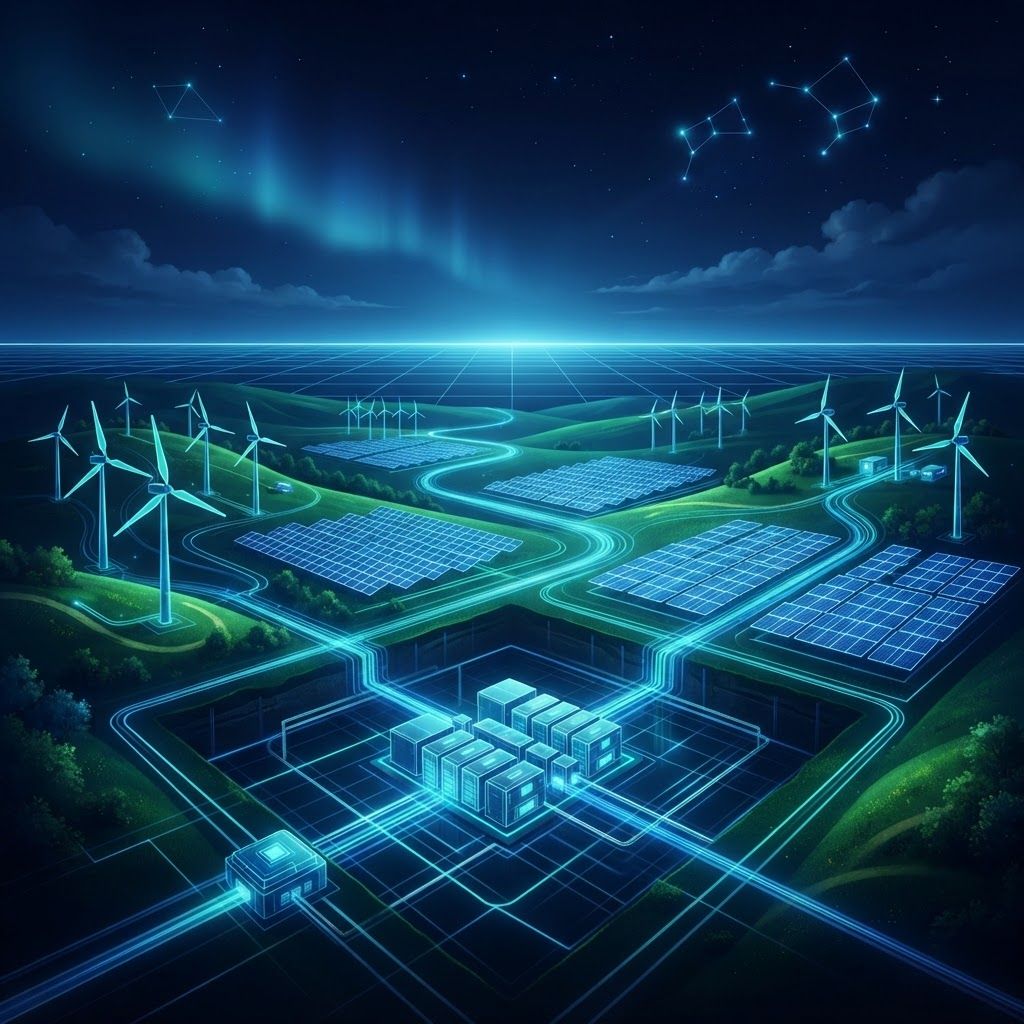
A Borough With Genuine Renewable Advantages
West Lancashire is unusually well positioned for renewable energy. It sits close to the Irish Sea coast with its strong and consistent wind resource. It has extensive flat agricultural land with large building footprints, from packhouses to livestock sheds, ideally suited to rooftop solar. It has an industrial and logistics base with substantial warehouse roofs and high daytime electricity consumption, which is precisely the profile where on-site generation delivers the strongest returns. And it has an agricultural sector producing organic material suitable for anaerobic digestion.
These physical advantages coincide with strong commercial drivers. Energy costs remain a major line item for manufacturers, cold storage operators and growers with heating or lighting requirements. Larger corporate customers increasingly require supply chain emissions data, which pushes decarbonisation down to smaller suppliers. And planning policy continues to favour appropriately sited renewable development.
The Technologies in Use Locally
Solar photovoltaic installations dominate in volume terms, ranging from domestic rooftop arrays to large ground-mounted and warehouse roof systems. Wind generation operates at various scales, from single turbines on farms to larger developments and offshore capacity feeding into the regional grid. Battery energy storage has grown rapidly, allowing generation to be shifted to periods of higher value and providing grid balancing services. Heat pumps, both air and ground source, are replacing fossil heating in domestic and commercial buildings. Anaerobic digestion converts agricultural and food waste into biogas and digestate fertiliser. Energy efficiency measures, though less visible, frequently deliver the best return of all.
The Top 10 Renewable Energy Companies in West Lancashire
1. West Lancashire Renewables Group
A full-service developer and installer covering solar, battery storage and heat pumps for commercial and agricultural clients. Its integrated approach, combining energy assessment, system design, installation and ongoing monitoring, suits businesses that want a single accountable partner rather than coordinating multiple contractors.
2. Ormskirk Solar and Storage
Specialising in commercial rooftop solar paired with battery systems, focusing on maximising self-consumption rather than simply installing capacity. Its financial modelling for clients is detailed, which matters because the economics depend heavily on consumption patterns rather than panel count.
3. Burscough Agricultural Energy Solutions
Serving farms and growers with solar on agricultural buildings, biomass heating, anaerobic digestion feasibility and grid connection support. It understands the seasonal load profiles of horticultural and livestock operations, which differ markedly from typical commercial patterns.
4. Skelmersdale Industrial Energy Systems
Focused on manufacturing and distribution sites with high daytime demand, delivering large rooftop arrays, electric vehicle charging infrastructure and power quality improvements. Its projects typically include half-hourly consumption analysis to size systems accurately.
5. Coastal Wind Partners
Developing and maintaining wind generation across the western part of the borough and supporting offshore supply chain activity. Its expertise covers site assessment, planning, grid connection and long-term operations and maintenance for turbines of various scales.
6. Aughton Heat Pump Specialists
Concentrating on air and ground source heat pump design and installation for domestic and small commercial properties. Its emphasis on fabric assessment and correct system sizing addresses the main reason heat pump installations disappoint, which is poor design rather than technology limitation.
7. Parbold Energy Efficiency Consultants
Providing energy audits, building assessments, lighting upgrades, insulation programmes and monitoring. Efficiency work is often overlooked in favour of generation, yet reducing consumption is almost always cheaper per unit than producing new supply.
8. Tarleton Battery Storage Systems
Dedicated to energy storage, from behind-the-meter commercial batteries to larger grid-connected installations. Storage enables businesses to avoid peak pricing, support site resilience and participate in flexibility markets that provide additional revenue.
9. Up Holland Community Energy Cooperative
A community-owned organisation developing shared renewable projects with local investment and reinvesting surplus into community initiatives. Community energy models keep financial benefit within the borough and tend to enjoy stronger local support for development.
10. Northway Green Energy Consultancy
Advising organisations on decarbonisation strategy, carbon reporting, power purchase agreements and grant funding. It is typically engaged by larger employers responding to customer sustainability requirements or preparing formal net zero commitments.
Making Sound Renewable Investment Decisions
Start with consumption data rather than technology. Half-hourly electricity data reveals when energy is actually used, which determines whether solar generation will be self-consumed at full value or exported at a much lower rate. A warehouse operating during daylight hours has fundamentally better solar economics than a facility running overnight.
Address efficiency before generation. Reducing demand through lighting, controls, insulation and equipment upgrades lowers the size and cost of any generation system subsequently installed.
Scrutinise financial projections carefully. Assumptions about future energy prices, degradation rates and maintenance costs vary between proposals and materially change payback calculations. Ask for the underlying assumptions rather than accepting headline return figures.
Check grid connection early. Connection capacity constraints affect parts of the North West, and availability can determine whether a project proceeds at the intended scale. This is frequently the binding constraint on larger installations.
Trends in the Renewable Sector
Battery storage is increasingly standard alongside generation rather than an optional addition, driven by falling costs and the value of flexibility. Corporate power purchase agreements are growing as businesses seek long-term price certainty and verifiable clean supply. Electric vehicle charging is being integrated with on-site generation, particularly for fleet operators. Agrivoltaics, combining solar generation with continued agricultural use, is attracting interest where land use conflicts arise. And carbon reporting obligations flowing through supply chains are turning decarbonisation from an ethical choice into a commercial requirement.
Final Thoughts
West Lancashire has the natural resources, land profile and industrial demand to support substantial renewable deployment, and the companies operating here cover solar, wind, storage, heat and efficiency across domestic, commercial and agricultural markets. The projects that succeed are those grounded in accurate consumption data and realistic financial modelling rather than enthusiasm alone. For most businesses in the borough, the question is no longer whether renewable investment makes sense, but which combination of measures fits their particular load profile and site.
Want your brand featured in front of decision-makers? Publish a guest post or get a link insertion in our guides through AAMAX's guest post and link insertion service.
Helpful Links
 SponsoredAAMAX — Full-Service Digital Agency
Write for Us
Share your expertise with our readers. We welcome guest contributions from industry specialists.
Pitch your idea