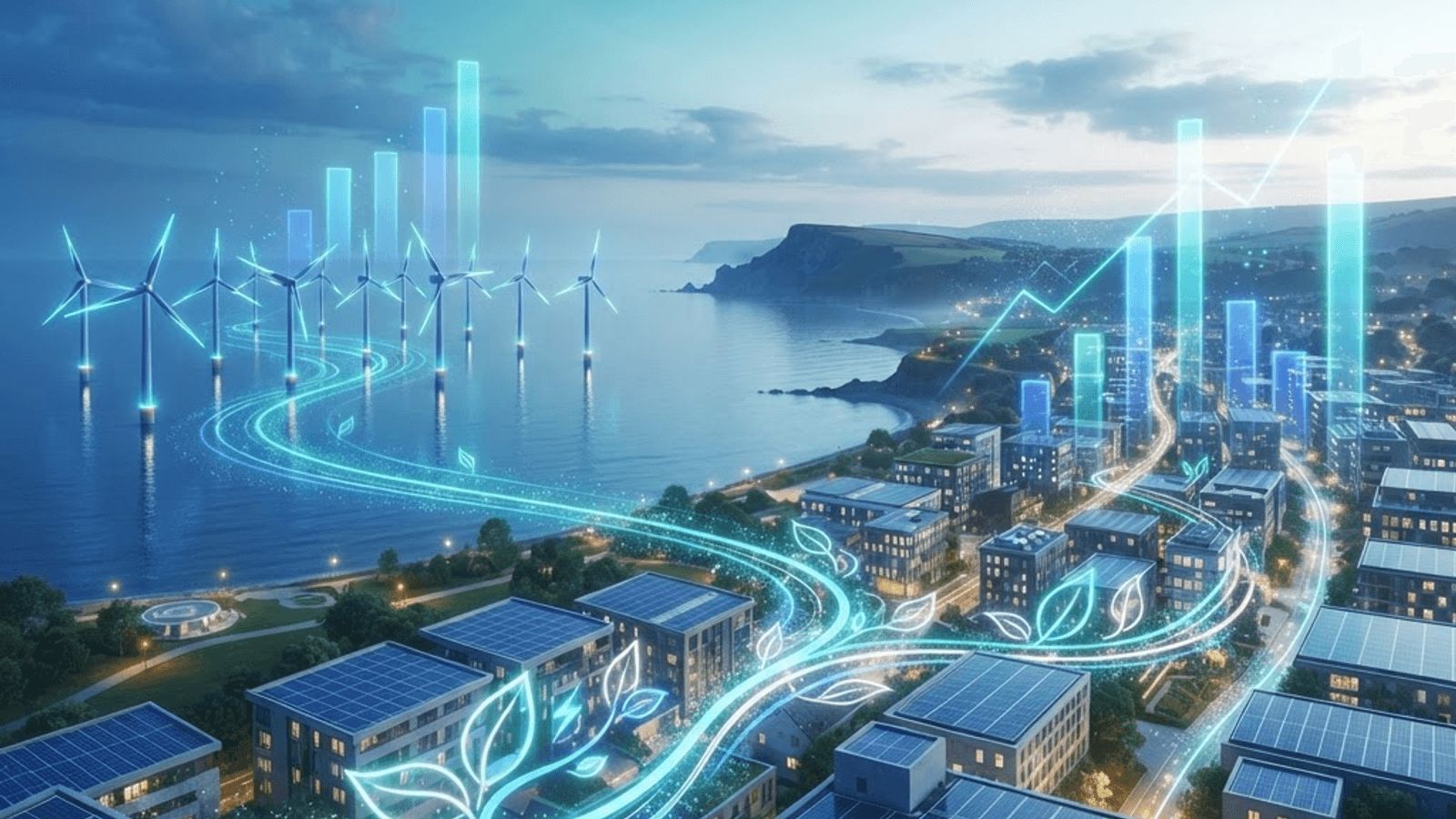
Swansea Bay as a Clean Energy Region
Few UK cities have a stronger natural case for renewable energy than Swansea. The Bristol Channel carries one of the largest tidal ranges in the world, the Celtic Sea offshore of South West Wales is a designated growth area for floating offshore wind, and the city's post-industrial land and large commercial rooftops offer straightforward opportunities for solar generation. Add the Swansea Bay City Deal, a regional programme with a substantial low-carbon and energy component, and the result is a market with unusual breadth for a city of its size.
What makes the local sector interesting is its layering. At the top sit multi-billion-pound offshore and grid projects with national significance. Beneath them is a substantial mid-market of engineering, installation and maintenance businesses fitting heat pumps, solar arrays and battery storage across Swansea, Neath, Port Talbot and the Gower. Underpinning both is a research base at Swansea University that has genuine international standing in photovoltaics and building-integrated energy generation.
The Technologies Driving Local Growth
Solar photovoltaics remains the volume market, driven by commercial energy costs and the simplicity of rooftop installation. Battery storage has moved from optional extra to standard specification, because storing generation for evening use materially improves returns. Air source heat pumps dominate the low-carbon heating conversation, particularly in retrofit projects across the city's large stock of solid-wall terraced housing, where fabric improvement has to come first. Onshore and offshore wind continue to supply the bulk of Welsh renewable electricity by volume. And a distinctive Welsh strand — marine and tidal energy — remains under active development, with tidal stream and tidal range concepts repeatedly examined for the Swansea Bay area.
The Top 10 Renewable Energy Companies Serving Swansea
1. RWE — One of the largest renewable generators operating in Wales, with significant wind and hydro assets and a leading role in Celtic Sea floating offshore wind development. Its presence anchors the regional supply chain and creates opportunities for Swansea engineering firms and port services.
2. Blue Gem Wind — A joint venture focused specifically on floating offshore wind in the Celtic Sea. Its early-stage projects off the Pembrokeshire and wider South West Wales coast are central to the region's ambition, and its supply chain engagement work regularly involves Swansea Bay businesses.
3. Egni Co-op — A Welsh community-owned solar cooperative that has installed rooftop photovoltaic systems on schools, community buildings and businesses across South Wales, including the Swansea area. It is widely respected for demonstrating that community ownership can deliver at commercial scale.
4. Awel Aman Tawe — A community energy charity operating in the valleys north of Swansea, best known for developing a community-owned wind project and for education and retrofit work. It represents the strongest example of locally owned generation in the region.
5. SPECIFIC Innovation and Knowledge Centre — Based at Swansea University's Bay Campus, SPECIFIC is a nationally significant research programme on building-integrated solar, energy storage and active buildings. Its demonstration buildings have influenced construction standards well beyond Wales.
6. Sero — A Welsh decarbonisation business combining energy modelling, retrofit delivery and low-carbon new-build services. It works with housing providers and developers across South Wales on whole-home approaches rather than single-measure installations.
7. Pure Renewables — A South Wales installer covering solar photovoltaics, battery storage, heat pumps and electric vehicle charging for domestic and commercial clients, with a strong reputation for accredited installation standards and after-sales support.
8. Hafod Renewables Style Regional MCS Installers — Wales has a well-developed network of Microgeneration Certification Scheme accredited installers serving Swansea for heat pumps, solar and biomass. Accreditation matters because it governs eligibility for grant support and export payments.
9. Marine Power Systems — A Swansea-founded engineering company developing floating platform technology for offshore wind and wave energy. It is one of the clearest examples of homegrown marine energy innovation in the city, with testing and development links to local port infrastructure.
10. Associated British Ports Swansea and Port Talbot — Port operations are indispensable renewable infrastructure. The Swansea Bay ports provide the quayside, laydown and logistics capacity that offshore wind assembly, maintenance and component handling require, making them a strategic part of the regional clean energy chain.
Industry Insights and Local Context
Grid capacity is currently the most significant constraint in South Wales. Connection queues and substation capacity determine whether a project proceeds, and the best developers now assess grid availability before site selection rather than after. Skills are the second constraint: demand for qualified electricians, heat pump engineers and offshore technicians consistently outstrips supply, which is why Gower College Swansea and Swansea University training pathways matter as much as any single project. Third, planning and consenting in Wales operates within its own framework, including Welsh Government energy policy and the Well-being of Future Generations Act, which requires developers to demonstrate long-term public benefit rather than short-term output.
Choosing a Renewable Energy Provider
For homeowners and businesses in Swansea, the practical checklist is short but decisive. Verify relevant accreditation and insurance-backed warranties. Insist on a site-specific generation estimate rather than a generic figure, because Gower orientation, shading and roof pitch materially change output. Ask how the system will be monitored and who responds to a fault in year six, not year one. For commercial buyers, model consumption profile against generation profile before sizing a system; oversized arrays without storage or export arrangements rarely pay back as promised. And for anyone considering heating, treat insulation and airtightness as part of the energy project rather than a separate job.
Swansea's renewable sector is no longer aspirational. It is a working industry with research depth, community ownership models, established installers and genuine industrial-scale ambition offshore — a combination that positions the city well for the next decade of energy transition.
Want your brand featured in front of decision-makers? Publish a guest post or get a link insertion in our guides through AAMAX's guest post and link insertion service.
Helpful Links
 SponsoredAAMAX — Full-Service Digital Agency
Write for Us
Share your expertise with our readers. We welcome guest contributions from industry specialists.
Pitch your idea