

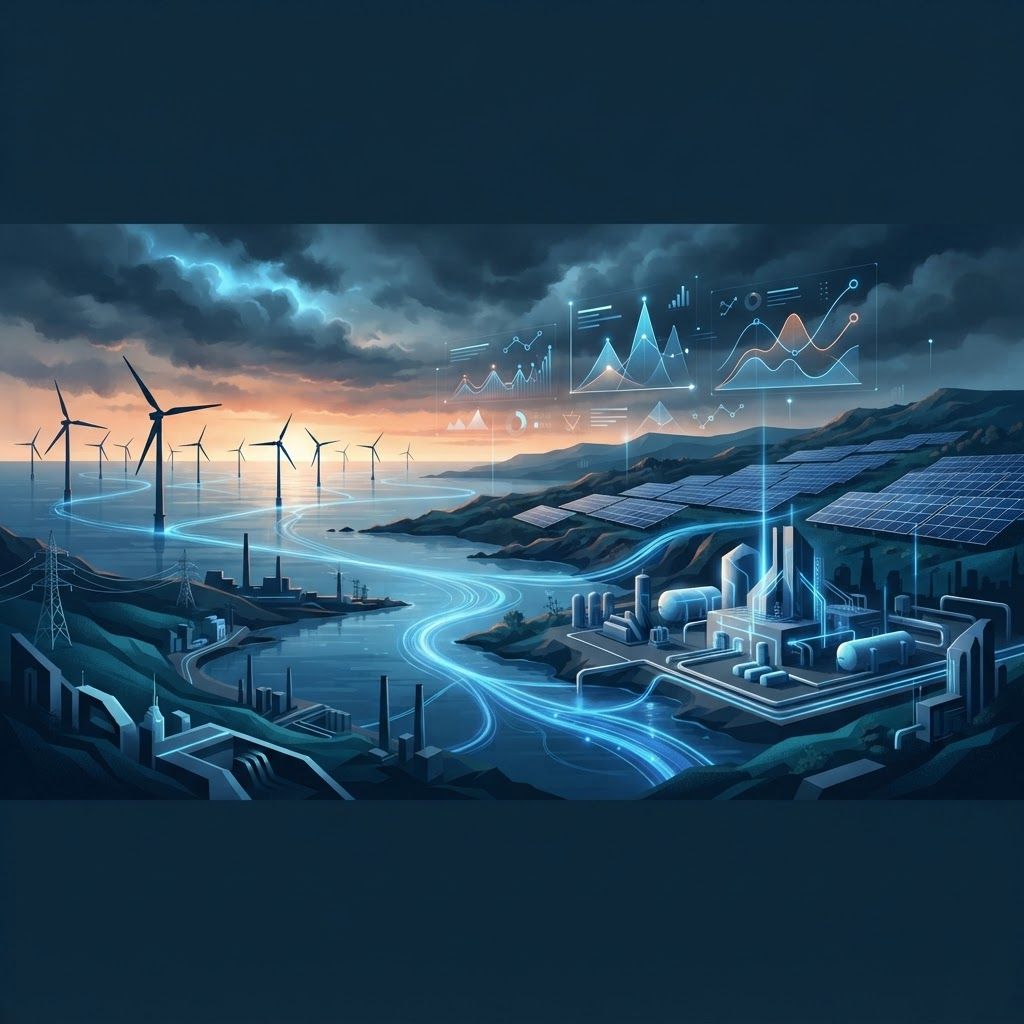
From Steel Town to Clean Energy Hub
Few places in Britain illustrate industrial transition as vividly as Redcar and Cleveland. The closure of the Redcar steelworks removed thousands of jobs and left behind an enormous industrial site on the south bank of the Tees. That site, along with deep-water port access, existing grid infrastructure and a workforce experienced in heavy engineering, has since made the area one of the most attractive locations in Europe for clean energy investment.
Offshore wind manufacturing, hydrogen production, carbon capture and storage, and low carbon industrial clusters are all being developed in and around the borough. This is not speculative: turbine blade manufacturing, port infrastructure and major decarbonisation schemes represent substantial committed capital, and they are generating supply chain demand across engineering, logistics, inspection and maintenance.
Why the Location Works
Several factors combine. The Tees estuary offers deep-water quays capable of handling enormous offshore components. Extensive brownfield land is available at scale, already zoned for industrial use. High-capacity grid connections exist from the former steel and chemical operations. Geological storage in the North Sea makes carbon capture viable. And critically, the local workforce already understands high-hazard process operations, welding, fabrication and heavy lifting, which are directly transferable skills.
Ten Leading Renewable Energy Companies and Organisations
1. SeAH Wind
Operates a major offshore wind monopile manufacturing facility on the Teesworks site, producing the enormous steel foundations that support offshore turbines. It represents one of the largest single manufacturing investments in the area's recent history.
2. Net Zero Teesside
A flagship gas-fired power and carbon capture project designed to decarbonise industrial emissions across the cluster, capturing carbon dioxide for permanent offshore storage. Central to the region's industrial decarbonisation strategy.
3. Northern Endurance Partnership
Develops the offshore carbon dioxide transport and storage infrastructure that underpins carbon capture across the Humber and Teesside clusters, including pipelines and subsea storage.
4. Teesworks Energy Infrastructure
Coordinates the redevelopment of the former steelworks land into a clean energy and advanced manufacturing campus, providing serviced sites, grid access and port connectivity for renewable energy occupiers.
5. Redcar Renewable Engineering Services
A supply chain engineering business providing fabrication, installation and maintenance services to wind, solar and hydrogen projects. Typical of the firms converting traditional engineering capability to clean energy markets.
6. Tees Hydrogen Developments
Focuses on low carbon hydrogen production and distribution for industrial users and heavy transport, addressing sectors that are difficult to electrify directly.
7. Cleveland Solar and Storage
Designs and installs commercial-scale solar arrays and battery energy storage systems for industrial sites, warehouses and public buildings across the borough.
8. Northern Biomass and Energy from Waste Services
Operates and supports facilities converting waste and biomass into energy, contributing to landfill diversion and local heat and power supply.
9. Coastal Marine Renewables Support
Provides vessels, crew transfer, survey and inspection services to offshore wind construction and operations, an increasingly significant employer along the Tees coast.
10. Tees Valley Energy Efficiency Partnership
Delivers retrofit, insulation, heat pump installation and energy efficiency programmes for homes and public buildings, addressing the demand side of the energy transition.
Industry Trends
Offshore wind continues to scale, with turbines growing larger and installations moving further from shore. This increases demand for heavy fabrication, specialist vessels and long-term operations and maintenance contracts, all of which favour locations with deep-water port capability.
Industrial decarbonisation is the second major theme. Rather than closing emitting industries, the strategy in Teesside is to decarbonise them through carbon capture, hydrogen substitution and electrification, preserving industrial employment while cutting emissions.
Grid capacity and energy storage have emerged as critical constraints nationally. Battery storage, flexible demand and grid reinforcement projects are attracting significant investment, and the borough's existing high-capacity connections are a genuine competitive asset.
Opportunities for Local Businesses and Workers
The supply chain opportunity is substantial but requires preparation. Contractors need appropriate safety accreditation, quality management systems and often specific offshore certifications before they can bid for work. Businesses that invest in these credentials early position themselves well.
For workers, transferable skills from steel, chemical and offshore oil backgrounds are in demand, particularly welding, electrical, mechanical and inspection disciplines. Conversion training is widely available, and apprenticeship numbers in energy engineering have grown accordingly.
Community Impact and Local Benefit
Large energy projects bring more than construction jobs. Developers operating in Redcar and Cleveland are increasingly expected to demonstrate tangible local benefit, whether through apprenticeship commitments, supply chain spend within the region, community funds or investment in education. For a borough that experienced the social consequences of industrial closure at first hand, these commitments carry real weight and are scrutinised closely.
There are challenges alongside the opportunity. Construction phases are intense but finite, and the long-term employment picture depends on securing operations, maintenance and manufacturing activity rather than only installation work. Skills pipelines need to be established years in advance, which requires coordination between employers, colleges and training providers. Grid connection queues and planning timescales can delay projects considerably. Recognising these constraints honestly, rather than treating every announcement as an immediate jobs guarantee, produces a more realistic and ultimately more sustainable picture of what the transition means for local people.
Conclusion
Redcar and Cleveland has transformed from a symbol of industrial decline into a genuine centre of the United Kingdom's energy transition. The renewable energy companies operating here span enormous infrastructure projects and small specialist suppliers, and together they are rebuilding an industrial economy on cleaner foundations. For businesses and workers in the borough, engaging with this sector is now one of the clearest routes to long-term opportunity.
Want your brand featured in front of decision-makers? Publish a guest post or get a link insertion in our guides through AAMAX's guest post and link insertion service.
Helpful Links
 SponsoredAAMAX — Full-Service Digital Agency
Write for Us
Share your expertise with our readers. We welcome guest contributions from industry specialists.
Pitch your idea

