

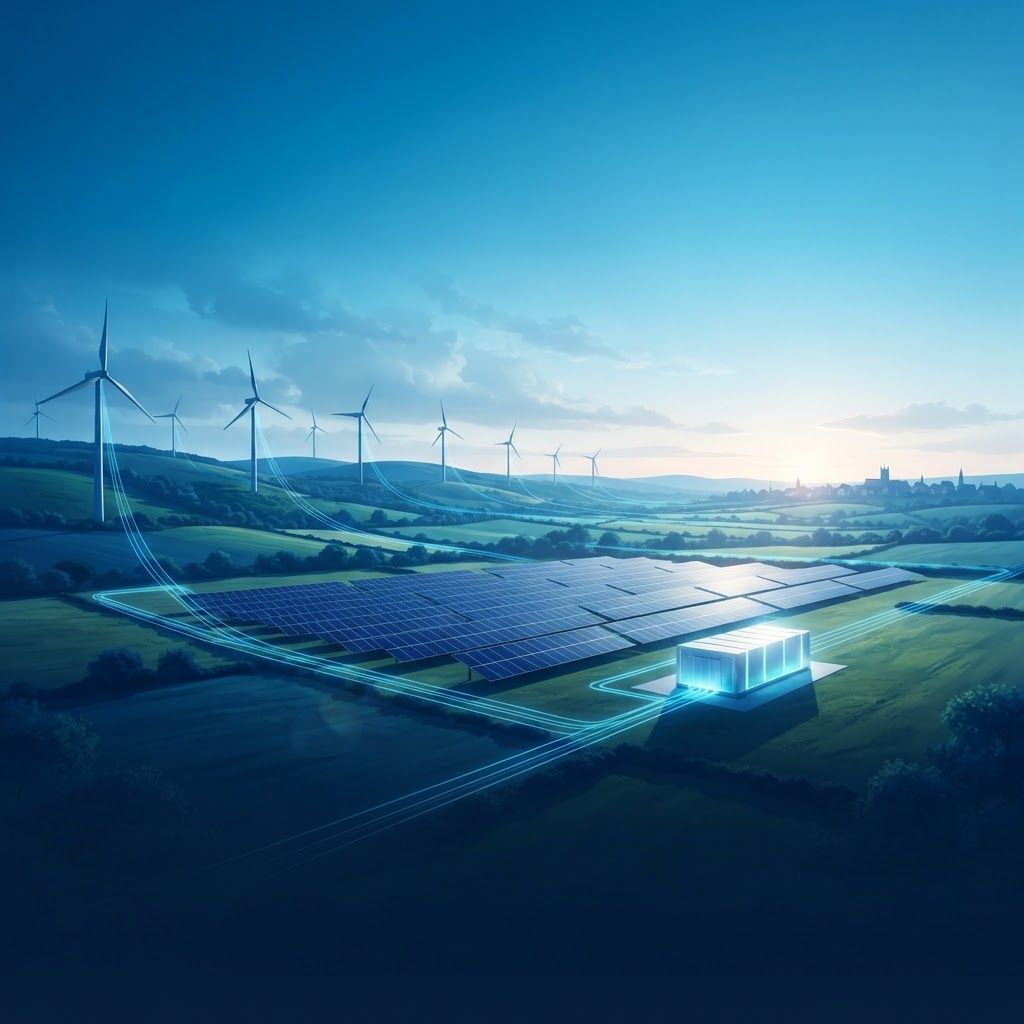
Preston's Place in the Renewable Energy Transition
Lancashire has an unusually complete renewable energy story. The Irish Sea coastline west of Preston hosts some of the UK's most productive offshore wind resources, the county's agricultural land supports solar and anaerobic digestion, its industrial heritage supplies engineering and fabrication skills, and Preston itself provides the professional services, project management and grid engineering capability that developments require.
The city's role is largely as a hub rather than a generation site. Design consultancies, mechanical and electrical contractors, installers, operations and maintenance providers and energy consultants operate from Preston while delivering projects across the North West. That makes the local renewable sector broad in discipline, spanning domestic rooftop solar through to grid-scale battery storage.
Ten Renewable Energy Companies Serving Preston
1. Forrest. A North West contractor with substantial retrofit and renewables capability, delivering solar photovoltaic installation, insulation, heat pumps and energy efficiency programmes across social housing stock, an area where Lancashire has significant activity.
2. Emtec Energy. Provides commercial solar, electric vehicle charging infrastructure and mechanical and electrical engineering services, serving industrial and public sector clients seeking to reduce operational energy costs.
3. Solarsense and similar regional solar specialists. Companies of this profile design and install commercial rooftop and ground-mounted photovoltaic systems with monitoring and maintenance, typically targeting factories and warehouses with large roof areas and high daytime demand.
4. Lancashire Renewables. Operating in the waste-to-resource space, this type of facility recovers value from residual municipal waste, contributing to landfill diversion and energy recovery within the county's waste strategy.
5. Sun Solar Energy Solutions. A regional installer focused on domestic and small commercial solar with battery storage, offering system design, installation and aftercare under recognised competency schemes.
6. Heat pump and low carbon heating specialists. Preston supports a growing group of installers accredited for air source and ground source heat pumps, delivering retrofit projects supported by government grant schemes alongside new-build installations.
7. Anaerobic digestion operators across rural Lancashire. Farm-based and commercial digesters converting agricultural residues, food waste and slurry into biogas and digestate, providing both renewable energy and a fertiliser substitute for local farms.
8. Battery energy storage developers. A fast-growing segment developing grid-connected storage assets that balance intermittent generation, provide frequency response services and relieve local network constraints.
9. Energy consultancy and procurement firms. Preston hosts advisers helping businesses model consumption, procure renewable supply contracts, secure power purchase agreements, and build credible decarbonisation roadmaps with measurable targets.
10. Electrical contractors delivering renewables integration. Established Lancashire contractors have expanded into distribution network operator applications, inverter and switchgear installation, and half-hourly metering, providing the unglamorous engineering that makes projects function.
Technologies Driving Local Growth
Solar photovoltaics remain the most accessible technology. Falling module costs and rising electricity prices have shortened payback periods substantially, particularly for businesses with strong daytime consumption. Warehouse and manufacturing roofs across the Preston area represent a large, still largely untapped resource.
Wind, especially offshore, provides the region's largest generation volumes. While turbines sit at sea, the supply chain reaches inland through fabrication, cabling, logistics, crew transfer and maintenance services, several of which are supported from Lancashire.
Battery storage has become the critical enabler. Storage allows self-consumption of solar generated outside working hours, protects against peak pricing, and provides revenue through grid balancing services. Increasingly, solar and storage are specified together rather than separately.
Low carbon heat is the next major frontier. Heating buildings accounts for a large share of emissions, and heat pump deployment, alongside improved building fabric, is central to meeting local and national targets.
Trends and Market Drivers
Corporate reporting requirements have moved renewables from optional to strategic. Businesses supplying larger customers are increasingly asked to evidence emissions data and reduction plans, making on-site generation a commercial requirement rather than a sustainability gesture.
Grid capacity has become the principal constraint. Connection queues and network reinforcement timescales now shape project feasibility more than technology cost, which has increased interest in private wire arrangements, demand flexibility and co-located storage.
Skills demand is intense. Electricians, controls engineers, heat pump installers and commissioning technicians are in short supply, and Lancashire training providers have expanded provision in response, creating genuine career pathways in the sector.
Choosing a Renewable Energy Provider
Verify certification. Look for Microgeneration Certification Scheme accreditation for domestic and small commercial installations, appropriate electrical competency registration, and membership of relevant trade bodies. These determine both quality and eligibility for grants and export arrangements.
Demand realistic modelling. A credible proposal shows generation forecasts based on roof orientation, shading and local irradiance data, alongside your actual consumption profile, not a generic estimate. Be sceptical of payback claims that assume perfect self-consumption.
Check aftercare. Inverters, batteries and heat pumps require monitoring and servicing. Ask about warranty terms, response times and whether the installer will still exist in ten years, since much of the sector is young.
Finally, consider phasing. Many businesses achieve better returns by improving efficiency and controls first, then adding generation sized to reduced demand, rather than installing a large system to power avoidable waste.
Final Thoughts
Preston sits within one of the UK's more promising renewable energy regions, with offshore wind offshore, agricultural biomass inland and substantial commercial rooftop potential in between. The companies above cover installation, engineering, development, consultancy and operations. For businesses and households in the city, well-designed renewable investment now offers both cost reduction and resilience against volatile energy markets.
Want your brand featured in front of decision-makers? Publish a guest post or get a link insertion in our guides through AAMAX's guest post and link insertion service.
Helpful Links
 SponsoredAAMAX — Full-Service Digital Agency
Write for Us
Share your expertise with our readers. We welcome guest contributions from industry specialists.
Pitch your idea

