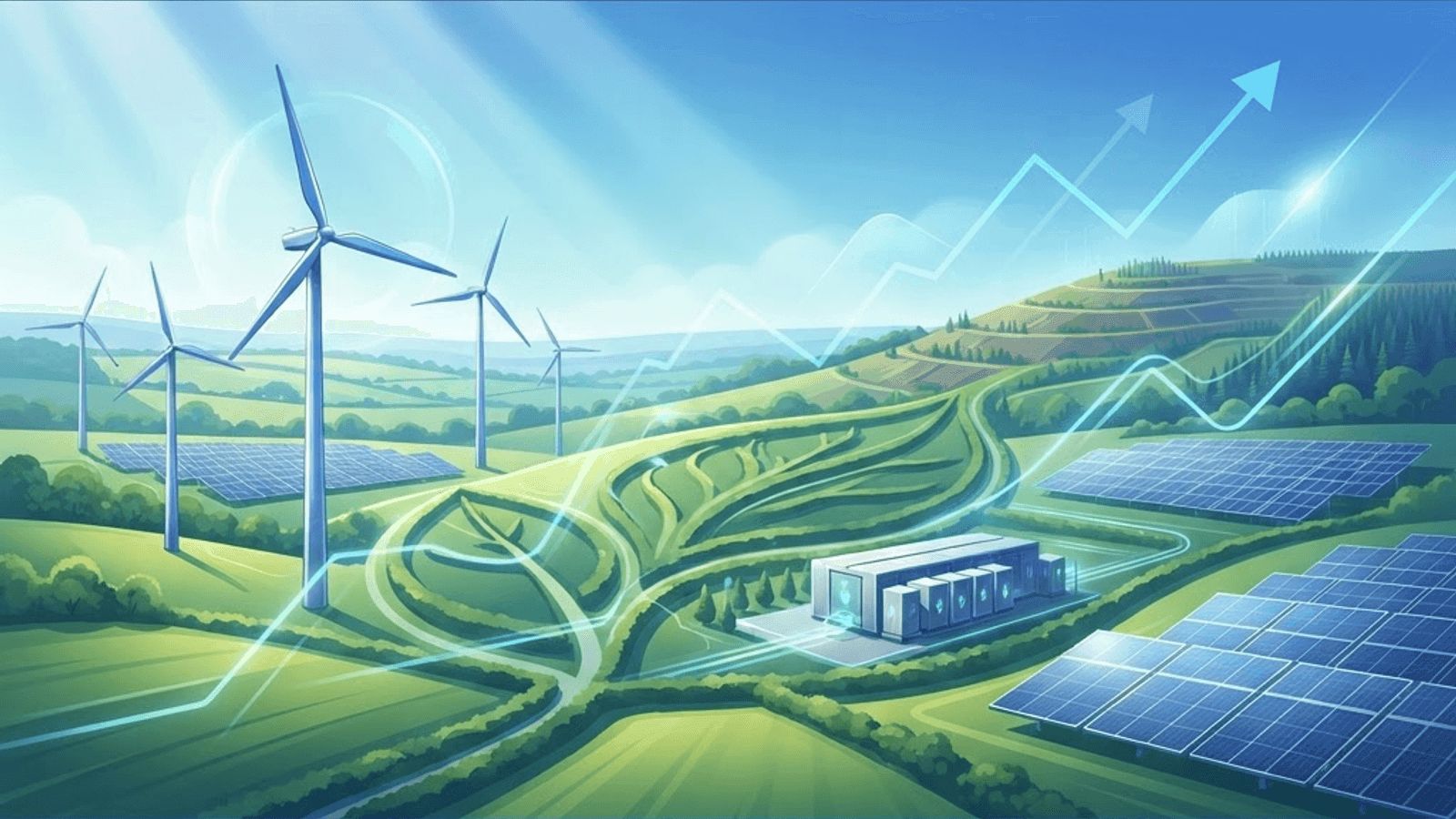
From Coalfield to Clean Energy
There is a particular resonance to renewable energy in North West Leicestershire. This was the heart of the Leicestershire coalfield, where collieries at Whitwick, Bagworth, Ellistown, Snibston and Measham powered the region for generations. The last deep mine closed in the early 1990s, and the National Forest planting programme has since transformed much of the spoil and industrial land into woodland. The energy transition here is not an abstract policy debate; it is a continuation of a story the district has lived through before.
Today the drivers are practical. The vast roof areas of distribution warehouses at Bardon and the East Midlands Gateway represent some of the best commercial solar real estate in the Midlands. Manufacturing and quarrying operations face significant electricity costs and increasing pressure from customers to demonstrate credible decarbonisation. Households across Coalville, Ashby-de-la-Zouch, Ibstock and the villages are installing solar, batteries and heat pumps at a pace that would have seemed implausible a decade ago.
The Renewable Technologies in Play Locally
Rooftop and ground-mounted solar photovoltaic installations dominate by volume, suiting both the district's large industrial roofs and its agricultural land. Onshore wind exists at smaller scales, with single turbines and community-scale schemes more common than large arrays given planning constraints. Battery energy storage is growing rapidly, both behind the meter to reduce demand charges and at grid scale to provide balancing services.
Heat represents the harder challenge. Air source heat pumps are the mainstream solution for domestic and small commercial buildings, with ground source systems suited to properties with land available. Biomass and biogas play a role in rural and agricultural settings, and heat network opportunities exist where development density allows. Electric vehicle charging infrastructure, while not generation, is closely bound to the same grid and commercial considerations.
The Top 10 Renewable Energy Companies in North West Leicestershire
1. National Forest Renewables takes a whole-site approach, combining solar, storage and efficiency measures for commercial and agricultural clients, with a strong emphasis on measured performance rather than headline capacity figures.
2. Bardon Clean Power focuses on large-scale commercial rooftop solar and behind-the-meter battery systems for warehousing and manufacturing, including power purchase arrangements that remove upfront capital cost.
3. Coalfield Energy Solutions works across domestic and small commercial retrofit, installing solar, batteries and heat pumps, and is well regarded for thorough pre-installation surveys and realistic yield estimates.
4. Ashby Sustainable Systems specialises in heat decarbonisation, delivering air and ground source heat pump installations alongside fabric improvements, with careful attention to system design and emitter sizing.
5. Donington Wind and Solar develops small to medium-scale generation projects, handling site assessment, planning applications, grid connection applications and construction management.
6. Measham Battery Storage concentrates on energy storage, from commercial peak-shaving systems to grid-scale projects providing frequency response and capacity market services.
7. Ibstock Green Energy Group serves rural and agricultural clients with combined solar, storage and anaerobic digestion solutions, integrating generation with farm operations.
8. Whitwick Community Energy operates a community ownership model, developing locally owned generation assets and returning surplus into local energy efficiency initiatives.
9. Kegworth EV and Grid Services installs electric vehicle charging infrastructure for fleets and workplaces, with load management systems that avoid costly grid reinforcement.
10. Ivanhoe Energy Consultancy provides independent technical and commercial advice, conducting feasibility studies, procurement support and performance auditing for organisations investing in renewables.
Grid Capacity: The Real Constraint
The limiting factor for renewable deployment in the district is rarely technology or finance. It is grid connection. Distribution network capacity in parts of the East Midlands is heavily subscribed, and connection offers for larger schemes can carry long timescales and substantial reinforcement costs. Developers now routinely design around this, using flexible connection agreements that curtail export at times of network stress, co-locating storage to smooth output, and prioritising on-site consumption over export.
For commercial clients, this reframes the economics favourably. A warehouse operating refrigeration, conveyors and lighting through daylight hours can consume most of its rooftop solar generation directly, displacing imported electricity at retail rates rather than exporting at wholesale rates. Self-consumption, not export, is where the value sits.
Financing and Commercial Models
Several models are available. Direct purchase gives the fullest long-term return but requires capital. Leasing and asset finance spread cost across the asset life. Power purchase agreements allow a third party to install and own the system, selling the generated electricity to the site at an agreed rate, typically below grid prices with no upfront outlay. For businesses, capital allowances on qualifying plant can improve after-tax returns materially, and advice on this before procurement is worthwhile.
Planning and Permitting Considerations
Many domestic and commercial rooftop installations proceed under permitted development rights, but conditions apply and listed buildings and conservation areas require consent. Ground-mounted solar and wind schemes need full planning permission, with assessment of landscape impact, heritage settings, ecology, glint and glare near the airport, and cumulative effects. The National Forest designation and proximity to East Midlands Airport both introduce specific considerations that experienced local developers factor in from the outset.
Choosing a Reputable Installer
Quality varies widely in a fast-growing market. Look for certification under the Microgeneration Certification Scheme for domestic work, membership of a consumer protection body, appropriate electrical competency registration, and workmanship warranties backed by insurance. Insist on a written performance estimate with stated assumptions, and be sceptical of projections that ignore shading, orientation, degradation or realistic self-consumption rates.
Final Thoughts
North West Leicestershire is unusually well placed for renewable energy: large industrial roofs, an established engineering skills base, strong logistics connectivity and a landscape already reshaped once by energy. The organisations succeeding here are those treating renewables as an operational investment with measurable returns rather than a gesture. Assess your consumption profile first, design for self-consumption, understand your grid position early, and choose installers on evidence rather than price alone.
Want your brand featured in front of decision-makers? Publish a guest post or get a link insertion in our guides through AAMAX's guest post and link insertion service.
Helpful Links
 SponsoredAAMAX — Full-Service Digital Agency
Write for Us
Share your expertise with our readers. We welcome guest contributions from industry specialists.
Pitch your idea