

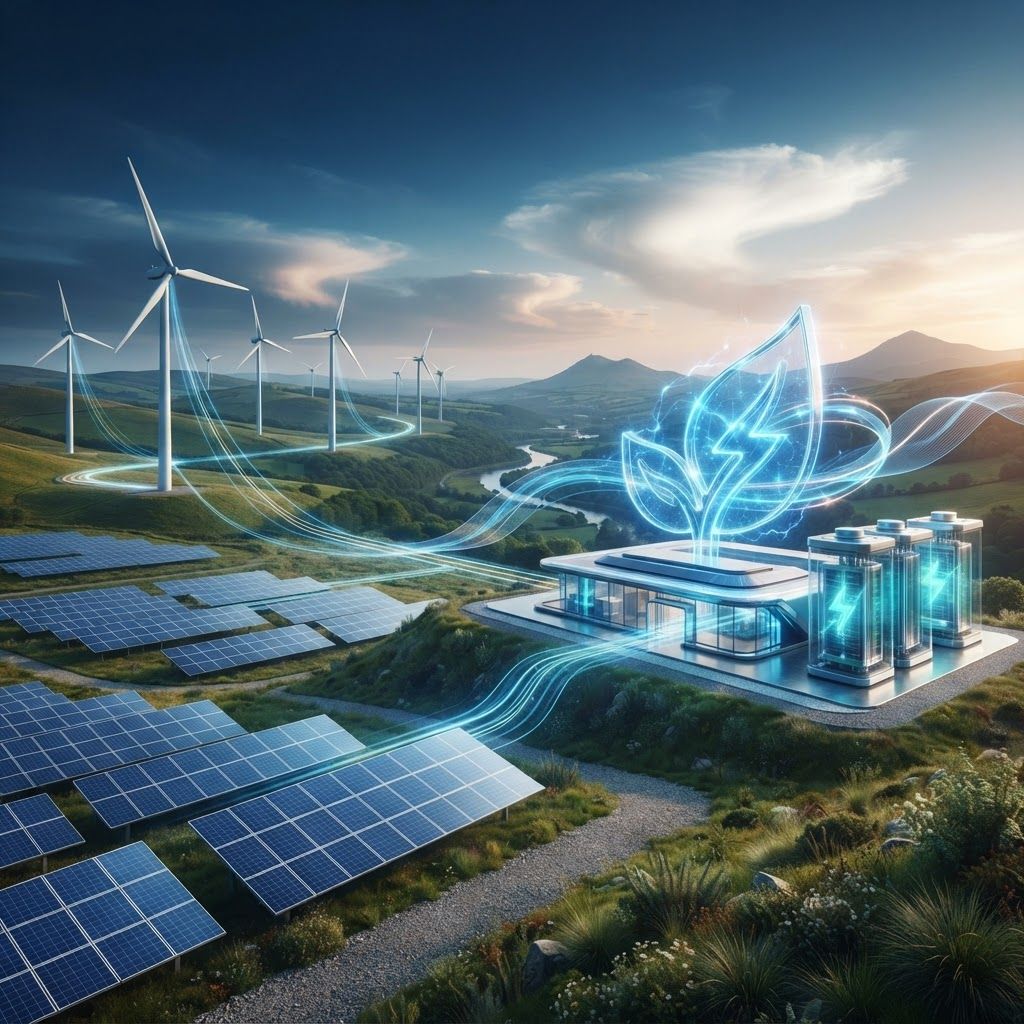
A County Well Suited to Renewables
Carmarthenshire's natural characteristics make it a natural home for renewable energy. Exposed upland areas in the north and east offer strong wind resource, the coastal plain around Carmarthen Bay receives comparatively high solar irradiance for Wales, fast-flowing rivers descending from the Cambrian foothills support small-scale hydro, and the county's extensive agricultural base generates feedstock for anaerobic digestion and biomass. Combined with substantial land availability and a strong local commitment to decarbonisation, these factors have produced an active and diverse renewable sector.
Welsh Government policy has reinforced this trajectory, with ambitious targets for renewable electricity generation, a strong emphasis on locally owned energy and support for community and public sector schemes. Carmarthenshire County Council has itself pursued decarbonisation across its estate, creating steady demand for design, installation and maintenance capability within the county.
Technologies Deployed Locally
Solar photovoltaic remains the most widely installed technology, spanning domestic rooftops, agricultural building roofs, commercial premises and ground-mounted arrays. Farm buildings with large south-facing roof areas are particularly well suited, and many holdings now generate a meaningful proportion of their own consumption.
Onshore wind operates at several scales, from single farm turbines serving on-site demand to larger commercial developments in upland locations. Hydro schemes, though smaller in aggregate capacity, provide valuable baseload generation with excellent capacity factors. Anaerobic digestion converts slurry, silage and food waste into biogas for electricity, heat or biomethane injection, simultaneously addressing manure management and nutrient recovery.
Heat technologies have grown rapidly. Air source and ground source heat pumps, biomass boilers using locally sourced woodchip and, increasingly, high-temperature heat pumps suitable for older stone properties are all being installed across the county. Battery storage is now routinely specified alongside generation to increase self-consumption and provide grid services.
What Distinguishes a Quality Provider
The renewable sector attracts both highly professional operators and opportunistic entrants, so due diligence matters. Certification under the Microgeneration Certification Scheme is essential for domestic installations, both for workmanship standards and to access support mechanisms. Membership of consumer protection bodies such as the Renewable Energy Consumer Code or HIES provides recourse if problems arise. Electrical work requires competent person registration, and heat pump installers should hold relevant water regulations and refrigerant handling qualifications.
Technical rigour separates good installers from poor ones. A quality provider conducts a proper survey, calculates heat loss for heat pump systems rather than sizing by rule of thumb, models shading for solar arrays using site-specific data, checks structural adequacy of roofs, assesses electrical infrastructure capacity and obtains distribution network operator approval before installation. Providers who quote from aerial photographs alone should be treated with caution.
Grid Connection and Constraint
Grid capacity is the sector's most persistent constraint in west Wales. Distribution network capacity in parts of rural Carmarthenshire is limited, and connection offers can involve significant reinforcement costs or lengthy timescales. Experienced developers manage this by applying early, considering flexible connection agreements that curtail export at times of network stress, sizing systems around on-site demand, and incorporating storage to smooth export profiles.
Transmission-level reinforcement across mid and west Wales is progressing, which should ease constraint over time, but prospective generators should always establish the connection position before committing to project expenditure.
Commercial Models and Funding
Several commercial structures operate locally. Direct ownership suits organisations with capital and consistent daytime demand, delivering the strongest long-term returns. Power purchase agreements allow a developer to fund and own the installation while the site host buys generated electricity at an agreed rate, requiring no upfront investment. Roof and land leases provide landowners with rental income where a developer takes full project responsibility.
Community ownership has a strong tradition in Wales, with cooperative share offers funding local schemes and returning surplus to community benefit funds. Grant support, Welsh Government loan facilities, and the smart export guarantee for exported electricity all contribute to project viability. For heat, the domestic support schemes available in Wales and the non-domestic funding routes for public and third sector bodies materially improve payback.
Assessing Proposals Sensibly
When comparing quotations, examine the assumptions rather than the headline return. Check the assumed generation figures against independent modelling, the electricity price inflation applied, degradation rates for panels, maintenance and inverter replacement provisions, and whether financing costs are included. Optimistic assumptions compound quickly and can double an apparent return.
Ask about warranties in detail: product warranties from manufacturers, workmanship warranties from the installer, performance guarantees and, importantly, what happens if the installer ceases trading. Insurance-backed warranties provide the strongest protection. Request references from installations of similar scale and, where possible, speak to owners about performance after two or three years rather than immediately after commissioning.
Planning and Environmental Considerations
Many domestic installations proceed under permitted development, but constraints apply in conservation areas, on listed buildings and within national landscape designations. Larger schemes require planning permission, with assessment of landscape and visual impact, ecology including bat and bird surveys, hydrology, cultural heritage, access and cumulative effects. Anaerobic digestion projects additionally require environmental permits and careful attention to odour, traffic and digestate management.
Early engagement with the planning authority and local communities improves outcomes substantially, and developers who consult openly generally encounter less objection than those who present proposals as complete.
Final Thoughts
Carmarthenshire's renewable energy sector offers genuine expertise across generation and heat technologies, supported by a policy environment that actively encourages deployment. Choose providers with verifiable accreditation, rigorous technical process and transparent financial modelling. Renewable energy is a long-term investment, and the quality of the initial specification determines performance for decades.
Want your brand featured in front of decision-makers? Publish a guest post or get a link insertion in our guides through AAMAX's guest post and link insertion service.
Helpful Links
 SponsoredAAMAX — Full-Service Digital Agency
Write for Us
Share your expertise with our readers. We welcome guest contributions from industry specialists.
Pitch your idea

