

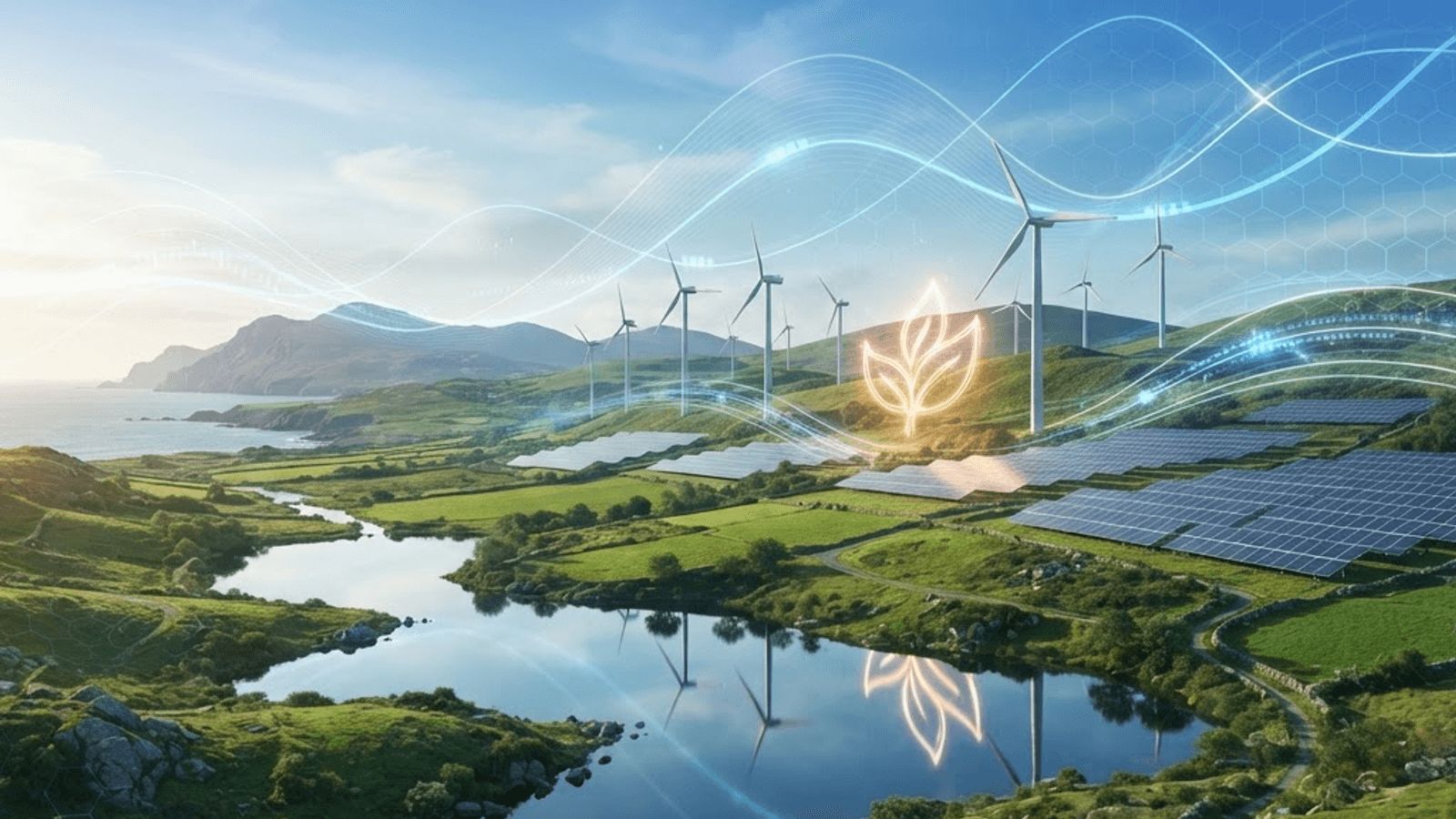
A Borough Built for Renewable Energy
Antrim and Newtownabbey occupies an unusually favourable position in Northern Ireland's energy transition. The Antrim Hills catch strong and consistent westerly wind. The shores of Lough Neagh and the Belfast Lough coastline provide grid connection points and industrial land. Mallusk and Newtownabbey host dense clusters of warehouses, factories and distribution centres with vast unused roof space, while the rural west of the borough has farms with land, slurry and heat demand suited to bioenergy.
Northern Ireland has already achieved one of the highest shares of renewable electricity of any comparable region, driven overwhelmingly by onshore wind. Policy ambition has since increased substantially, with targets that require far more generation, far more grid capacity and a much larger role for heat and transport decarbonisation. That combination has turned renewable energy from a niche activity into a mainstream local industry employing engineers, electricians, project managers and installers across the borough.
The Technologies That Matter Here
Onshore wind remains the backbone, from utility scale farms to single farm turbines. Solar photovoltaic has grown rapidly as panel costs fell, with commercial rooftops in industrial estates now offering some of the best returns in the region. Battery storage is increasingly paired with both, smoothing output and providing grid balancing services. Heat pumps, both air source and ground source, are replacing oil boilers in homes and small commercial buildings, which matters enormously in a region where home heating oil has long dominated. Anaerobic digestion and biomass convert agricultural residues into gas and heat. Alongside these, energy efficiency work such as insulation, LED lighting and building controls remains the cheapest carbon saving available.
Top 10 Renewable Energy Companies Serving Antrim and Newtownabbey
1. RES Group
RES is one of the most experienced independent renewable energy developers operating in Northern Ireland, with a portfolio spanning onshore wind, solar and battery storage. The company handles development, construction and long term asset management, and its projects across County Antrim have made it a familiar name to landowners and planners alike. Its strength lies in taking complex utility scale schemes from feasibility through to operation.
2. SSE Renewables
SSE Renewables operates significant generating assets in Northern Ireland and has invested heavily in the region's wind capacity. As part of a large integrated energy group, it brings substantial engineering resource, long term operational discipline and the balance sheet needed for major grid connected projects. Its presence has helped establish local supply chains for turbine maintenance and civil works.
3. Simple Power
Simple Power built its reputation on single turbine wind installations for farms and rural businesses across Northern Ireland, including many across County Antrim. The model gave landowners access to generation without becoming developers themselves, and the company retains deep experience in siting, planning and community engagement for smaller scale wind.
4. Gaelectric
Gaelectric has a long history of renewable development across the island of Ireland, with particular expertise in wind and in energy storage concepts including compressed air. Its work has contributed to the technical understanding of how variable generation can be balanced, an increasingly central question as renewable penetration rises in the single electricity market.
5. Energia Group
Energia is one of the most significant renewable energy businesses on the island, combining generation assets with supply to homes and businesses. Its renewable portfolio and corporate power purchase agreements allow manufacturers and large employers in the borough to buy verified renewable electricity directly, which is often the fastest route to reducing reported emissions.
6. Mannok Energy
Mannok has invested substantially in renewable generation and energy efficiency alongside its manufacturing operations, and its energy arm develops wind and solar projects. The company is a useful example of an industrial business turning its own decarbonisation experience into services for others, with practical understanding of heavy energy users.
7. Solmatix Renewables
Solmatix is one of Northern Ireland's longest established renewable installers, working across solar photovoltaic, solar thermal and heat pumps for domestic, commercial and public sector clients. Its longevity in a sector that has seen many entrants and exits is itself a strong signal, and it is regularly recommended for careful system design rather than volume selling.
8. Eco Renewable Solutions
Eco Renewable Solutions provides integrated packages combining solar photovoltaic, battery storage, electric vehicle charging and heat pump installation for homes and small businesses. Its appeal for householders in Glengormley, Antrim and Ballyclare is the single point of responsibility across several technologies that would otherwise involve multiple contractors.
9. Kelly Renewables
Kelly Renewables focuses on biomass, heat pump and efficient heating systems for rural properties and agricultural businesses. Given how many homes and farms in the borough still rely on oil, expertise in retrofitting low carbon heat into older, poorly insulated buildings is genuinely specialist knowledge and in short supply.
10. Action Renewables
Action Renewables is a Northern Ireland based not for profit organisation that provides independent advice, technical assessment and support on renewable energy and energy efficiency. Because it does not sell hardware, it is frequently used by community groups, schools and councils that want an impartial view before committing to a technology or contractor.
Benefits for Local Homes and Businesses
The commercial case has strengthened considerably. Industrial and warehouse operators in Mallusk with high daytime electricity demand can often self consume most of the output from a rooftop solar array, which produces the strongest possible return because it displaces the full retail price of imported power. Adding battery storage extends that self consumption into evenings and provides resilience against interruption.
For households, replacing an ageing oil boiler with a heat pump alongside solar generation reduces exposure to volatile fuel prices. For farms, anaerobic digestion turns a waste management cost into both energy and digestate fertiliser. Across all of these, there is a reputational and procurement dimension, since larger customers increasingly ask suppliers to evidence emissions reduction.
How to Choose a Renewable Energy Partner
Insist on a proper site assessment. Credible providers measure roof orientation, shading, structural capacity, existing electrical infrastructure and actual half hourly consumption data before quoting. A proposal produced without consumption data is a guess.
Check accreditations and membership of recognised competence schemes, and confirm who holds responsibility for grid application and any planning permission. Grid capacity is the single most common cause of delay in Northern Ireland, so ask early whether a connection is realistically available at your location.
Compare warranties carefully, distinguishing between product warranty, performance guarantee and workmanship cover. Ask what happens in year eight if an inverter fails. Request references from installations of similar size and, where possible, visit one. Finally, treat unrealistic payback claims as a warning sign rather than a selling point.
The Outlook
Three forces will shape renewable energy in Antrim and Newtownabbey over the next decade. Grid reinforcement will determine how quickly new capacity can connect. Electrification of heat and transport will raise electricity demand while making flexibility more valuable. And corporate procurement will keep pulling investment forward as manufacturers commit to emissions targets that require verified clean power.
The borough has the wind resource, the industrial roof space, the agricultural land and, importantly, the engineering workforce. Renewable energy here is no longer an environmental gesture but an established sector with real employment, real supply chains and a growing influence on how local businesses compete.
Want your brand featured in front of decision-makers? Publish a guest post or get a link insertion in our guides through AAMAX's guest post and link insertion service.
Helpful Links
 SponsoredAAMAX — Full-Service Digital Agency
Write for Us
Share your expertise with our readers. We welcome guest contributions from industry specialists.
Pitch your idea

