

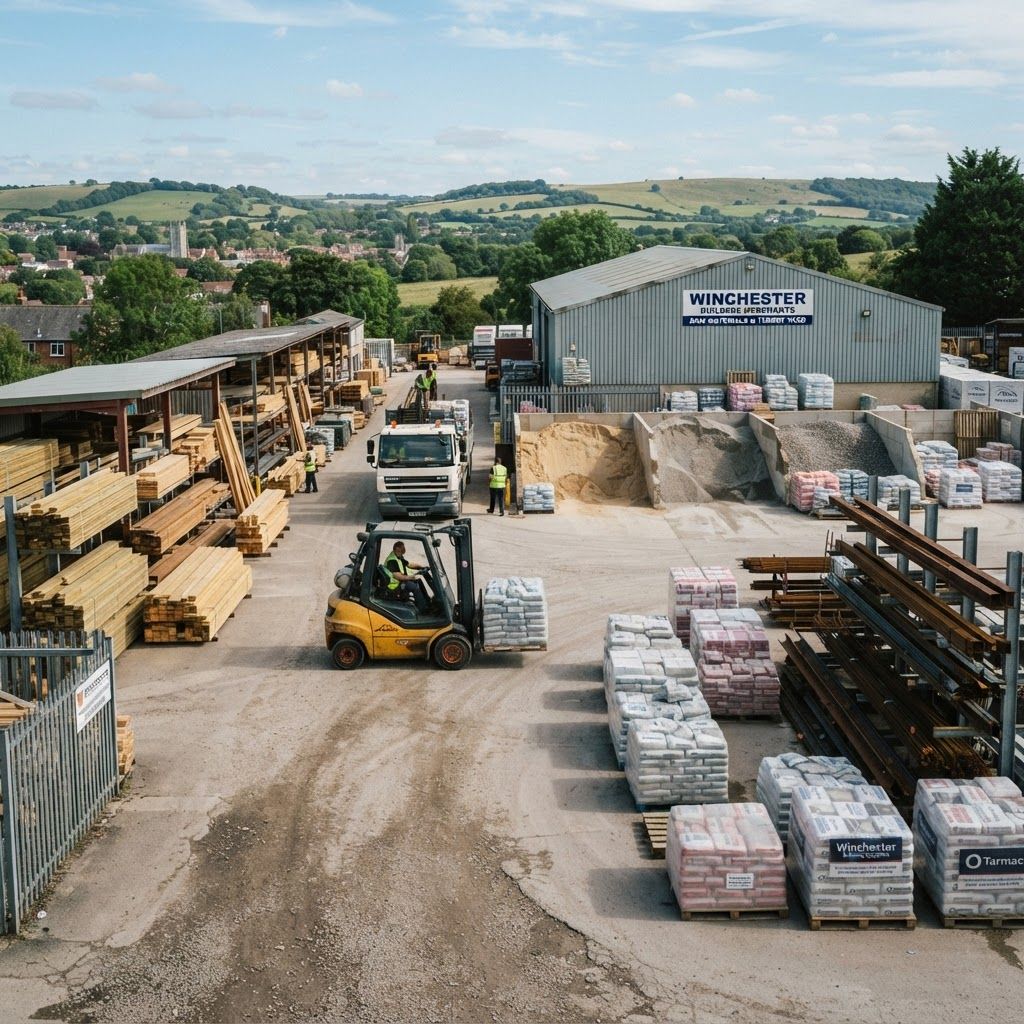
Raw Materials and the Winchester Supply Chain
Raw material supply is the least visible but most fundamental layer of any local economy. In and around Winchester, it underpins housebuilding across the district, heritage restoration in the historic core, agricultural infrastructure in the surrounding countryside, light manufacturing, and a notable population of craftspeople working in wood, metal, stone and textiles.
The category is broad by definition. Aggregates, sand, cement and ready-mixed concrete serve groundworks and structures. Timber, sheet materials and engineered wood serve carpentry and construction. Steel, aluminium and non-ferrous metals serve fabrication and engineering. Polymers, resins and composites serve manufacturing. Stone, brick, lime and specialist mortars serve conservation work, which matters considerably in a city with so much protected fabric.
What Makes a Strong Raw Material Supplier
Buyers assess raw material suppliers on criteria that differ sharply from finished goods purchasing. Consistency of specification is paramount: a batch of concrete or a consignment of structural timber must meet declared standards every time, with documentation to prove it. Lead time reliability comes next, because a delayed delivery can idle an entire site crew. Technical support matters when a specification needs interpreting or substituting.
Certification has become central. Timber requires chain-of-custody evidence. Structural steel requires CE or UKCA marking and declarations of performance. Concrete requires conformity to relevant standards. Increasingly, buyers also want environmental product declarations quantifying embodied carbon, because carbon reporting has moved from voluntary to expected on larger projects.
1. Travis Perkins
As a general builders merchant with strong local presence, Travis Perkins supplies aggregates, cement, timber, insulation, plasterboard, bricks and blocks to contractors across the Winchester area. Its advantage is consolidation and delivery flexibility. Crane-offload deliveries to constrained sites, scheduled drops matched to build programmes, and trade account management make it a default choice for residential and light commercial construction.
2. Jewson
Jewson competes directly in the merchant space and is often chosen for timber and landscaping materials. Its branches maintain stocks of sawn and planed softwood, sheet materials, fencing, decking and paving. For jobbing builders and landscapers working across Hampshire villages, branch proximity and same-day collection are decisive advantages over centralised distribution models.
3. Aggregate Industries
Aggregate producers supply the sand, gravel, crushed rock, asphalt and ready-mixed concrete that underpin civil engineering and housebuilding. Operations of this scale bring quarry and plant capacity, consistent mix designs and the technical laboratories needed to verify performance. For Winchester projects, the practical benefit is the ability to supply large, continuous pours without interruption, supported by documented conformity.
4. Tarmac
Tarmac serves the region with cement, concrete, asphalt and aggregates, and is closely associated with highway and infrastructure work. Its lower-carbon concrete and asphalt products have grown in importance as public sector clients apply carbon criteria to tenders. For contractors in Winchester bidding on local authority frameworks, access to verified lower-carbon mixes has become a commercial necessity rather than an option.
5. Hampshire Timber Merchants
Independent timber merchants serving the county specialise in structural and joinery grades, offering machining, treatment and cutting services alongside supply. Their value lies in expertise: advising on appropriate grades for exposed conditions, matching species for heritage repairs, and sourcing hardwoods for bespoke joinery. Winchester's conservation work regularly requires oak and other traditional species that general merchants do not routinely stock.
6. Metal Supermarkets and Regional Steel Stockholders
Steel stockholders supply beams, sections, plate, tube, bar and sheet, usually with cutting and drilling services included. Fabricators and engineering workshops around Winchester rely on stockholders who can cut to size, because that removes waste and saves workshop time. Fast turnaround on small quantities distinguishes the best operators; a fabricator waiting three days for a length of box section loses far more in labour than in material cost.
7. Polymer and Plastics Distributors
Sheet plastics, engineering polymers, resins and composite materials serve manufacturers, signmakers, laboratory suppliers and product designers. Distributors in this category provide material data sheets, machining guidance and cut-to-size services. Material selection matters intensely here: choosing between acrylic and polycarbonate, or between different grades of engineering polymer, determines whether a component survives its intended service life.
8. Lime and Heritage Material Specialists
Winchester's historic building stock creates persistent demand for traditional materials. Lime mortars, lime plasters, natural hydraulic limes, hair-reinforced renders, reclaimed brick and appropriate stone are essential for work on listed and conservation area buildings, where modern cement-based products cause long-term damage. Specialist suppliers in this field provide not only materials but also advice and training, and conservation officers frequently expect their involvement.
9. Natural Stone Suppliers
Stone suppliers serve both construction and landscaping demand, supplying flooring, cladding, paving, walling and masonry. In Winchester the relevant traditions include flint, chalk, and imported limestones used in historic construction. Matching stone for repairs requires sourcing expertise and an understanding of weathering behaviour, which is why specialist suppliers with quarry relationships outperform general merchants on this work.
10. Textile and Craft Material Suppliers
Beyond construction, Winchester supports a community of makers working in textiles, leather, ceramics and fine materials. Suppliers serving this segment provide fabrics, yarns, clays, glazes, leathers and finishing products, usually in small quantities with strong technical guidance. Small-batch manufacturers and independent designers in the city depend on these suppliers for both material and knowledge, and the relationships are typically long-standing.
Managing Price Volatility
Raw material prices move more sharply than most other business inputs. Energy costs feed directly into cement, glass, steel and ceramics. Shipping rates affect imported timber, stone and polymers. Currency movements affect anything traded internationally. Demand cycles in construction amplify all of it.
Experienced Winchester buyers manage this in several ways. Fixing prices for the duration of a project removes uncertainty, though suppliers will price that risk into the quotation. Ordering in stages against a programme reduces exposure to storage and damage while keeping some flexibility. Maintaining relationships with more than one supplier preserves options when allocation becomes tight. Building realistic contingency into tender pricing prevents margin erosion when costs move mid-project.
Sustainability and Embodied Carbon
Embodied carbon has become a serious consideration on Winchester projects, particularly those involving public sector or institutional clients. Concrete and steel dominate the carbon footprint of most buildings, which has driven interest in cement replacements, recycled steel content, and timber structures that store carbon rather than emit it.
Practical steps include specifying concrete with ground granulated blast-furnace slag or fly ash replacement, choosing steel from electric arc furnace production, using certified timber from responsibly managed forests, sourcing aggregates from recycled sources where structurally appropriate, and reducing transport distances by favouring regional supply. Suppliers who can provide environmental product declarations make this reporting straightforward; those who cannot increasingly find themselves excluded from larger tenders.
Specification Compliance and Documentation
The paperwork accompanying raw materials is not bureaucratic overhead; it is the evidence that a building is safe and insurable. Declarations of performance, test certificates, mill certificates for steel, batch records for concrete and chain-of-custody documentation for timber all form part of the handover package on a completed project.
Buyers should establish at the point of ordering that documentation will be supplied, in what format, and when. Retrofitting missing certificates after completion is difficult and occasionally impossible. The best suppliers automate this, attaching documentation to delivery records so that it is available when the project file is assembled.
Building a Resilient Supply Base
The lesson of recent years is that resilience matters as much as price. Winchester businesses that maintained relationships with multiple suppliers, held modest buffer stocks of critical materials, and specified flexibly where performance allowed substitution, weathered disruption far better than those optimised purely for cost. Choosing suppliers is therefore as much about assessing their own supply chains and capacity as it is about comparing quotations.
Want your brand featured in front of decision-makers? Publish a guest post or get a link insertion in our guides through AAMAX's guest post and link insertion service.
Helpful Links
 SponsoredAAMAX — Full-Service Digital Agency
Write for Us
Share your expertise with our readers. We welcome guest contributions from industry specialists.
Pitch your idea

