York: A Railway City by Design
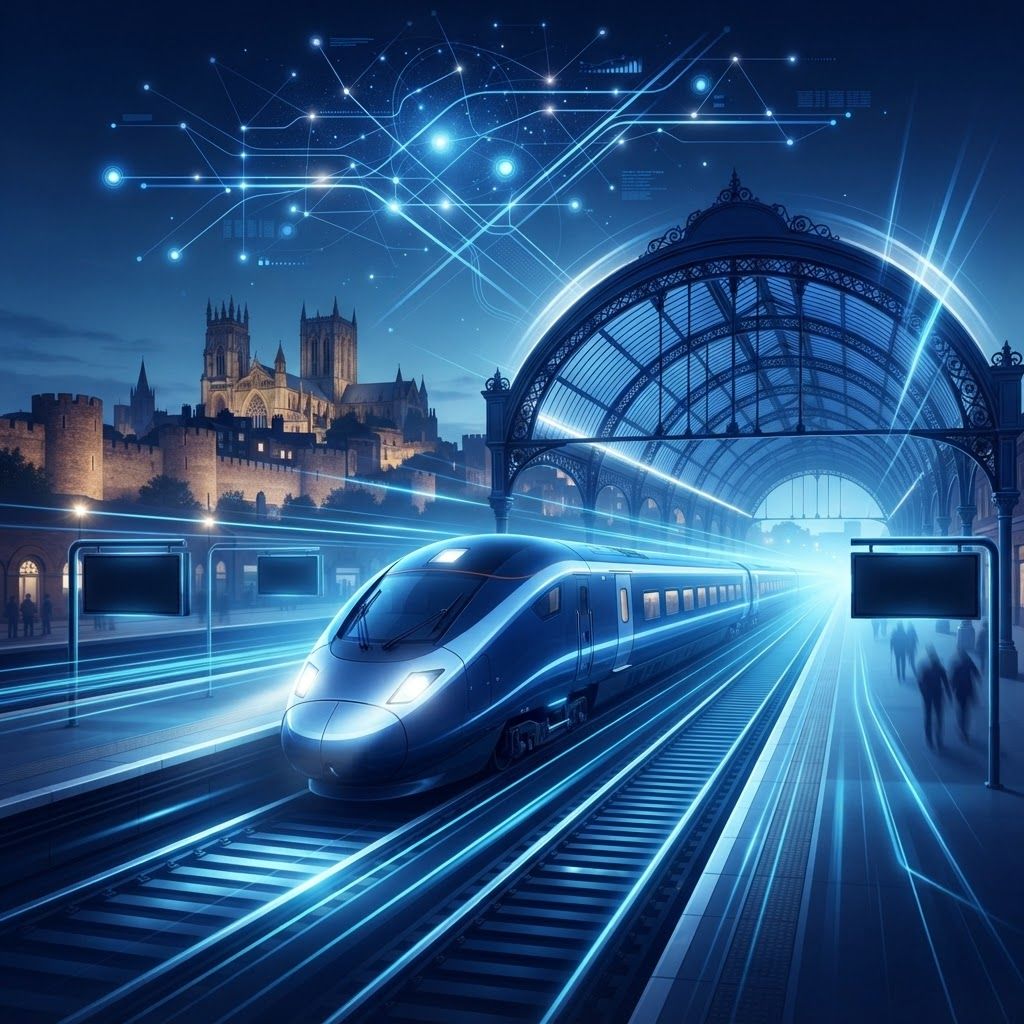
Few cities in Britain are as thoroughly defined by rail as York. The city was central to the development of the railway network in the nineteenth century, became a major hub for locomotive and carriage construction, and remains home to the national collection of railway heritage. Its station, with its magnificent curved train shed, is one of the most architecturally admired in the country and one of the busiest interchanges outside London.
Operationally, York's importance comes from its position on the East Coast Main Line, the high-speed spine connecting London with Yorkshire, the North East and Scotland. Cross-country routes converge here too, linking the South West and the Midlands with the North East, and regional lines fan out toward Leeds, Manchester, Hull, Scarborough, Harrogate and the Yorkshire coast. For passengers, this means York offers direct services to an unusually wide range of destinations for a city of its size, often without changing trains.
1. London North Eastern Railway
London North Eastern Railway is the flagship long-distance operator at York, running high-frequency services along the East Coast Main Line between London, York, Newcastle, Edinburgh and beyond. Journey times to London are among the fastest of any comparable city, making York genuinely viable for day return business travel and for commuting on a weekly basis.
The passenger experience is a major strength. The operator's modern bi-mode fleet offers quiet, air-conditioned interiors, generous luggage space, at-seat power and reliable wireless internet, with a first-class product that includes complimentary catering on many services. Advance fares booked early are dramatically cheaper than walk-up prices, and seat reservations are straightforward. For anyone travelling between York and London, this is the default and generally the best option.
2. CrossCountry
CrossCountry operates one of the longest and most useful route networks in the country, and York sits firmly on it. Services connect the city with Birmingham, Bristol, Reading, Southampton, Bournemouth, Exeter and Plymouth to the south and west, and with Newcastle and Edinburgh to the north. The value is in avoided interchanges: a passenger travelling from York to the South West can do so in a single seat rather than crossing London.
Rolling stock includes both high-speed diesel sets and electric units depending on route, with reservations, catering trolleys and cycle spaces. Because journeys are long, advance booking is particularly worthwhile, both for price and for guaranteed seating on services that can become busy at intermediate stations.
3. TransPennine Express
TransPennine Express provides the key inter-regional connections across the north of England, linking York with Leeds, Manchester, Manchester Airport, Liverpool, Newcastle, Middlesbrough and Scarborough. For York residents, the Manchester Airport service is especially valuable, offering a direct rail link to a major international hub without road transfer or airport parking costs.
The operator has invested in newer fleets offering improved comfort, power sockets, air conditioning and better accessibility. Its role in the northern economy is significant, carrying large numbers of commuters and business travellers between the region's major cities, and it is central to the practical case that Yorkshire and the North West function as a connected labour market.
4. Northern
Northern operates the dense network of regional and local services that give York genuine reach into Yorkshire. Routes serve Leeds, Harrogate, Hull, Sheffield, Doncaster, Selby, Malton and Scarborough, calling at intermediate stations that long-distance operators pass through. For residents of surrounding towns and villages, these services are the practical means of accessing York for work, education, healthcare and shopping.
The Harrogate line and the coastal route toward Scarborough and Whitby connections are also among the most scenic in the region, making Northern a leisure operator as much as a commuter one. Fares on regional journeys are modest, particularly with off-peak day returns and rover tickets, and the network's coverage is its principal asset.
5. Grand Central
Grand Central is an open-access operator, meaning it runs commercially without a franchise, and it provides direct services between York, the North East and London King's Cross. Its distinguishing features are competitive pricing, a straightforward no-frills product with comfortable seating and wireless internet, and service to communities that benefit from a direct London link.
For price-sensitive travellers, Grand Central often undercuts the principal East Coast operator on comparable journeys, and its presence demonstrates the value of competition on a major corridor. Frequencies are lower than the main operator's, so it works best for passengers whose timing is flexible enough to fit its schedule.
6. Hull Trains
Hull Trains is another open-access operator, connecting the East Riding with London and serving the corridor through Yorkshire. Like Grand Central, it competes on fares and customer service, with modern bi-mode rolling stock and a reputation for attentive onboard staff. Its relevance to York is as part of the wider competitive landscape on the route south, and for travellers combining journeys between the Humber region and the capital. The operator has consistently scored well in passenger satisfaction, reflecting the advantage of a small, focused operation with a strong local identity.
7. Lumo
Lumo represents the newest thinking in intercity rail: an all-electric, single-class, digital-first operator running between London and Edinburgh via the East Coast route. Its proposition is low fares, entirely paperless ticketing, and a substantially lower carbon footprint than flying the same city pair. Onboard, the emphasis is on simplicity: comfortable standard seating, power sockets, wireless internet and app-based catering ordering rather than a trolley service.
For travellers between Yorkshire and Scotland, Lumo has meaningfully shifted the economics of rail against air travel, and its environmental case is straightforward: electric traction on an electrified route produces a fraction of the emissions of a short-haul flight.
8. Caledonian Sleeper and Long-Distance Overnight Travel
Overnight rail travel occupies a distinctive niche, and while the sleeper network does not call at York directly, the concept remains relevant to the city's travellers through connecting services and the wider East Coast route. Sleeper travel offers private berths, en-suite options on newer stock, lounge access and the practical advantage of arriving rested at the start of a working day without paying for a hotel night. For York-based travellers heading to the Scottish Highlands, combining an East Coast service with an overnight connection remains one of the more civilised ways to cross the country.
9. North Yorkshire Moors Railway
The North Yorkshire Moors Railway is a heritage operator of national significance and one of the great railway experiences within reach of York. Running steam and historic diesel services between Pickering, Levisham, Goathland and Whitby, it crosses moorland scenery that is inaccessible by any other rail route. The line is meticulously maintained by a combination of paid staff and a large volunteer community, and its stations are preserved to period standards that have made them familiar filming locations.
For visitors to York, this is more than nostalgia. It is a genuinely practical way to reach the coast through spectacular country, and it functions as a working demonstration of the engineering heritage that the city's museums document.
10. Wensleydale Railway and Regional Heritage Operators
The Wensleydale Railway and other regional heritage lines complete York's railway landscape. Operating through the Yorkshire Dales countryside, these lines preserve rolling stock, infrastructure and operating practice that would otherwise be lost, while providing accessible days out for families and enthusiasts. They also play a real economic role, drawing visitors into rural communities and supporting local businesses along their routes. Combined with York's own railway museum collection, they make the area arguably the most rewarding destination in Britain for anyone interested in railways.
Getting the Best Value and Experience
Book advance fares as early as possible for long-distance journeys, where the difference between an advance and a walk-up fare can be several times the price. Use split ticketing where it applies, as breaking a journey into segments at intermediate stations is sometimes substantially cheaper for the identical train. Consider a railcard if you qualify, since the discount typically pays for the card within two or three journeys.
Travel off-peak where possible for both price and comfort, avoiding weekday morning and late-afternoon peaks and the busiest Friday evening departures. Reserve seats on long-distance services, particularly on routes that fill at intermediate stations. Check engineering work before travelling, as weekend closures on the East Coast route are periodically substantial. And for regional exploring, look at day rover and rail rover products that allow unlimited travel within an area, which are excellent value for touring Yorkshire from a York base.
The Future of Rail at York
Several developments will shape the next decade. Electrification and bi-mode fleets are steadily reducing diesel operation and emissions on routes through the city. Digital signalling programmes on the East Coast route aim to increase capacity and reliability without laying new track. Ticketing continues to simplify, with pay-as-you-go, digital season products and flexible season tickets responding to hybrid working patterns.
York's fundamental advantage is unlikely to change. Its position at the junction of a high-speed national spine and a dense regional network means that, for a city of modest size, it offers rail connectivity most places can only envy, along with a railway heritage that remains visible in its streets, its station and its museums.
Want your brand featured in front of decision-makers? Publish a guest post or get a link insertion in our guides through AAMAX's guest post and link insertion service.
Helpful Links
 SponsoredAAMAX — Full-Service Digital Agency
Write for Us
Share your expertise with our readers. We welcome guest contributions from industry specialists.
Pitch your idea