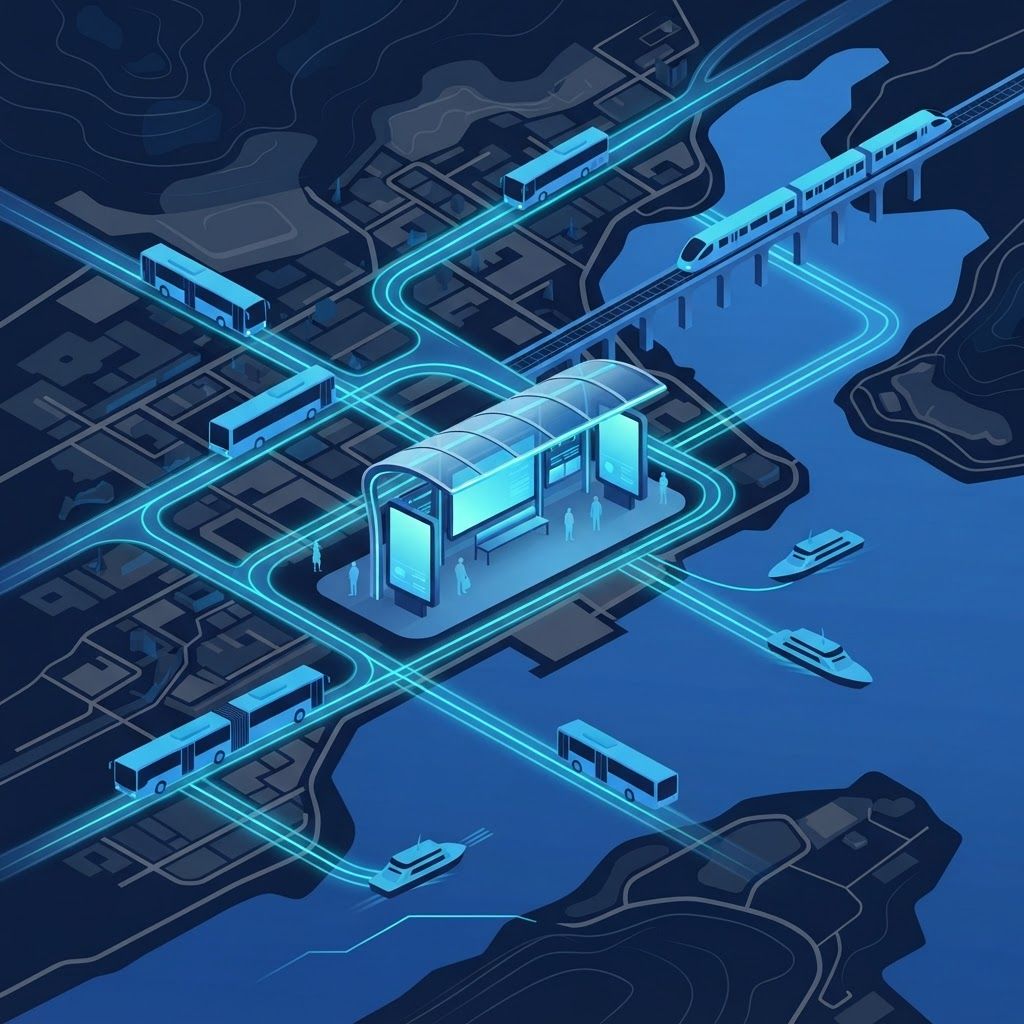
Public Transport on the Essex Coast
Tendring presents one of the more interesting public transport puzzles in the East of England. It has a population of well over one hundred and fifty thousand people spread across a peninsula, with three railway branches, a network of bus corridors radiating from Clacton-on-Sea, a large number of small villages, and a working international port at Harwich. It also has a demographic profile with a high proportion of older residents, meaning concessionary bus travel is used intensively, and pockets of significant deprivation where car ownership is low and public transport access directly affects employment prospects.
The result is a network where different services play complementary rather than competing roles. Rail carries the long-distance commuting market. Buses handle town and inter-urban travel. Community transport reaches the people and places that scheduled services cannot. Ferries and leisure links serve tourism and cross-estuary journeys. Used together, they cover the district reasonably well, but only if travellers know what exists.
What Makes Public Transit Work
Frequency matters more than speed for local journeys. A bus every fifteen minutes needs no timetable consultation. A bus every two hours dictates the shape of your entire day.
Interchange quality is the second factor. Connections at Clacton railway station, Thorpe-le-Soken junction, Harwich Town and Manningtree determine whether multi-leg journeys are practical. Sheltered waiting areas, real-time displays and short walking distances make an enormous difference.
Fares and ticketing integration is the third. Contactless payment, daily and weekly caps, multi-operator tickets and clear concessionary rules reduce the friction that deters occasional users.
Accessibility is the fourth, and in Tendring it is central. Step-free boarding, wheelchair spaces, audio-visual announcements and staff trained in passenger assistance transform independence for a large share of the population.
The Top 10 Public Transit Services in Tendring
1. Greater Anglia Rail Services
Greater Anglia operates the district's rail services, including the Clacton-on-Sea branch, the Walton-on-the-Naze branch via Thorpe-le-Soken, and the Harwich branch, plus main line services through Manningtree towards London and Norwich. Its modern fleet has substantially improved comfort, accessibility and reliability, and rail remains the fastest way out of the district.
2. First Essex Bus Network
First Essex provides the highest-frequency bus services in Tendring, particularly the corridors linking Clacton with Colchester and the town routes serving Jaywick, Holland-on-Sea, Great Clacton and the residential estates. Contactless payment, app-based ticketing and fare caps have made these services considerably easier to use.
3. Panther Travel Local Services
Panther Travel runs local and supported routes across the Clacton and Tendring area, including journeys that connect smaller communities to the main towns. Operators of this type are essential to network coverage, filling gaps that commercial services leave.
4. Hedingham and Chambers Rural Routes
Serving north Essex including the Tendring hinterland and links towards Colchester, these operations provide the semi-rural connections that allow village residents to reach shops, schools, health services and rail stations.
5. Tendring Community Transport and Dial-a-Ride
Community transport is arguably the most important service in the district for people who cannot use conventional buses. Door-to-door minibuses, accessible vehicles, volunteer car schemes and group hire give isolated and less mobile residents genuine independence. Membership-based and demand-responsive, these schemes are staffed by drivers trained in passenger assistance.
6. Harwich Harbour Foot Ferry
The seasonal foot ferry linking Harwich with Shotley and Felixstowe is both a genuine transport link and a much-loved local institution. It saves an extremely long road journey around the estuaries and connects walkers, cyclists and commuters across the Haven.
7. Essex County Council Supported Bus Services
Many rural routes in Tendring exist because the county council tenders them, filling commercial gaps. These supported services, along with school transport provision and travel information services, form a critical part of the public transport offer even though passengers rarely see the funding mechanism behind them.
8. Demand-Responsive Transport Schemes
Bookable minibus services that operate within a zone rather than on a fixed route are increasingly used in rural Essex. Passengers request a journey by phone or app and the vehicle routes dynamically. For sparsely populated parishes, this model provides far better coverage per pound spent than a lightly used timetabled route.
9. Non-Emergency Patient Transport and Health Travel Schemes
Access to healthcare is a major transport issue in Tendring, with residents travelling to Clacton, Colchester and Ipswich for treatment. Patient transport services and voluntary car schemes provide accessible, appointment-linked journeys for those who cannot travel independently, and are a vital though often overlooked part of the transit landscape.
10. Licensed Taxi and Private Hire Operators
Finally, taxis and private hire vehicles licensed by Tendring District Council function as an essential part of the public transport mix, particularly in the evenings when bus services thin out and in villages with limited daytime provision. Wheelchair-accessible vehicles and school contract work make them a formal component of local transport policy rather than merely a private convenience.
Trends and Challenges
Fare capping has significantly improved the value proposition of bus travel for medium-distance journeys, particularly Clacton to Colchester. Real-time information and mobile ticketing have reduced uncertainty for occasional users. Fleet decarbonisation is progressing through low-emission and electric vehicle introduction. At the same time, driver recruitment, rural service economics and seasonal demand swings remain persistent pressures. The most promising direction is better integration: coordinated timetables, shared information platforms and multi-operator ticketing that let a resident of a small village plan a journey to Ipswich or London as a single trip rather than a series of gambles.
Practical Advice for Passengers
Plan multi-leg journeys around the rail timetable first, then fit bus connections around it, since trains are less frequent but more time-critical. Check whether a day or weekly cap makes repeat travel cheaper. If you hold a concessionary pass, confirm the operators and time restrictions that apply. For rural journeys, investigate community transport membership well before you need it, as registration takes time. And for evening travel, verify last departure times, which can be much earlier than expected outside Clacton.
Final Thoughts
Tendring's public transport is more capable than its rural reputation suggests, but it rewards knowledge. Rail provides the strategic links, high-frequency bus corridors serve the main towns, supported and community services keep villages connected, ferries add a distinctive coastal option, and taxis fill the gaps. Learning how these layers interlock is the single most useful thing any resident or visitor can do to travel the district without a car.
Want your brand featured in front of decision-makers? Publish a guest post or get a link insertion in our guides through AAMAX's guest post and link insertion service.
Helpful Links
 SponsoredAAMAX — Full-Service Digital Agency
Write for Us
Share your expertise with our readers. We welcome guest contributions from industry specialists.
Pitch your idea