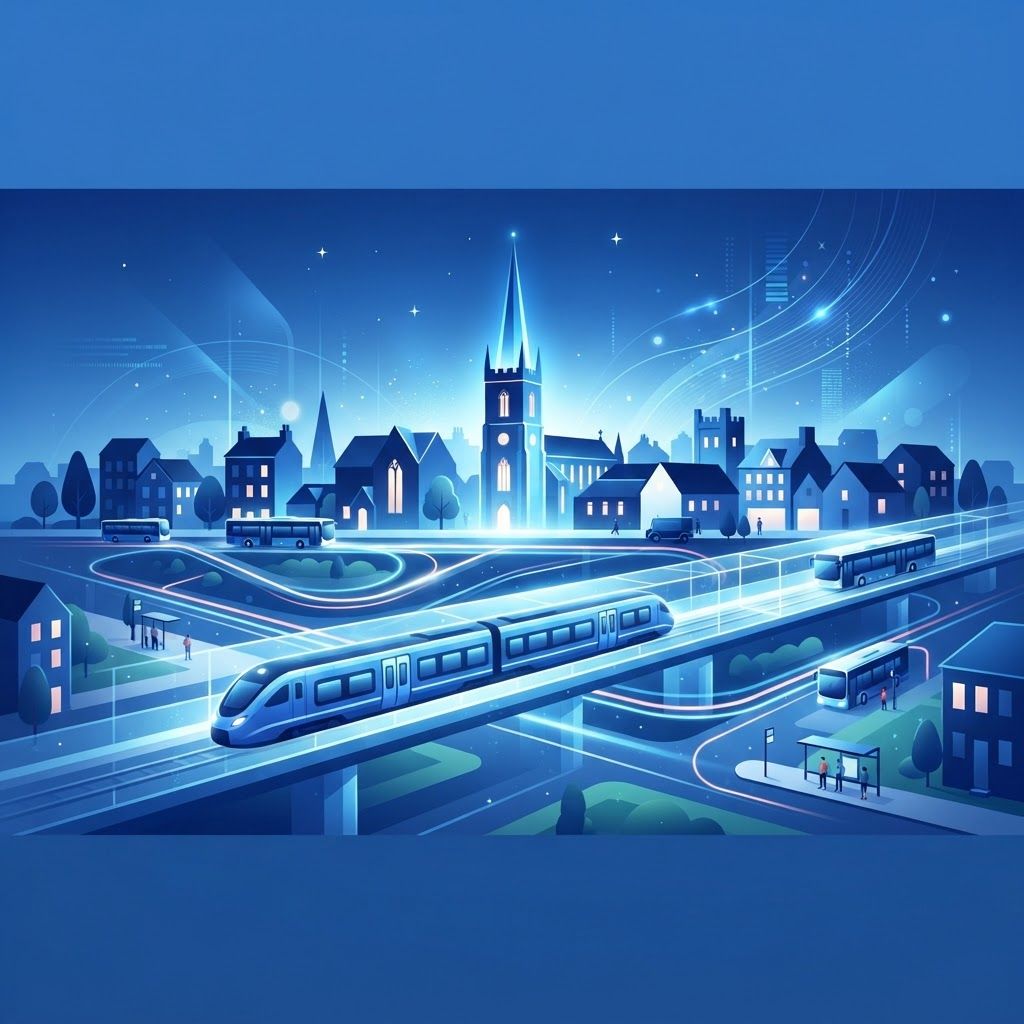
Getting Around Newark and Sherwood
Newark and Sherwood is a district of contrasts. At its heart sits Newark-on-Trent, a bustling market town with two railway stations, a compact centre and a growing commuter population. Radiating outwards are Southwell, Ollerton, Edwinstowe, Bilsthorpe, Rainworth, Blidworth, Clipstone and dozens of smaller villages scattered across former coalfield land and the ancient expanse of Sherwood Forest. Connecting these communities is a genuine transport challenge, and the operators that do it well play an outsized role in local life.
Public transport here serves several distinct groups. Commuters travel daily to Nottingham, Lincoln, Grantham and even London. Students move between village homes and colleges in Newark and Mansfield. Older residents rely on buses for shopping, appointments and social contact, particularly where car ownership is not practical. Visitors arrive to explore Sherwood Forest, Southwell Minster and Newark Castle. The best services recognise these different needs rather than treating the district as a single homogenous market.
1. East Midlands Railway
East Midlands Railway operates services through Newark Castle station on the Nottingham to Lincoln line, giving residents a frequent regional connection in both directions. For many people in the district this is the backbone of the daily commute. Journeys to Nottingham are quick and comfortable, and the Lincoln direction opens up study and employment options to the east. The operator has invested in newer rolling stock, improved passenger information and simplified ticketing, all of which matter on a line where connections are tight and reliability is closely watched.
2. London North Eastern Railway
Newark North Gate sits on the East Coast Main Line, and London North Eastern Railway gives the town a genuinely exceptional connection for a place of its size. Fast services reach London in well under ninety minutes, with northbound trains serving York, Newcastle and Edinburgh. This single fact has shaped Newark's property market and its appeal to hybrid workers who travel to the capital a couple of days a week. Advance fares, reserved seating and a straightforward station layout make the journey manageable even at peak times.
3. Stagecoach East Midlands
Stagecoach East Midlands is one of the most visible bus operators across the district, running services that link Newark, Mansfield, Ollerton and surrounding villages. The company's strengths are network reach and consistency. Contactless payment, app-based journey planning and day or weekly capped tickets have modernised what used to be a cash-heavy experience. For residents in the former coalfield communities of Ollerton and Boughton, Stagecoach routes often represent the most practical link to larger towns for work and shopping.
4. Nottingham City Transport
While Nottingham City Transport is primarily an urban operator, its longer routes and interchange role matter enormously to Newark and Sherwood residents travelling into the city. The fleet is well regarded nationally for cleanliness and environmental performance, with a significant number of biogas double deckers. Passengers from the district frequently combine a local bus or train with NCT services to reach hospitals, universities and workplaces across Nottingham, and the smooth integration between these networks is a genuine benefit.
5. Marshalls of Sutton on Trent
Marshalls of Sutton on Trent is a long-established independent operator serving villages to the north of Newark. Family-run coach and bus companies like this one are the quiet heroes of rural transport. They maintain routes that larger operators would struggle to justify commercially, they know their passengers by name, and they adapt timetables around school runs, market days and hospital appointments. For residents in communities such as Sutton on Trent, Collingham and Carlton-on-Trent, this kind of service is not a convenience but a lifeline.
6. Vectare
Vectare has become known for operating carefully targeted routes where demand has been identified but conventional commercial models have failed. The company takes a data-led approach to network design, which suits a district with dispersed settlements and uneven demand patterns. Passengers tend to appreciate the clear timetabling and the willingness to trial new links rather than simply withdrawing from difficult corridors.
7. Nottsbus On Demand
Nottsbus On Demand represents one of the most significant changes to rural transport in recent years. Rather than following a fixed route, the service uses bookable minibuses that respond to passenger requests within defined zones, including large parts of rural Newark and Sherwood. Users book by app or phone and are collected close to home. For villages with only one or two conventional buses a day, demand-responsive transport has transformed access to shops, surgeries and social activities, and it has proved particularly valuable for older passengers.
8. Newark Area Community Transport
Community transport schemes fill the gaps that neither commercial operators nor scheduled services can reach. Newark Area Community Transport and similar voluntary organisations provide accessible minibuses, group hire and door-to-door journeys for people with mobility difficulties. Vehicles are typically fitted with tail lifts and low-floor access, and drivers receive training in passenger assistance. The social value of these services is considerable, reducing isolation as much as solving a travel problem.
9. Newark and Sherwood Dial-a-Ride Schemes
Dial-a-ride operations across the district offer pre-booked transport for residents who cannot use conventional buses. Journeys are often arranged to supermarkets, medical centres and community groups, with volunteer drivers making up a large part of the workforce. Because bookings are handled locally, the service can be flexible about pick-up points and waiting times in a way that timetabled routes simply cannot match.
10. Local Taxi and Private Hire Operators
Licensed taxi and private hire firms based in Newark, Southwell and Ollerton complete the district's transport picture. They cover late evenings, early mornings and the rural journeys where no bus runs, and many hold contracts for school transport and non-emergency patient travel. Increasingly, operators offer app booking, card payment and wheelchair accessible vehicles, bringing a more professional and predictable experience to a sector that was once heavily informal.
Trends Shaping Local Transport
Several trends are reshaping how people move around the district. Fare capping and contactless payment have removed much of the friction from occasional bus use. Demand-responsive services are proving that rural transport does not have to mean empty buses on fixed routes. Electric and biogas vehicles are gradually replacing older diesel stock, improving air quality in Newark town centre. Meanwhile, hybrid working has flattened the traditional peak, with more passengers travelling midweek and midday than before.
Choosing the Right Service
The best choice depends on your journey. For long-distance travel, the East Coast Main Line from Newark North Gate is difficult to beat. For regional trips towards Nottingham or Lincoln, the Castle station line is usually quicker and cheaper than driving and parking. For local and village journeys, a combination of scheduled bus routes and demand-responsive booking generally works best, while community transport and licensed taxis cover the specialist needs that nothing else can. Understanding how these services interlock is the key to travelling well in Newark and Sherwood.
Want your brand featured in front of decision-makers? Publish a guest post or get a link insertion in our guides through AAMAX's guest post and link insertion service.
Helpful Links
 SponsoredAAMAX — Full-Service Digital Agency
Write for Us
Share your expertise with our readers. We welcome guest contributions from industry specialists.
Pitch your idea