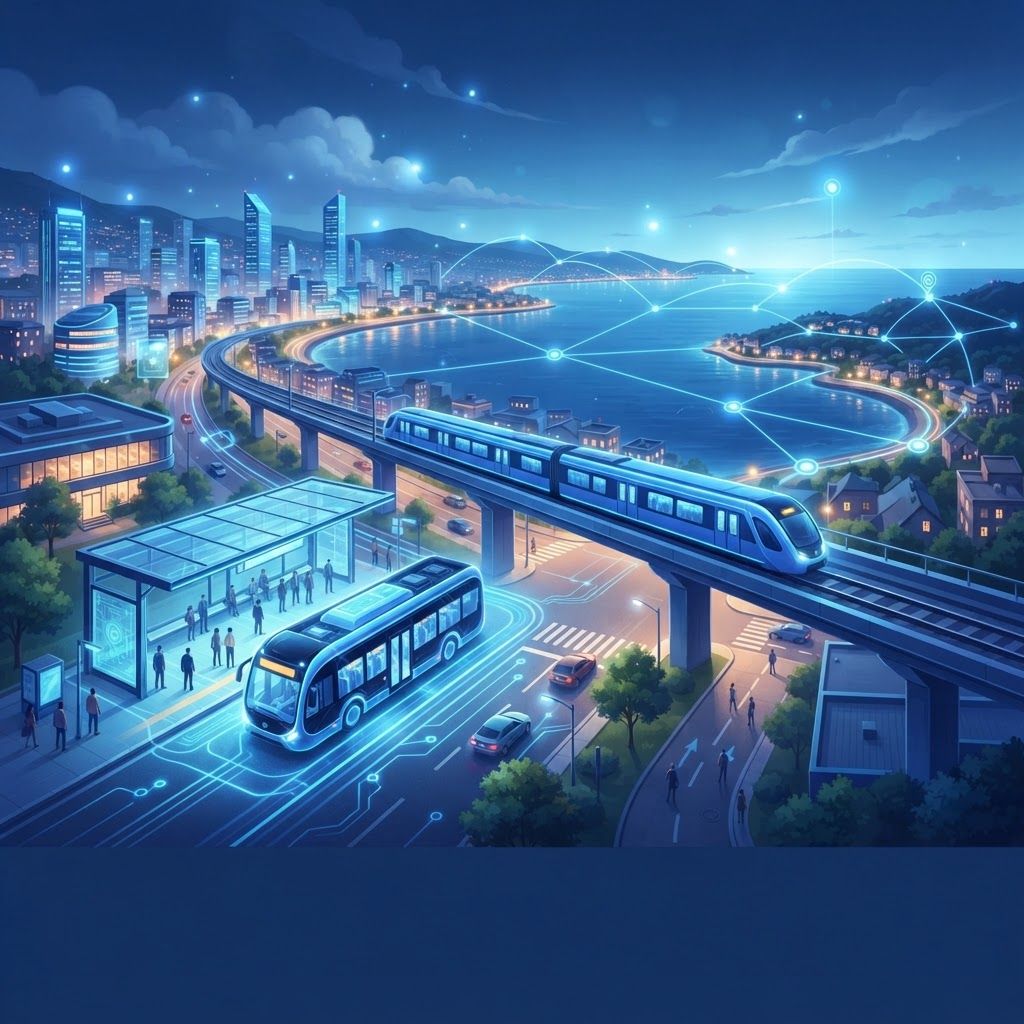
Public Transit Across a Large Rural Borough
Causeway Coast and Glens covers well over eighteen hundred square kilometres, making it one of Northern Ireland's largest council areas by land. It contains substantial towns, dozens of villages, and a scattered rural population living in townlands across the Antrim plateau, the Glens, the Bann valley and the Roe Valley. Delivering effective public transit across such a geography is genuinely difficult, and the solution has been a layered network in which different service types cover different needs.
The result is a system that works well along the main corridors and requires more planning in remote areas. Understanding the layers is the key to using it effectively, whether you are a resident without a car, a student travelling to college, an older person attending appointments, or a visitor exploring the Causeway Coastal Route.
The Layers of the Transit Network
Rail forms the spine for longer journeys. The Belfast to Derry line runs through Ballymoney, Coleraine, Castlerock and Bellarena, with the branch to Portrush providing access to the main resort town. Rail offers the fastest journeys to Belfast and Derry and is operated by Northern Ireland Railways under the Translink banner.
Scheduled bus services provide the densest coverage. Ulsterbus operates local town services, inter urban routes connecting Coleraine with Limavady, Ballymoney, Ballycastle, Bushmills and Portstewart, and rural routes reaching smaller settlements. Goldline express coaches link the borough to Belfast and other major centres with limited stop services.
Seasonal and tourist services supplement the network in summer. The Causeway Rambler operates along the coast between Coleraine, Portrush, Bushmills, the Giant's Causeway, Carrick-a-Rede and Ballycastle, giving car free access to the borough's principal attractions. Open top and tour coaches add further capacity during peak months.
Community transport fills the gaps that commercial timetables cannot. Rural community transport partnerships operate dial a lift style door to door services for members in isolated areas, alongside accessible transport for people with mobility impairments and group transport for community organisations. For many older residents in the Glens, these services are the difference between independence and isolation.
School transport forms a substantial parallel network, with dedicated and shared services carrying pupils to schools across the borough, often providing the only scheduled service in some rural areas.
Ferry services complete the picture, with the Ballycastle to Rathlin Island route providing the island community's essential connection to the mainland for passengers, goods and vehicles.
What Makes Public Transit Work Well
Integration between modes is the critical factor. A rail arrival at Coleraine is only useful if a bus connection to Portstewart or Bushmills follows within a reasonable time. Coordinated timetabling, shared interchange facilities and through ticketing make multi modal journeys practical rather than theoretical.
Frequency determines whether a service is usable for spontaneous travel. Hourly services allow flexible journey planning, while services running two or three times a day require the entire day to be planned around them. The main corridors in the borough offer good frequency; rural branches inevitably offer less.
Information quality profoundly affects uptake. Real time arrival information, clear printed and digital timetables, journey planning apps and accurate bus stop signage remove the uncertainty that deters occasional users. Visitors in particular rely heavily on good digital information.
Accessibility must be built in throughout. Low floor buses with ramps, wheelchair spaces, audio and visual next stop announcements, step free station access and staff assistance schemes allow independent travel for passengers with disabilities.
Affordability and fare structure matter. Multi journey tickets, day tickets that allow unlimited travel, concessionary passes for older people and young person discounts all increase accessibility, and simple fare structures encourage use.
Trends in Regional Public Transit
Zero emission fleets are being introduced across Northern Ireland, with hydrogen and battery electric buses entering service and infrastructure being developed to support wider rollout. Cleaner vehicles benefit air quality in town centres and reduce operating emissions substantially.
Demand responsive transport is gaining ground as a solution for rural areas. Rather than running near empty buses on fixed rural timetables, flexible services respond to bookings, routing vehicles to actual demand. Technology has made this far more practical than it was a decade ago.
Contactless and mobile ticketing has simplified payment and removed a significant barrier for occasional users and visitors who previously needed exact change and local knowledge.
Active travel integration is increasingly emphasised, with cycle carriage on trains, secure cycle parking at interchanges and improved walking routes to stops extending the effective catchment of each service.
Tourism and transport coordination has strengthened, with combined travel and attraction tickets, park and ride at peak periods, and marketing that positions car free travel as an enjoyable part of the visitor experience rather than a compromise.
Practical Tips for Using the Network
Plan with a journey planner that combines bus and rail, and always check the day of week, since Sunday and public holiday timetables differ substantially from weekday services in rural areas.
Buy a day or multi journey ticket if making more than two trips. These usually pay for themselves quickly and remove the need to calculate individual fares.
For rural journeys, check whether a community transport scheme serves your area, as membership often provides options that do not appear on public timetables.
Visitors should consider basing themselves in Coleraine, Portrush or Ballycastle, all of which have good service connections, rather than in a remote location that requires a car.
Allow buffer time for connections, particularly in summer when coastal roads carry heavy tourist traffic and buses can run behind schedule.
Benefits of Public Transit
Cost savings for households are considerable. Running a second car costs thousands annually once purchase, insurance, fuel, tax and maintenance are included, and for many households in well served towns a transit pass replaces that expense entirely.
Environmental benefit is significant and increasingly recognised. Shifting journeys from private cars to shared transport reduces emissions, congestion and parking pressure, protecting the landscape and air quality that make the borough attractive.
Social inclusion is perhaps the most important outcome. Public transit provides access to employment, education, healthcare and social contact for people who cannot drive due to age, disability, or cost. In a rural borough, that access is fundamental to quality of life.
Final Thoughts
Public transit in Causeway Coast and Glens works as a layered system of rail, scheduled bus, seasonal coastal services, community transport and ferry links. Strong performance along main corridors is complemented by flexible rural provision, and continued investment in zero emission fleets, demand responsive services and digital information is steadily improving the offer. With a little planning, it is entirely possible to live in or explore this remarkable borough without a car.
Want your brand featured in front of decision-makers? Publish a guest post or get a link insertion in our guides through AAMAX's guest post and link insertion service.
Helpful Links
 SponsoredAAMAX — Full-Service Digital Agency
Write for Us
Share your expertise with our readers. We welcome guest contributions from industry specialists.
Pitch your idea