Pools and Spas in a Northern Climate
Swimming pools may not be the first thing associated with the Scottish Borders, yet the region supports a surprising number. Country houses and estates have long featured indoor pools, and the growth of premium self-catering accommodation has added many more. Luxury holiday cottages around Melrose, Kelso, Peebles and the Tweed valley increasingly offer hot tubs, swim spas or small indoor pools as a key selling point, and hotels, spa retreats and wellness businesses across the region operate commercial facilities.
The climate shapes how these installations are built and maintained. Almost all pools here are indoors or enclosed, since an outdoor pool would be usable for only a brief part of the year. Enclosure introduces its own challenges, principally humidity control, condensation management and the protection of the building fabric from chemically laden moist air. In traditional stone buildings converted to house a pool, this becomes a serious technical consideration.
What Pool Maintenance Actually Involves
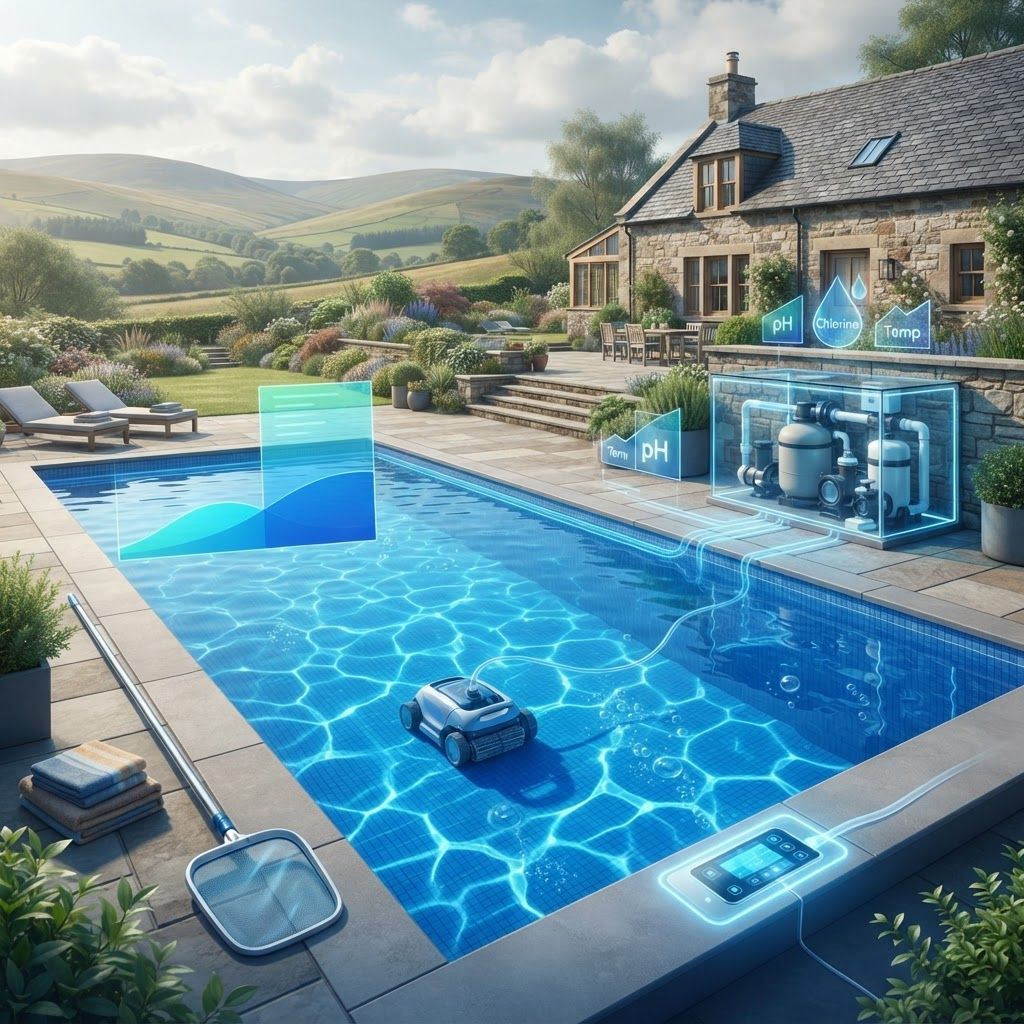
Water chemistry is the heart of the discipline. Maintaining correct sanitiser levels, whether chlorine, bromine or a salt chlorination system, prevents bacterial growth. pH must be held within a narrow band, since water that is too acidic corrodes equipment and irritates skin while water that is too alkaline causes scaling and reduces sanitiser effectiveness. Total alkalinity buffers pH stability, and calcium hardness must be balanced to protect both plaster surfaces and heat exchangers.
Filtration and circulation form the second pillar. Sand, cartridge and diatomaceous earth filters each require different maintenance, and pumps must run long enough daily to turn over the full water volume. Poor circulation creates dead zones where algae establishes regardless of chemical levels.
Physical cleaning covers brushing walls and floors, vacuuming, skimming the surface, cleaning waterline tiles and emptying skimmer and pump baskets. Robotic cleaners handle much of the routine work but do not eliminate the need for manual attention to corners, steps and fittings.
Plant room maintenance addresses pumps, heaters, heat pumps, dosing systems, ultraviolet and ozone secondary disinfection, and dehumidification equipment. For indoor pools, the dehumidification system is as important as the water treatment, protecting the building from condensation damage and keeping the environment comfortable.
Ten Pool and Spa Service Providers
Borders Pool Services offers scheduled maintenance for private and commercial pools across the region, covering water testing, chemical dosing, filtration servicing and plant room checks.
Tweed Valley Pool & Spa serves Peebles and the central Borders with hot tub servicing, water changes, filter replacement and repairs for domestic and holiday let clients.
Eildon Hot Tub Care specialises in self-catering properties, providing rapid changeover servicing between guests including drain-downs, sanitisation and water balancing.
Kelso Aquatic Maintenance covers Roxburghshire with private pool servicing for country houses and estates, including seasonal opening and winterisation.
Cheviot Pool Engineering focuses on plant room work, handling pumps, filters, heat exchangers, pipework and control systems, along with upgrades to more efficient equipment.
Berwickshire Spa Solutions serves the eastern Borders with hot tub and swim spa installation, servicing and repair, including cover replacement and insulation checks.
Hawick Commercial Pool Services works with hotels, leisure facilities and wellness businesses, providing documented water testing regimes and compliance support.
Selkirk Water Treatment concentrates on water quality, offering automated dosing systems, ultraviolet secondary disinfection and salt chlorination conversions that reduce chemical handling.
Lauderdale Pool Refurbishment undertakes tiling, liner replacement, coping repairs and full pool refurbishment for ageing installations.
Jedburgh Leisure Maintenance completes the list, combining pool care with sauna, steam room and wellness equipment servicing for properties offering a full spa experience.
Energy Efficiency and Running Costs
Heating is the dominant operating cost for any pool in a cool climate. Several measures make a substantial difference. A quality thermal cover used whenever the pool is not in use is the single most effective intervention, dramatically reducing evaporative heat loss, which accounts for the majority of energy consumption in an uncovered pool.
Heat pumps have largely replaced direct electric and older boiler arrangements for pool heating, delivering several units of heat per unit of electricity consumed. Variable speed circulation pumps offer further savings, running at low speed for extended filtration periods rather than at full power for shorter bursts, which reduces energy use disproportionately.
Insulation of pipework, plant room heat recovery and well-specified dehumidification with heat recovery all contribute. For indoor pools in older Borders buildings, improving the enclosure fabric often delivers greater savings than any plant upgrade.
Health, Safety and Compliance
Commercial and rental facilities carry legal responsibilities. Water quality must be monitored and recorded, with testing frequency appropriate to the bathing load. Legionella risk assessment applies to pools, spas and associated water systems, and hot tubs present particular risk because of aerosol generation at warm temperatures.
Holiday let owners providing hot tubs should understand that guest-use spas require more rigorous management than private domestic units, typically including drain-down between lets, higher sanitiser residuals and documented checks. Professional servicing provides both the technical work and the records that demonstrate diligence.
Physical safety measures include secure covers, pool alarms, non-slip surfaces, clear depth marking and controlled access, particularly where children may be present.
Seasonal Considerations
Even indoor pools follow a seasonal rhythm in the Borders. Winter brings higher heating demand, greater condensation risk and increased dehumidification load. Any outdoor installation requires proper winterisation, including lowering water levels, draining vulnerable pipework, adding winterising chemicals and fitting a secure cover to prevent frost damage.
Spring reopening involves thorough cleaning, refilling, rebalancing chemistry and servicing equipment that has stood idle, which is when faults typically surface.
Final Thoughts
Pool and spa maintenance in the Scottish Borders combines chemistry, engineering and building physics in a climate that tests all three. The providers profiled here cover routine servicing, hot tub changeovers, plant room engineering, water treatment and refurbishment. Regular professional maintenance protects water quality, equipment life and the building itself, and for holiday accommodation it protects the guest experience on which bookings ultimately depend.
Want your brand featured in front of decision-makers? Publish a guest post or get a link insertion in our guides through AAMAX's guest post and link insertion service.
Helpful Links
 SponsoredAAMAX — Full-Service Digital Agency
Write for Us
Share your expertise with our readers. We welcome guest contributions from industry specialists.
Pitch your idea