Pool Maintenance in a Welsh Climate
Swimming pools are less common in South Wales than in warmer parts of Britain, but the sector in Neath Port Talbot is more substantial than many people assume. The borough contains domestic indoor pools in larger properties, hot tubs and swim spas that have proliferated enormously in recent years, hotel and leisure club facilities, holiday accommodation with private pools, and community and school pools serving the public.
The Welsh climate creates specific maintenance conditions. Outdoor pools and hot tubs collect a significant volume of organic debris from rainfall, wind-blown leaves and, near the coast, salt and sand. High humidity makes indoor pool halls particularly demanding, since without properly designed ventilation and dehumidification, condensation attacks the building fabric far faster than the water attacks the pool. Cooler ambient temperatures mean heating and heat retention are major operating costs, making covers and efficient plant genuinely important rather than optional extras.
Ten Pool and Spa Specialists Serving the Area
1. Bay Pool Services provides routine maintenance for domestic and small commercial pools, covering water testing, chemical dosing, filtration servicing and cleaning on a scheduled basis.
2. Neath Spa & Hot Tub Care focuses on hot tubs and swim spas, including water changes, filter replacement, sanitiser management and pump repairs.
3. Port Talbot Aquatic Maintenance serves leisure facilities and hotels with plant room servicing, circulation system maintenance and compliance-oriented water quality management.
4. Afan Valley Pool Care covers the valley communities and rural properties, where private pools and spas benefit from a local provider rather than a distant national contractor.
5. Baglan Water Treatment specialises in water chemistry and treatment systems, including automated dosing, ultraviolet secondary disinfection and salt chlorination.
6. Coastal Pool Engineering handles mechanical and structural work including pump and filter replacement, pipework repairs, liner renewal and tiling.
7. Valley Leisure Services supports community and school pools with planned preventative maintenance and reactive breakdown response.
8. Skewen Pool Heating Solutions concentrates on heating efficiency, including heat pump installation, heat exchangers, insulated covers and control optimisation.
9. Margam Pool Installations designs and builds new pools and spas, including plant room layout and the associated building services coordination.
10. Swansea Bay Pool Group operates region-wide with capability across domestic, commercial and hospitality installations.
Understanding Water Chemistry
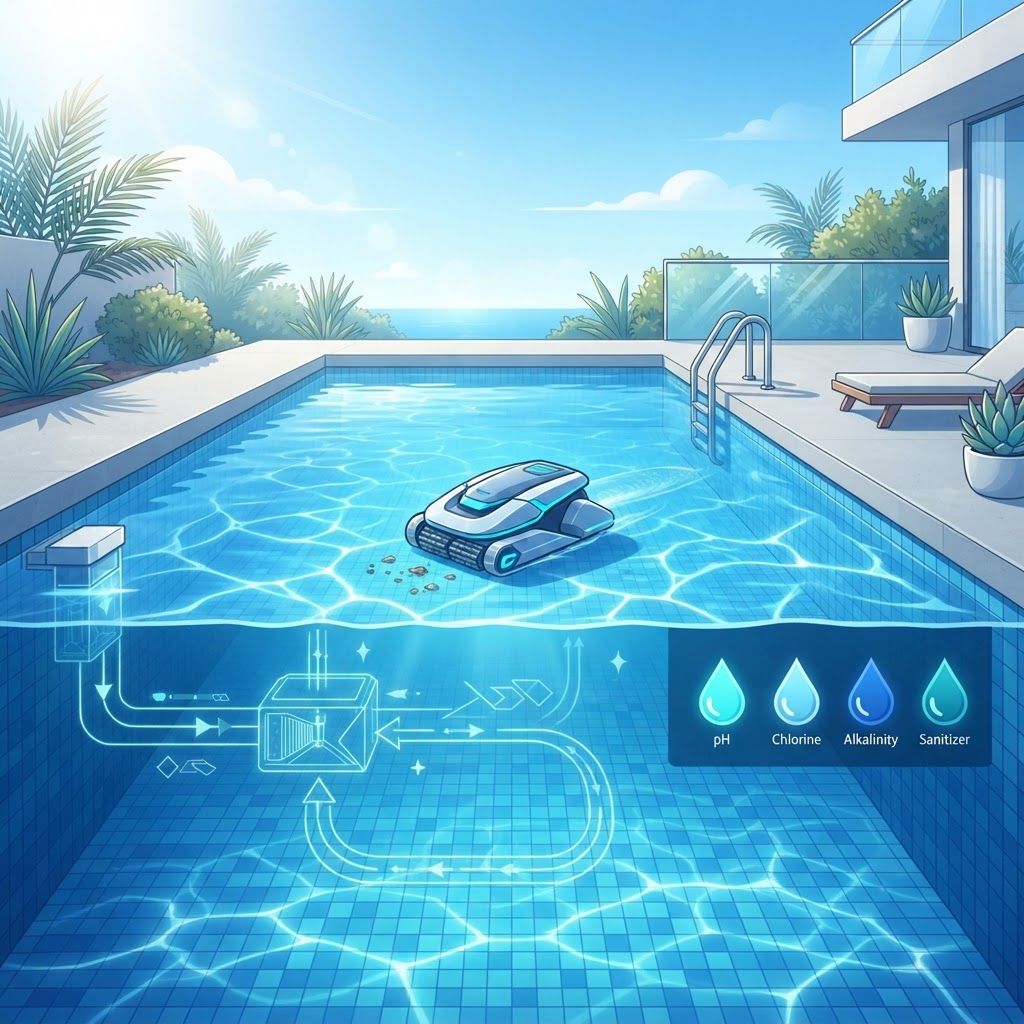
Water treatment is where most pool problems begin and end. The core parameters are sanitiser level, pH, total alkalinity, calcium hardness and, for chlorinated pools, combined chlorine. Each interacts with the others, which is why isolated adjustments often make matters worse.
pH is the master variable. If it drifts high, chlorine becomes markedly less effective and scale forms; if it drifts low, water becomes corrosive to plant, fittings and grout. Total alkalinity acts as a buffer that keeps pH stable, so correcting alkalinity first is standard practice before attempting to adjust pH.
Combined chlorine, formed when chlorine reacts with organic contaminants, is responsible for the harsh smell and eye irritation that people wrongly attribute to excessive chlorine. In reality it indicates insufficient free chlorine or inadequate dilution, and the remedy is oxidation and fresh water rather than less sanitiser.
Alternative systems have gained popularity. Salt chlorination generates chlorine electrolytically from dissolved salt, producing gentler water and reducing chemical handling. Ultraviolet and ozone systems reduce combined chlorine and improve water quality but still require a residual sanitiser.
Mechanical Maintenance and Plant Care
Filtration is the mechanical backbone. Sand filters require regular backwashing and periodic media replacement, since sand becomes channelled and ineffective over time. Cartridge filters need routine cleaning and eventual replacement. Whatever the type, turnover rate matters: the entire pool volume should pass through filtration within a defined period, and a pump that is undersized or a filter that is fouled will never achieve it.
Circulation pumps, heat exchangers, dosing equipment and flow sensors all require periodic inspection. Variable speed pumps have become a significant efficiency upgrade, since running at lower speed for longer uses dramatically less energy than short bursts at full speed.
For hot tubs, the pipework itself is a maintenance concern. Biofilm builds up inside circulation lines and can reseed the water repeatedly. Periodic pipe flushing with a dedicated product, followed by a complete water change and filter clean, resolves problems that chemical dosing alone will not.
Safety and Compliance Responsibilities
Commercial and public pools carry substantial legal duties covering water quality testing frequency, record keeping, supervision, plant safety and chemical storage. Operators should follow recognised industry guidance and maintain documented procedures. Chemical storage in particular demands care, since incompatible products stored together can react dangerously.
Domestic pools carry fewer formal obligations but no less real risk. Secure fencing or a rigid cover, accessible rescue equipment, clear depth markings and supervision of children are all basic precautions. Chemicals should be stored securely away from children and separated by type.
Legionella risk applies particularly to hot tubs and spas, where warm aerated water creates ideal conditions. Regular disinfection, correct temperature management, filter hygiene and periodic complete water replacement are essential rather than optional.
Energy Efficiency and Running Costs
Heating dominates pool running costs in this climate. A good insulated cover is the single most effective investment, dramatically reducing evaporative heat loss, which is by far the largest loss mechanism. Heat pumps have replaced direct electric and many gas systems as the preferred heating method, delivering several units of heat per unit of electricity.
For indoor pools, dehumidification with heat recovery pays for itself both in energy and in protecting the building structure from condensation damage.
Final Thoughts
Pools and spas reward consistent, informed maintenance and punish neglect quickly. The specialists serving Neath Port Talbot cover everything from a domestic hot tub in a valley garden to a hotel leisure suite on the coast. Prioritise stable water chemistry, well-maintained filtration, proper covers and documented safety practice, and your pool will remain a pleasure rather than a problem.
Want your brand featured in front of decision-makers? Publish a guest post or get a link insertion in our guides through AAMAX's guest post and link insertion service.
Helpful Links
 SponsoredAAMAX — Full-Service Digital Agency
Write for Us
Share your expertise with our readers. We welcome guest contributions from industry specialists.
Pitch your idea