Pool Ownership in Chorley
Private swimming pools were once a rarity in Lancashire, but the picture has changed. Larger detached properties across Euxton, Whittle-le-Woods, Heath Charnock and the rural fringes toward Rivington increasingly feature indoor pools, outdoor pools with enclosures, endless pools and swim spas. Hot tub ownership has grown even more dramatically, becoming commonplace across the borough.
This growth has created demand for specialist maintenance. Pool water chemistry, filtration and plant equipment are genuinely technical subjects, and the consequences of getting them wrong range from cloudy water and damaged surfaces through to real health risks. Professional servicing is not an indulgence; it is how pools stay safe and equipment stays serviceable.
Leading Pool Service Companies in the Area
Providers with strong reputations locally include Chorley Pool Services, Lancashire Pool and Spa Care, Astley Park Pool Maintenance, Yarrow Valley Aquatics, Pennine Pool Solutions, Buckshaw Spa and Pool Care, Euxton Pool Technicians, Coppull Water Treatment Services, Northern Pool Engineering and Rivington Leisure Water Services. The market spans routine cleaning and water testing rounds, plant room engineering, refurbishment specialists and hot tub servicing.
The distinguishing quality of a good pool company is technical depth. Anyone can net leaves from a surface. Understanding the relationship between chlorine, pH, cyanuric acid, alkalinity and calcium hardness, and diagnosing why a filtration system is underperforming, requires genuine training.
Routine Pool Maintenance Explained
Water testing is the foundation of everything. Free and combined chlorine levels, pH, total alkalinity, calcium hardness and stabiliser concentration all need regular measurement. pH in particular governs how effectively chlorine sanitises; water that drifts too alkaline renders chlorine largely ineffective regardless of how much is added, which is why pools with apparently adequate chlorine still develop problems.
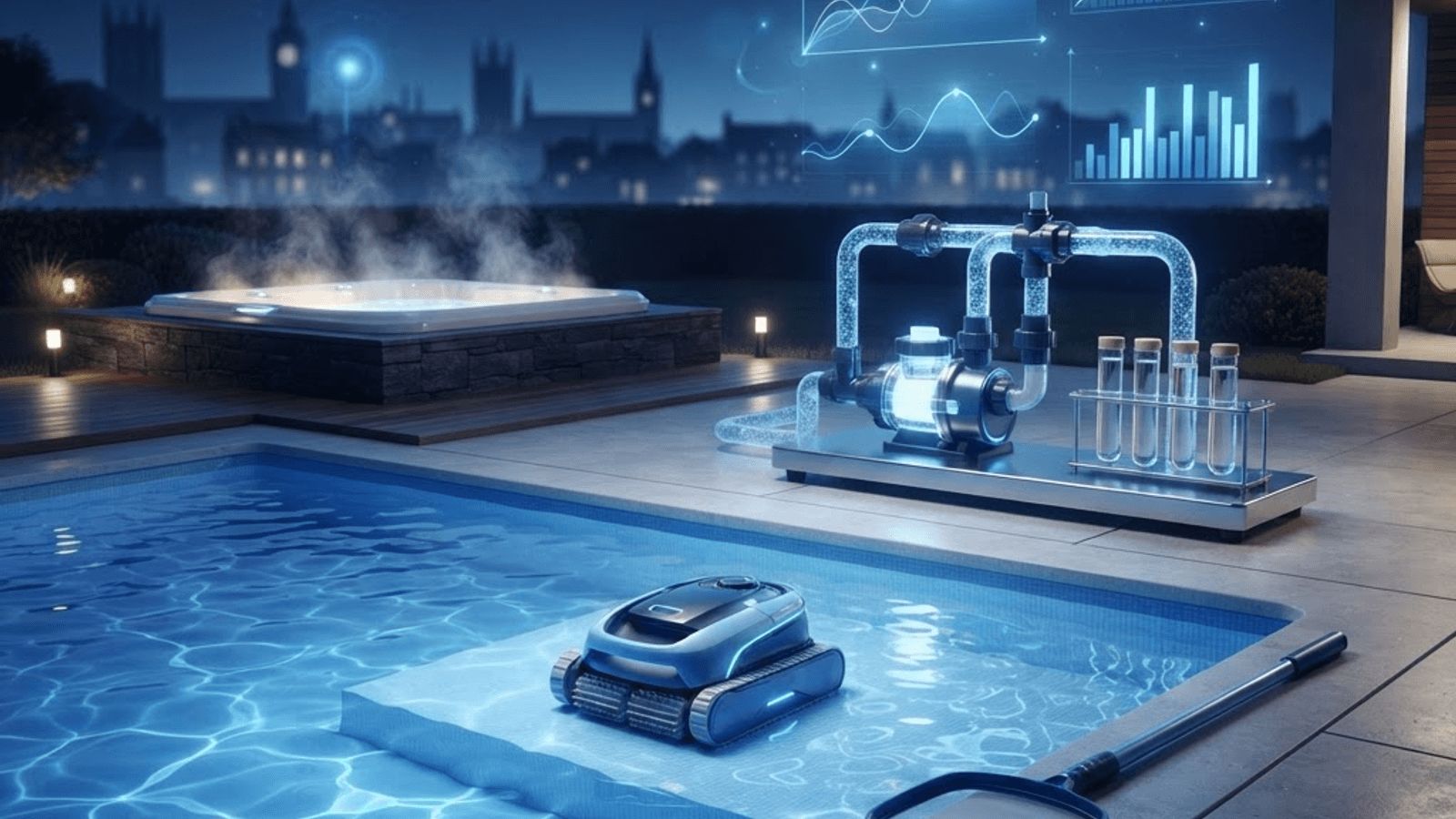
Physical cleaning covers skimming debris, brushing walls and waterline tiles, vacuuming the floor either manually or with robotic cleaners, and emptying skimmer and pump strainer baskets. Waterline scum lines form quickly from body oils and cosmetics and need regular attention to prevent staining.
Filtration maintenance involves backwashing sand filters, cleaning or replacing cartridge elements, and monitoring pressure differentials that indicate when a filter is loading up. Filter media itself has a finite life; sand typically needs replacing every several years as it becomes rounded and less effective.
Plant room checks cover pump operation and seals, heater function, flow rates, dosing equipment calibration, timer settings and leak detection. Automatic dosing systems that continuously measure and correct chemistry have become popular, but they require regular probe calibration to remain accurate.
Indoor Pools and Environmental Control
Indoor pools introduce challenges that outdoor pools do not. Evaporation loads the surrounding air with moisture, which condenses on cold surfaces and causes damage to building fabric, timber and decoration if not controlled. Proper dehumidification and air handling is therefore integral to indoor pool operation, not an optional extra.
Chloramines, the combined chlorine compounds produced when chlorine reacts with organic contaminants, are responsible for the strong smell often mistakenly attributed to too much chlorine. In fact it usually indicates insufficient free chlorine and inadequate ventilation. Good pool companies address this through shock dosing regimes, UV or ozone secondary treatment and air handling adjustments.
Given Chorley's cool climate, indoor pool halls also need careful heating balance. Air temperature should typically sit slightly above water temperature to limit evaporation, and heat recovery ventilation substantially reduces the considerable running costs involved.
Hot Tubs and Swim Spas
Hot tubs concentrate bathers in a small volume of warm water, which is chemically demanding. Water turnover, sanitiser levels and filter cleanliness all matter more than in a large pool because there is far less water to dilute contamination.
Professional hot tub servicing typically includes full water changes, flushing the pipework to remove biofilm that accumulates in jets and plumbing, filter deep cleaning or replacement, cover inspection, and checking heaters, pumps and control systems. Biofilm removal is frequently neglected by owners and is a common cause of persistent water quality problems that resist chemical correction.
Seasonal Considerations
Outdoor pools in Lancashire face a genuine winter. Winterisation involves balancing water chemistry, lowering the level below skimmers, draining and protecting pipework and plant against freezing, adding winter chemicals to inhibit algae, and fitting a suitable cover. Poorly executed winterisation results in cracked pipework and damaged pumps discovered expensively in spring.
Spring opening reverses the process, with cover removal and cleaning, refilling, plant recommissioning, filtration running continuously to clear the water, and progressive chemical balancing. Heavy organic loading from a winter under cover often requires shock treatment and several days of filtration before the pool is usable.
Covers deserve particular mention. Thermal covers dramatically reduce heat loss and evaporation, cutting running costs substantially, while safety covers protect children and pets. Automatic covers combine both functions and have become common on new installations.
Repairs, Refurbishment and Upgrades
Beyond routine care, pool companies handle liner replacement, tile and grout repair, leak detection using pressure testing and dye methods, pump and heater replacement, and control system upgrades.
Energy efficiency has become a major driver of upgrade work. Variable speed pumps use dramatically less electricity than single speed units by running longer at lower speeds, air source heat pumps have largely replaced older gas and electric heating on many installations, and improved insulation and covers cut heat loss considerably. Given the running costs associated with heating a pool through a Lancashire winter, these upgrades often pay back quickly.
Choosing a Pool Service Provider
Look for technical qualifications through recognised pool and spa industry training bodies, and membership of trade associations such as the British Swimming Pool Federation. Technicians handling chemicals should understand COSHH requirements and safe storage.
Establish exactly what a service visit includes. Comprehensive contracts cover testing, chemical adjustment, physical cleaning, filter maintenance and plant checks with a written report each visit. Cheaper arrangements may cover only basic cleaning, leaving chemistry to the owner.
Ask about emergency response. A heater failure in winter or a pump failure in summer needs prompt attention, and providers who stock common spares locally resolve issues far faster.
Final Thoughts
Pool and spa ownership is genuinely rewarding but depends entirely on consistent, knowledgeable maintenance. Chorley's specialist providers offer the technical depth that water chemistry and plant engineering demand. Invest in a proper service contract, take winterisation seriously, consider energy efficiency upgrades, and treat water testing as the routine discipline it needs to be. Well-maintained water is safe, clear and considerably cheaper to run.
Want your brand featured in front of decision-makers? Publish a guest post or get a link insertion in our guides through AAMAX's guest post and link insertion service.
Helpful Links
 SponsoredAAMAX — Full-Service Digital Agency
Write for Us
Share your expertise with our readers. We welcome guest contributions from industry specialists.
Pitch your idea