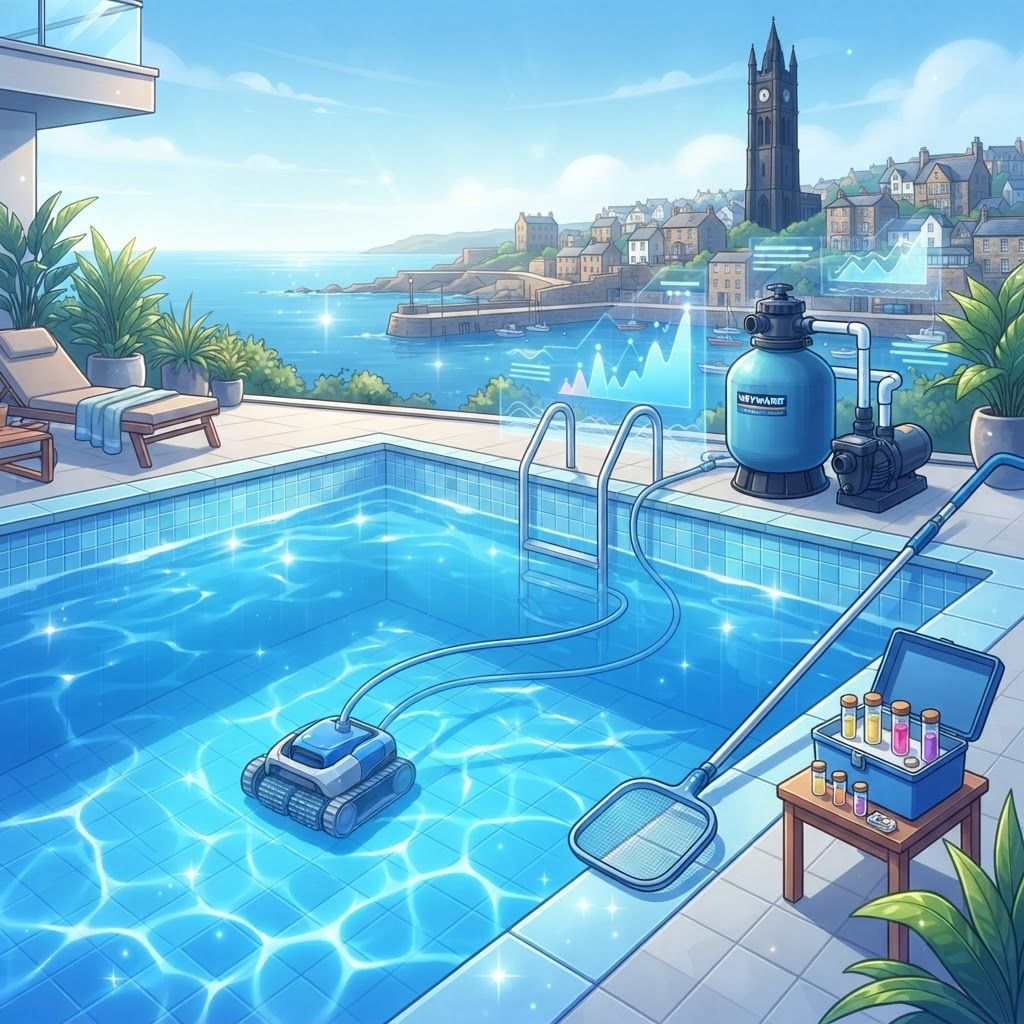
Pools on the Fylde Coast
Blackpool has a larger swimming pool population than many visitors realise. Hotels and holiday parks across the Fylde operate pools as a core amenity, leisure centres serve the resident community, and a growing number of private homes have installed indoor pools, swim spas and hot tubs. Each requires consistent, technically informed maintenance.
Commercial pools in particular carry substantial regulatory obligation. Water quality, chemical dosing, filtration performance and record keeping are all subject to inspection, and failure carries real consequences including closure. This has produced a local pool servicing sector that is more technically rigorous than casual observers might expect.
What Pool Maintenance Actually Involves
Professional pool care extends well beyond skimming leaves. Routine servicing includes water testing for chlorine or bromine levels, pH, alkalinity, calcium hardness and stabiliser; chemical dosing and balancing; brushing walls and waterline; vacuuming the pool floor; emptying skimmer and pump baskets; backwashing filters; and checking pump, heater and circulation performance.
Periodic work includes filter media replacement, pump and motor servicing, heater maintenance, automatic dosing system calibration, leak detection, tile and grout cleaning, liner inspection and repair, and full drain-down with deep clean. Providers such as Blackpool Pool Services, Fylde Coast Pool and Spa, Promenade Aquatic Maintenance, Coastal Pool Care and Northern Pool Technicians operate across the area, alongside Bispham Spa and Pool Services, Seaside Pool Engineering, Layton Leisure Water Services, Fylde Hot Tub and Pool Care and Marton Pool Plant Solutions.
Water Chemistry Fundamentals
Water chemistry is where most pool problems originate. Chlorine or bromine provides sanitisation, but its effectiveness depends heavily on pH. If pH drifts above the recommended range, chlorine effectiveness falls sharply even when the measured level appears adequate, allowing bacteria and algae to establish despite apparently correct dosing.
Total alkalinity acts as a buffer, preventing rapid pH swings. Calcium hardness affects whether water is corrosive or scale-forming, with soft water attacking grout and plaster while hard water deposits scale on heaters and surfaces. Cyanuric acid stabiliser protects chlorine from UV degradation in outdoor pools but reduces effectiveness at excessive concentration. Professional operators test and balance all of these, not just the sanitiser level.
Commercial Compliance Requirements
Hotels, holiday parks and leisure facilities operating pools in Blackpool must meet health and safety obligations covering water quality management, plant operation, risk assessment and staff competence. Industry guidance sets out expected microbiological standards, chemical parameters, testing frequency and record retention.
Documented daily testing, plant room logs, remedial action records and periodic microbiological sampling form the evidence base that demonstrates compliance. Professional service contracts typically include this documentation as standard, which is a significant part of their value to commercial operators. In the event of an incident or inspection, comprehensive records are the operator's primary protection.
Filtration and Plant Room Systems
The plant room is the heart of any pool. Circulation pumps must turn over the full pool volume within a specified period, and undersized or degraded pumps compromise water quality regardless of chemical dosing. Sand filters remain the most common technology, though glass media and cartridge systems are increasingly specified for their improved filtration efficiency and reduced backwash water consumption.
Heating represents the largest running cost for most pools. Heat pumps have largely replaced gas boilers in new installations because of their far superior efficiency, and retrofitting them to existing pools is now common across Fylde holiday parks. Pool covers deliver the single biggest energy saving available, dramatically reducing evaporation, which is the primary route of heat loss.
Hot Tubs and Swim Spas
Hot tubs have proliferated across Blackpool's holiday accommodation sector, where they command premium nightly rates. They also present elevated risk, since high water temperature, small volume and high bather load create ideal conditions for bacterial growth if maintenance lapses.
Commercial hot tubs in rental accommodation require far more rigorous management than domestic units, including drain-downs between guest changeovers in many circumstances, daily testing, and specific attention to legionella risk. Specialist providers offering changeover servicing for holiday lets have become an important part of the local market, and owners should treat this as a compliance requirement rather than an optional expense.
Common Problems and Their Causes
Cloudy water usually indicates filtration inadequacy, chemical imbalance or insufficient circulation rather than a need for more chlorine. Green water signals algae, typically resulting from low sanitiser or high pH. Eye and skin irritation is frequently blamed on excessive chlorine but is more often caused by chloramines, which form when chlorine combines with organic contaminants and indicate insufficient rather than excessive sanitiser.
Scale on tiles and heat exchangers points to high calcium hardness or elevated pH. Corrosion of metal fittings indicates aggressive water chemistry. A competent technician diagnoses the underlying chemistry rather than repeatedly treating symptoms, which is the practical difference between professional servicing and untrained maintenance.
Choosing a Pool Service Provider
Look for technicians holding recognised qualifications such as those offered by the Pool Water Treatment Advisory Group, and for company membership of relevant industry bodies. Ask about experience with your specific pool type, since a domestic indoor pool, a hotel pool and a holiday park hot tub estate present quite different requirements.
Clarify what a service contract includes, how frequently visits occur, what documentation is provided, and how emergency call-outs are handled. For commercial operators, ask whether the provider can support you during an environmental health inspection and whether they provide water sampling through an accredited laboratory.
Final Thoughts
Pool maintenance in Blackpool ranges from straightforward domestic servicing to fully documented commercial compliance programmes, and the sector has the technical depth to support both. Prioritise providers who understand water chemistry properly, maintain thorough records, and service plant as well as water. Consistent professional care keeps a pool safe, efficient and genuinely enjoyable rather than a recurring problem.
Want your brand featured in front of decision-makers? Publish a guest post or get a link insertion in our guides through AAMAX's guest post and link insertion service.
Helpful Links
 SponsoredAAMAX — Full-Service Digital Agency
Write for Us
Share your expertise with our readers. We welcome guest contributions from industry specialists.
Pitch your idea